





 Portuguese
  English
  Spanish
  3 min of reading
  0 comments


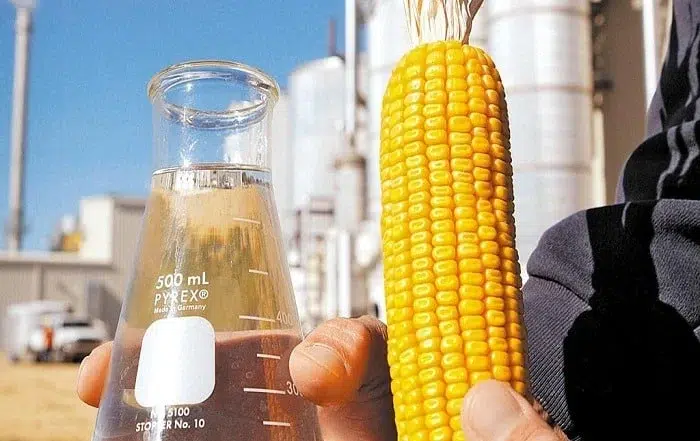
Discover The Chemical Reasons That Prevent Ethanol From Freezing Quickly, Unlike Water, Even At Low Temperatures
A bottle of ethanol, the most common type of alcohol, does not freeze in a regular freezer. Even when exposed to extremely low temperatures, this liquid remains fluid.
This happens due to the chemical characteristics of ethanol and the intermolecular forces acting between its molecules.
To understand this issue, it is important to comprehend why liquids freeze and how molecular interactions influence this process.
-
With a cost per shot close to zero, the DragonFire laser could change naval warfare in 2027 and provide British ships with nearly unlimited defense against drones.

-
A British startup creates tires that generate electricity in electric vehicles when passing over potholes, speed bumps, and cracks.

-
Scientists have created robots made with living cells that have their own nervous system, swim on their own, explore the environment, and self-organize without any genetic engineering, and now they want to do the same with human cells.

-
Students create a solar-powered ambulance that operates without a plug, without fuel, and still keeps medical equipment running in remote areas.

How Freezing of A Liquid Occurs
Freezing is the transformation of a liquid into a solid. This process occurs when the temperature of the liquid drops enough to reduce its internal energy.
With the loss of heat, the molecules move more slowly and come closer together, forming a more organized arrangement.
Each substance has a specific freezing point.
Water, for example, solidifies at 0°C. Ethanol, on the other hand, needs a much lower temperature to freeze: -114°C. This means that a typical household freezer, which operates around -15°C, is not sufficient to turn ethanol into a solid.
The difference between the freezing points of water and ethanol is related to the intermolecular forces acting on each of these substances.
Intermolecular Forces
Molecules interact with each other through different types of intermolecular forces. These forces determine how close the molecules are to each other and influence the transition between physical states.
Gases have very weak intermolecular forces, allowing the molecules to move freely. In solids, these forces are strong, keeping the molecules organized and fixed.
Liquids present an intermediate situation, where intermolecular forces allow some mobility but still keep the molecules relatively close.
Among the intermolecular forces, hydrogen bonding is one of the strongest.
This bond occurs when a hydrogen atom, bonded to a highly electronegative element like oxygen, nitrogen, or fluorine, interacts with another electronegative atom.
Comparing Water and Ethanol (Alcohol)
Water has a molecular structure that favors the formation of multiple hydrogen bonds. Each water molecule can form up to four hydrogen bonds with neighboring molecules.
This strong interaction causes the molecules to stay very close, resulting in a relatively high freezing point of 0°C.
In contrast, ethanol, despite also containing an -OH group capable of forming hydrogen bonds, does not have the same capacity as water. Its structure includes a carbon chain, which reduces the polarity of the molecule and weakens its ability to form hydrogen bonds.
As a result, ethanol molecules remain farther apart and have a weaker interaction with each other.
This explains why ethanol does not freeze easily. Since its molecules do not attract each other with the same intensity as water molecules, it is necessary to drastically lower the temperature for them to organize into a solid structure.
The Influence of Molecular Polarity
The polarity of a molecule indicates the distribution of electrical charges within it. The greater the polarity, the greater the capacity for strong intermolecular bonding.
Water is highly polar, which facilitates the formation of strong hydrogen bonds. Ethanol, in turn, has an apolar region in its structure, decreasing its ability to form these interactions.
The difference in polarity also explains the high volatility of ethanol. Since its intermolecular forces are weaker, the molecules easily detach from the liquid and evaporate rapidly, even at moderate temperatures.
Why Ethanol Refuses To Freeze
Given that ethanol has weak intermolecular forces and reduced polarity, its molecules do not attract each other with the necessary intensity to form a solid easily.
This means that, to freeze, it is necessary to lower its temperature to extremely low levels, reaching -114°C.
This characteristic has important practical applications. Ethanol is used as an antifreeze in situations where water would easily freeze, such as in windshield washer solutions and in laboratory processes.
Even in a household freezer at -15°C, a bottle of alcohol will remain liquid. This occurs because its molecules are unable to organize into a solid arrangement at that temperature.
With information from Science ABC.







-

Uma pessoa reagiu a isso.