





 Português
  Inglês
  Espanhol
  4 min de leitura
  0 comentários


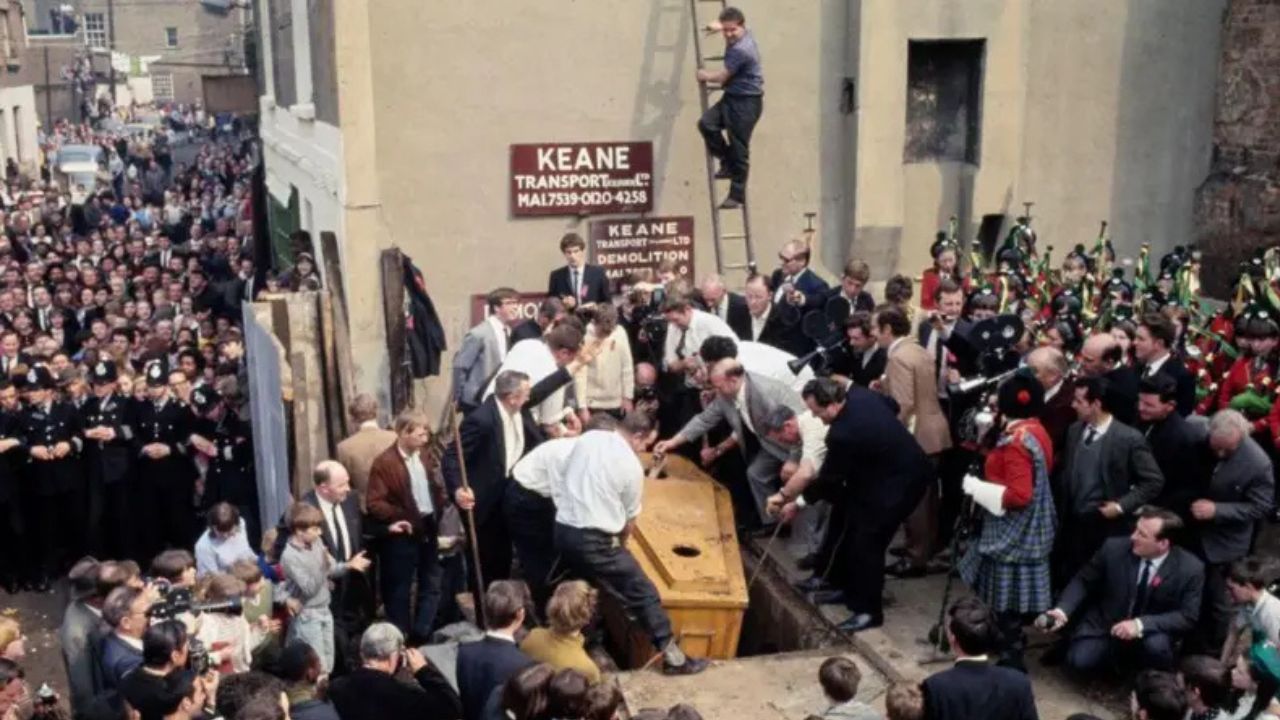
Know The Story Of Mick Meany, Who Was Buried Alive For 61 Days In A Coffin While Trying To Set A World Record That Shocked The World.
Being buried alive for over two months sounds like a nightmare that is impossible to endure. Yet, in 1968, the Irish Mick Meany turned this extreme fear into a public spectacle and made history by attempting a record that shocked the world.
The case took place in London, was covered by the international press, and resulted in what many still consider the greatest record for time buried alive in a coffin, with 61 days underground.
The feat, planned as a media event, involved promoters, onlookers, and journalists, took place in the Kilburn neighborhood in north London, and had a clear goal: to ensure fame, money, and a place in the record books.
-
Drought may be creating stronger superbugs in the soil and helping antibiotic resistance reach hospitals, warns a study highlighting a problem that could grow alongside extreme weather.

-
The biggest scam in history: Napoleon’s France deceived the United States by selling them a territory that was Spanish.

-
Why is the Danakil Desert so dangerous? It has unstable terrain and how extreme temperatures and toxic gases turn the region into one of the most hostile environments on Earth.

-
With a height of 221 meters and a capacity for trillions of liters, Hoover Dam still holds a trick that makes water defy logic.

Thus, more than a simple burial, Mick Meany’s story reveals ambition, desperation, and the human fascination with extreme limits.
Who Was Mick Meany And Why Did He Decide To Be Buried Alive
The son of a farmer from County Tipperary, Ireland, Mick Meany immigrated to England after the war in search of work. Like many Irish at the time, he worked in construction and dreamed of a better life.
Before that, Meany harbored the desire to be a professional boxer. However, a work accident compromised his hand and ended any chance of success in the ring.
Later, another accident—the collapse of a tunnel while he was working—buried him for a few moments and ignited an unlikely idea: to attempt the record for time buried alive in a coffin.
According to Meany himself, the decision stemmed from a lack of prospects. “I had no future in real life,” he declared. “That’s why I wanted to stay underground and prove my worth.”
The Context Of Extreme Records And The Macabre Goal
In the 1960s, unusual endurance competitions still sparked curiosity. In the United States, artists known as “funeralists” had become celebrities by voluntarily undergoing the act of being buried alive.
The biggest name of the time was Digger O’Dell, who had spent 45 days buried in Tennessee. This was the record Meany aimed to surpass.
For him, the burial was not just a physical challenge. It was a total bet on fame, public recognition, and the hope of returning to Ireland with enough money to build a house and change his life.
The Planned Spectacle In London
The execution of the idea had the support of businessman and former wrestler Michael Butty Sugrue, owner of The Admiral Nelson pub in Kilburn. It was there that everything took shape as a spectacle.
On February 21, 1968, in front of the world press, Mick Meany had his “last supper” at the pub before entering a custom-made coffin.
Wearing blue pajamas, holding a crucifix and a rosary, he declared: “I do this for my wife and daughter, and for the honor and glory of Ireland.”
Then, a procession wound through the neighborhood streets to the site of the burial, where the coffin was buried 2.5 meters deep under tons of earth.
How Mick Meany Survived Being Buried Alive
Inside the 1.90-meter-long coffin, Meany had two iron tubes for breathing and receiving food. Through them, he received tea, toast, roast beef, stout, newspapers, and books.
He also had a flashlight for lighting, a phone connected directly to the pub, and even a small makeshift compartment to serve as a toilet.
Despite this, Meany summarized the experience: “It wasn’t a hotel underground.”
To increase revenue, visitors paid to speak with him or just observe the site.
Personalities like boxer Henry Cooper and actress Diana Dors visited him during the time he was buried alive.
From Media Attention To Momentary Forgetfulness
In the first days, Mick Meany’s feat dominated the headlines. However, more impactful historical events, such as the Vietnam War and the assassination of Martin Luther King Jr., ended up overshadowing the achievement.
Even so, Sugrue ensured that the conclusion did not go unnoticed. On April 22, 1968, after 61 days, the coffin was unearthed amidst musicians, dancers, journalists, and a curious crowd.
The Broken Record And The Frustration After The Glory
Upon exiting the coffin, Mick Meany appeared smiling, with a long beard and wearing sunglasses. The medical examination confirmed that he was in good health.
“I wish I could last another hundred days,” he stated. “I’m thrilled to be the world champion.”
He had comfortably surpassed the old record, staying 15 days longer than necessary. Still, official recognition never came. The Guinness did not validate the feat due to the lack of a representative on site.
Moreover, the promised fortune and world tour never materialized. Meany returned to Ireland without money and fell into obscurity, while others, like Emma Smith, would soon surpass his mark.
The Late Rescue Of The Story Of Mick Meany
Decades after his death, in 2003, the story returned to the news thanks to the documentary Buried Alive / Beo Faoin bhFód, shown at international festivals.
The film reignited interest in this extreme journey and restored visibility to a man who sought recognition in a radical way.
Today, Mick Meany’s case remains one of the most impressive episodes ever recorded about human endurance, ambition, and the nearly desperate desire to leave a mark on the world—even if it meant being literally buried alive in pursuit of a historic record.








-

-

-

-

-

-

11 pessoas reagiram a isso.