





 Portuguese
  English
  Spanish
  4 min of reading


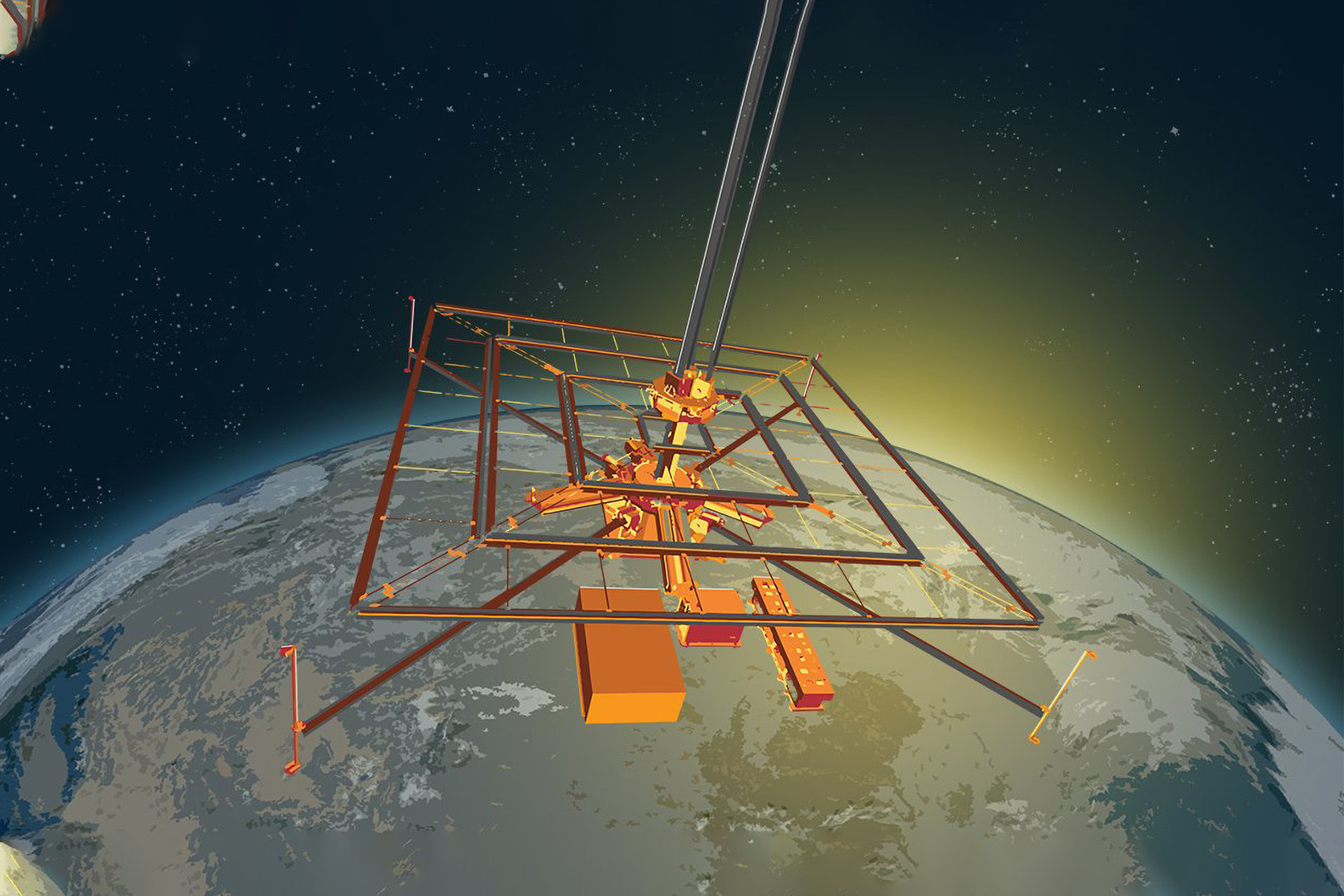
Space-Based Solar Power Has The Potential To Provide Access To Renewable Energy 24 Hours A Day, Thus Overcoming One Of The Most Significant Constraints Of The Technology
Following the successful launch of experimental equipment on a Falcon 9 rocket, the concept of space-based solar power will now undergo its first real test. This test aims to determine whether the project is feasible or not.
The concept of placing huge solar panels in orbit around the planet and then transmitting the generated electricity back to Earth has existed for decades. The possibility is attractive due to the fact that, once leaving Earth’s atmosphere, you are no longer subject to the whims of weather or the day-night cycles of the planet. Additionally, solar radiation levels are increased because sunlight does not have to pass through the atmosphere.
Due to the challenging technological hurdles and harsh financial realities of developing space technology, space-based solar power has remained firmly in the realm of science fiction until this point.
-
The Brazilian state accelerates industrial competitiveness with a focus on the extraction of strategic minerals to boost the energy transition in Goiás.

-
Seagri’s headquarters invests in solar energy with Neoenergia Coelba and promises to cut electricity costs, highlighting a strategic advance in sustainability and energy efficiency within state public administration.

-
A Canadian retiree creates a hydroelectric system on a real river, generating energy continuously throughout the day and demonstrating how the power of water can supply a house with stability even in a simple structure.

-
Solar Pyramid draws attention by converting solar energy into million-dollar savings and repositioning the City Hall of Curitiba as an example of innovation, sustainability, and intelligent use of public resources.

However, thanks to a $100 million grant in 2013, a team of researchers from various fields at Caltech has been diligently working behind the scenes for the past ten years, creating the numerous technologies needed to make it a reality.
In addition, last Tuesday, January 3, prototypes of several of the most important subsystems needed for a large-scale space solar power plant were launched into orbit by SpaceX to undergo testing.
The group of individuals working on the Caltech Space Solar Power Project will conduct experiments over the coming months to test the systems that will allow their flexible solar panels to deploy in space, as well as the technology designed to transmit electricity to Earth. Furthermore, they will determine how various types of solar panel technology perform in the hostile environment of space.
Research Supervisor Stated In A Statement That, Regardless Of The Outcome, The Space-Based Solar Power Prototype Represents A Significant Step
Ali Hajimiri, one of the three academics at Caltech overseeing the project, also stated that “It not only works here on Earth, but has also successfully completed all the rigorous tests required for anything sent into space. There are still many dangers, but having gone through the entire procedure has equipped us with important knowledge.”
Building solar panels in space is a much more challenging undertaking than performing the same work on Earth. The toughest hurdle will be getting them into orbit in the first place, which is complicated by the exorbitant costs associated with it.
As a direct consequence, the team was tasked with focusing their efforts on finding ways to minimize the weight of their solar panels without compromising their ability to generate electricity.
Their approach incorporates ultra-thin flexible solar panels, an inventive design that merges energy production and transmission and an innovative modular architecture that makes it possible to combine a large number of smaller independent panels to create large arrays.
The design of the panels for generating solar power in space is based on a rectangular tile a few centimeters wide and a surface covered with solar concentrators that look like mirrors. These solar concentrators direct sunlight to a band of photovoltaic cells, which then convert sunlight into energy.
An integrated circuit is located beneath the surface and is responsible for converting the electricity from the solar cells into microwaves. These microwaves are then transmitted from the bottom of the tile via a set of patch antennas that are very thin and flexible.
The Tests Initiated This Week Aim To Evaluate Some Of The Fundamental Technologies That Form The Basis Of Space-Based Solar Power Architecture
As this space-based solar power project does not require the use of heavy wiring to transport the produced electricity to a central transmitter, it results in a considerable reduction in the amount of weight created. After that, these tiles will be grouped into strips and incorporated into an innovative foldable structure that will be compressed before launch but will unfold once in space.
The final product will be an autonomous spacecraft capable of unfolding, generating electricity, and transmitting it back to Earth. However, the concept involves assembling several of them to build arrays capable of producing energy equivalent to a terrestrial system.
Due to the way the arrays are organized, it is straightforward to alter their size and configuration, as well as to ensure that the failure of individual modules does not render the entire system inoperable.










Seja o primeiro a reagir!