





 Portuguese
  English
  Spanish
 4 min of reading
  0 comments


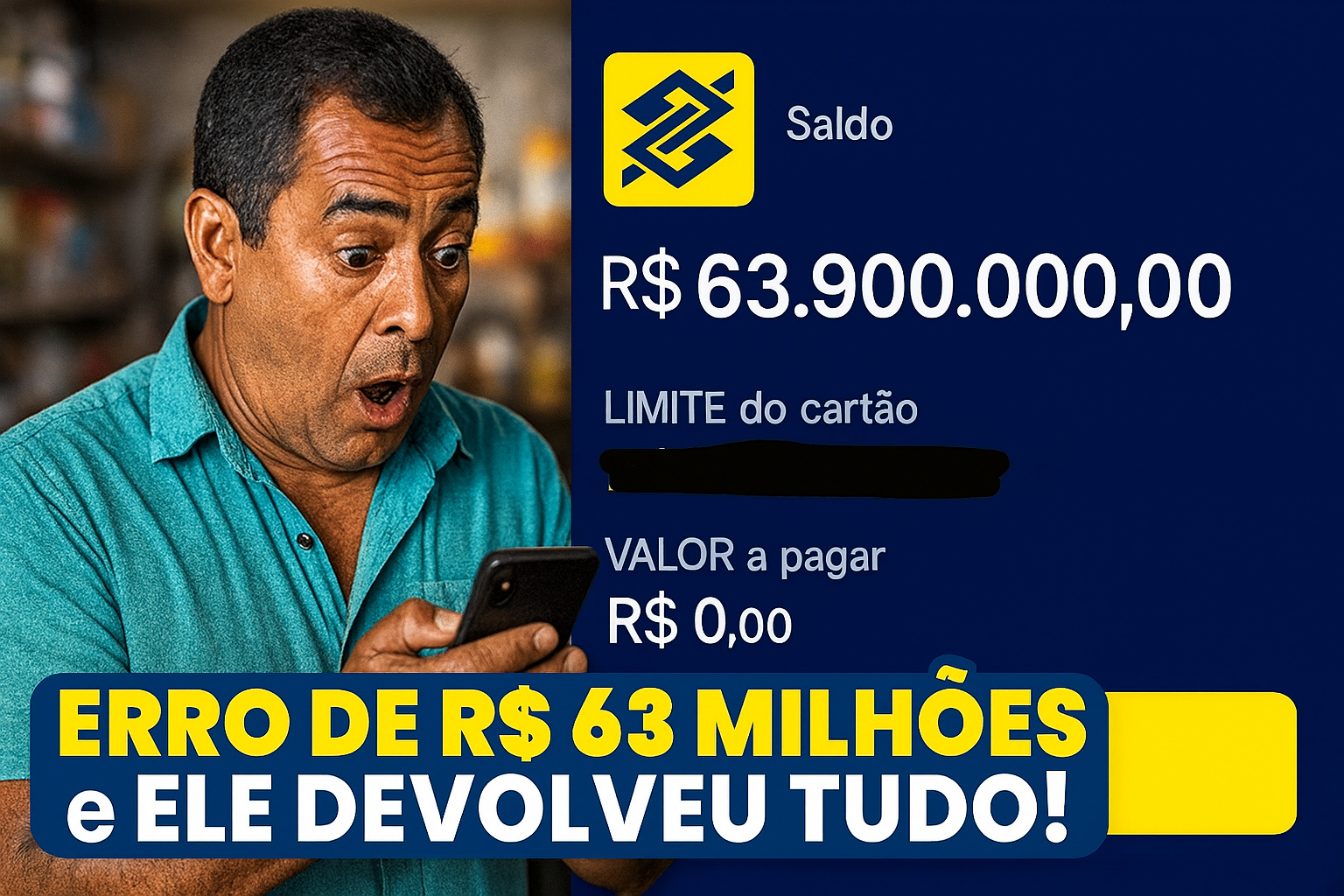
Merchant from Goiás Receives R$ 63.9 Million by Mistake in 2019 and Returns Everything to the Bank on the Same Day; Case Echoes as a Rare Example of Honesty.
In August 2019, a merchant from the city of Rio Verde, Goiás, experienced one of the most unlikely episodes ever recorded in the Brazilian banking system. Upon checking his account statement, he discovered a deposit of R$ 63.9 million, made by mistake. The amount represented more than one thousand times his store’s monthly revenue and had been mistakenly credited due to a bank system error.
Instead of trying to use the money or waiting for the problem to be resolved, the merchant immediately called the bank manager, reported the incident, and returned the full amount. The case was confirmed by Banco do Brasil, responsible for the error, and reported by portals such as Metrópoles, G1 Goiás, and Araguaia Notícias, which highlighted the honesty and quickness of his actions.
The Discovery of the Million-Dollar Deposit
According to the merchant, everything happened during an ordinary work morning when he decided to access the bank’s app to check his balance. The shock was immediate: the account displayed a credit of R$ 63,975,451.71.
-
Oil rises more than 7% and surpasses $102 this Monday (13) after the announcement of the U.S. blockade on Iran, putting pressure on fuels, raising global inflation, and impacting economic costs.

-
“Single Tax” becomes a hot topic in 2026 after new social fee: is there really a penalty for those who don’t get married in Japan?

-
Unlike Brazil, China has banned gambling and casinos to curb the rise of gambling addiction, blocks platforms, punishes operators, and maintains one of the strictest policies in the world to prevent billions from escaping the economy and to protect the population from the social impacts of gambling.

-
China could impose a quarantine on Taiwan without firing a shot, using the coast guard and inspections to force submission, blocking trade, raising insurance costs, and leaving the U.S. divided between reacting or accepting.

Not believing what he saw, he checked the statement again and then immediately contacted the manager.
“As soon as I saw it, I thought it could be a mistake. The thought of keeping the money never crossed my mind,” said the merchant in an interview with Jornal Anhanguera 1ª Edição, from TV Anhanguera, a Globo affiliate in Goiás.
The bank confirmed the mistake and reported that the deposit resulted from a typing error during an internal transfer. Within a few hours, the amount was reversed, and the merchant’s account returned to its original balance.
The Bank’s Reaction and the Case’s Repercussions
According to Banco do Brasil, the error was “corrected on the same day,” and the institution formally thanked the customer for his exemplary conduct and prompt return of the funds. The incident went viral on social media and sparked a wave of comments on honesty, ethics, and financial responsibility.
The story was mentioned in media outlets across the country and even in international publications that reported the case as an example of “integrity in the face of temptation”.
Although some internet users suggested that the bank should reward the merchant for his act, the institution did not pay any compensation, stating that the return of undue funds is a legal obligation, according to Article 876 of the Civil Code, which addresses unjust enrichment.
The Duty to Return Funds Received by Mistake
Under Brazilian law, anyone who receives an amount that does not belong to them must return it immediately. The Civil Code, in Article 876, establishes that “anyone who receives what is not owed is obliged to restore it.”
Using or unlawfully retaining the money, even for a short time, may constitute the crime of embezzlement, as provided in Article 169 of the Penal Code, with a penalty of up to four years in prison.
However, the merchant’s conduct in Rio Verde was pointed out as an example of objective good faith, a principle that guides civil and contractual relations in Brazil. Legal experts consulted by the portal Metrópoles affirmed that his actions demonstrate that honesty is still a value that overcomes financial temptation, especially in cases involving large amounts.
Similar Cases and the Lesson Learned
The case of the Goiás merchant recalls other similar episodes that gained attention in Brazil and abroad. In 2024, a driver in the Federal District also received R$ 131 million by mistake and returned the amount but went to court seeking 10% in reward and R$ 150,000 for moral damages.
In both cases, the common point was the good faith and immediate return of the money, reinforcing the importance of trust between customers and financial institutions.
More than just a simple banking error, the story of the Goiás merchant has become an example of ethics and responsibility in a country where, according to data from Febraban, over 250,000 incorrect transactions occur annually, including erroneous deposits and improper transfers.
At the end of the episode, the merchant declared that his conscience “was worth more than any fortune.” The case, which occurred in August 2019, continues to be remembered today as one of the most impressive demonstrations of honesty in the face of a million-dollar error.








-

-

-

-

-

11 pessoas reagiram a isso.