





 English
  Francês
  Alemão
  Italiano
  Japonês
  Norueguês
  Portuguese
  Spanish
  3 min of reading
  0 comments



On June 17, 2025, Mount Lewotobi Laki‑laki emitted an 11 km ash cloud, elevated the alert to maximum level, and suspended regional flights.
Intense Eruption and Immediate Reaction
On June 17, 2025, at 5:35 PM, Mount Lewotobi Laki‑laki erupted with great intensity, launching ash up to 11 km high, according to the Indonesian Geological Agency.
As a result, authorities raised the alert to maximum level. Immediately, the risk area around the crater expanded to a radius of 8 km.
Additionally, emergency teams ordered the evacuation of nearby communities, which underscored the severity of the event.
-
Seen from space, a colossal ‘Y’ cuts through the largest desert in China, blending a jade-filled river, red and white mountains, and revealing the absurd scale of the transformation of the Taklamakan surrounded by a green wall with billions of trees.

-
The Pacific Ocean reveals what the cliffs of Big Sur have hidden for millennia: Pfeiffer Beach, in California, features swirling purple sand formed by garnet crystals and displays a stone arch that is illuminated by the sun in winter for just a few days each year.

-
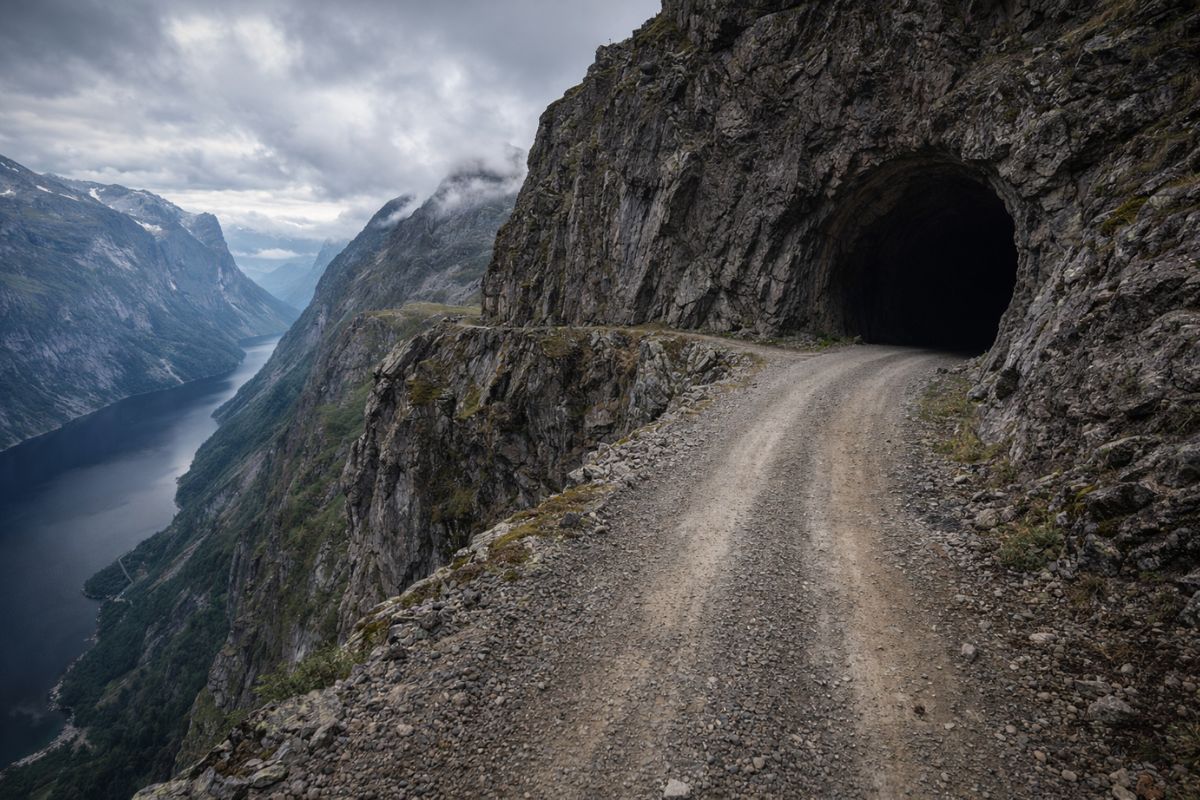
Aursjøvegen in Norway is a 100-kilometer gravel road that crosses chasms and dark tunnels carved into the rock at an altitude of 947 meters in the fjords and is only open for four months a year.
-
With about 4,000 m², the building constructed in a traditional neighborhood in France looks like a rainbow, has a colorful facade, mixes vibrant glass, and creates one of the most unusual visuals in Bordeaux.

Communities Mobilized and Risk of Lahars
Meanwhile, residents began to evacuate the affected areas and used protective masks to reduce the risks from ash fallout.
Furthermore, experts warned of the threat of lahars — volcanic mudflows. The risk significantly increases if intense rains hit the slopes.
Although no casualties have been reported, the situation requires constant vigilance.
Suspension of Flights and Impact on Air Traffic
As a consequence of the eruptions, air travel experienced immediate impacts.
On June 18, 2025, a smaller new eruption formed a column of approximately 1 km high.
As a result, several international airlines suspended flights to Bali, including routes from India, Australia, and Singapore.
Simultaneously, airport authorities determined the temporary closure of Maumere Airport (Fransiskus Xaverius Seda), ensuring greater safety for passengers and crews.
Recent Activity History and Alert Pattern
In addition to current events, the history of Mount Lewotobi Laki‑laki reveals a pattern of frequent alerts.
In March 2025, a seismic increase triggered ash emissions of up to 2.5 km. Consequently, the alert level was raised, and the exclusion zone was expanded.
Later, in May 2025, a new eruption released ash of 1 km, maintaining the maximum alert.
However, the most critical event occurred in November 2024. At that time, a violent eruption caused 9 deaths and dozens of injuries.
These records show that the volcano represents a constant threat to the region.
Geological Profile of the Volcano
To understand the behavior of Mount Lewotobi Laki‑laki, it is worth highlighting its geological profile.
Located on the island of Flores, the volcano reaches a height of 1,584 m. Its twin neighbor, Lewotobi Perempuan, reaches 1,703 m.
Together, they form a unique pair of volcanoes, with a crater 400 m in diameter and a typical andesitic composition of stratovolcanoes.
Both are part of the Pacific Ring of Fire, one of the most volcanically active regions on the planet. In Indonesia, over 120 volcanoes remain active.
Therefore, continuous monitoring is essential.
What Does This Scenario Reinforce for the Future of the Region?
With all this data, the eruption of Mount Lewotobi Laki‑laki on June 17, 2025 confirms its status as one of the most dangerous volcanoes in the country.
This situation reinforces the need for coordinated responses and preventive actions.
Considering the events of March and May 2025, along with the tragedy of November 2024, it is clear that constant vigilance is essential.
In this scenario, cooperation among authorities, the air sector, and local communities will be crucial to reduce risks and protect the population.









Seja o primeiro a reagir!