





 Português
  Inglês
  Espanhol
  4 min de leitura
  0 comentários



Labor Shortage Hits Sectors Like Construction, Retail, and Technology, Leaving Millions of Job Vacancies Open and Stalling Company Growth.
The shortage of skilled labor has become the new nightmare for Brazilian companies. With a heated job market and unemployment at historically low levels, thousands of job vacancies remain open without suitable candidates to fill them. Key sectors of the economy, such as construction, industry, retail, and technology, face a silent yet growing crisis that threatens investments, causes delays in deliveries, and forces companies to turn away new clients.
Construction Industry on Alert: 82% of Contractors Face Labor Shortage
Among the most affected sectors, the construction industry is experiencing a real blackout of professionals.
According to a survey by the Brazilian Institute of Economics of the Getulio Vargas Foundation (FGV-Ibre), over 82% of contractors report a shortage of workers to fill available positions.
-
Future profession with immediate earnings: Specialist reveals how a solar energy technician earns R$ 8,000 per month by taking advantage of the explosion in demand across the entire country.

-
Work from 8:30 AM to 5:30 PM with a 1-hour break at Sicredi as a Customer Service Assistant and receive a salary + benefits such as life insurance, dental plan, partnerships, Gympass, and much more in job openings across various states.

-
Subsea7 has job openings: the company has offshore and onshore positions available in 2026 for operators, pilots, supervisors, engineers, and much more.

-
Unimed is hiring candidates with and without experience! More than 10 job openings for Assistants, Analysts, Kitchen Assistants, and much more!


As a consequence, 21% of companies in the sector are already delaying construction deliveries, and 18% have begun passing the costs of the labor deficit onto property prices—thus fueling inflationary pressure.
The situation has become unsustainable for many companies, which see the lack of professionals not just as a challenge, but as a direct risk to their business.
Gerdau Points to Lack of Engineers and Criticizes Disincentive to Formal Employment
Even large corporations, such as Gerdau—the largest steel producer in Brazil—are feeling the effects of the mismatch between supply and demand for professionals.
The CEO of the company, Gustavo Werneck, states that there is a shortage of labor in various functions and salary ranges.
According to him, Gerdau could hire all the metallurgical engineers currently graduated in the country, given the level of need.
The company has sought partnerships with educational institutions to encourage enrollment of students in engineering courses, but Werneck also points to a structural barrier: social programs.
For the executive, the current design of Bolsa Família discourages formal employment, as entering the formal market may result in the loss of benefits for thousands of Brazilians enrolled in CadÚnico.
Supermarkets in São Paulo Try to Reverse 40 Thousand Unfilled Vacancies
The Association of Supermarkets of São Paulo (Apas) has also raised the alarm.
With nearly 40 thousand job vacancies open in the sector and difficulty in filling them, the entity has sent a request to the federal government asking for changes in the criteria for accessing social benefits as a way to encourage part of the population to return to the formal market.
The initiative aims to reduce the labor shortage that is beginning to compromise customer service and the financial results of the supermarket sector.
Steel and Oil and Gas Adopt Their Own Training to Form Labor
In an attempt to alleviate the shortage of skilled labor, companies in sectors like steel and oil and gas are adopting creative approaches.
Foresea, a company specialized in oil rigs, has started hiring workers without experience and without a college degree.
The only requirement is to have a technical high school diploma in areas such as mechanics, electronics, or oil and gas.
The company has developed the Offshore Development Program (PDO), which offers one year of theoretical training and another year of supervised activities.
The initiative is a way to fill technical gaps and also to retain talent, given the intense competition among companies for specialized professionals—the average turnover in the sector reaches 30%.
Estimates Indicate More Than 1 Million Job Vacancies Unfilled in Brazil
According to specialists, the number of idle job vacancies in Brazil may have already surpassed 1 million.
And the expectation is that this number will grow in 2025, driven by a hotter job market and the low qualification of available candidates.
Brasscom (Association of Information Technology and Communication Companies) estimates that the technology sector alone has 200 thousand open vacancies.
Meanwhile, the National Confederation of Industry (CNI) projects the need to train 2.2 million new professionals by 2027 to meet the demand of the national industry.
FGV-Ibre: Labor Shortage Already Affects Prices, Deliveries, and Business Expansion
According to FGV-Ibre, 58% of Brazilian companies report difficulties in hiring. The most affected sectors are: construction (82.4%), retail (77.3%), industry (76.8%), and services (76.5%).
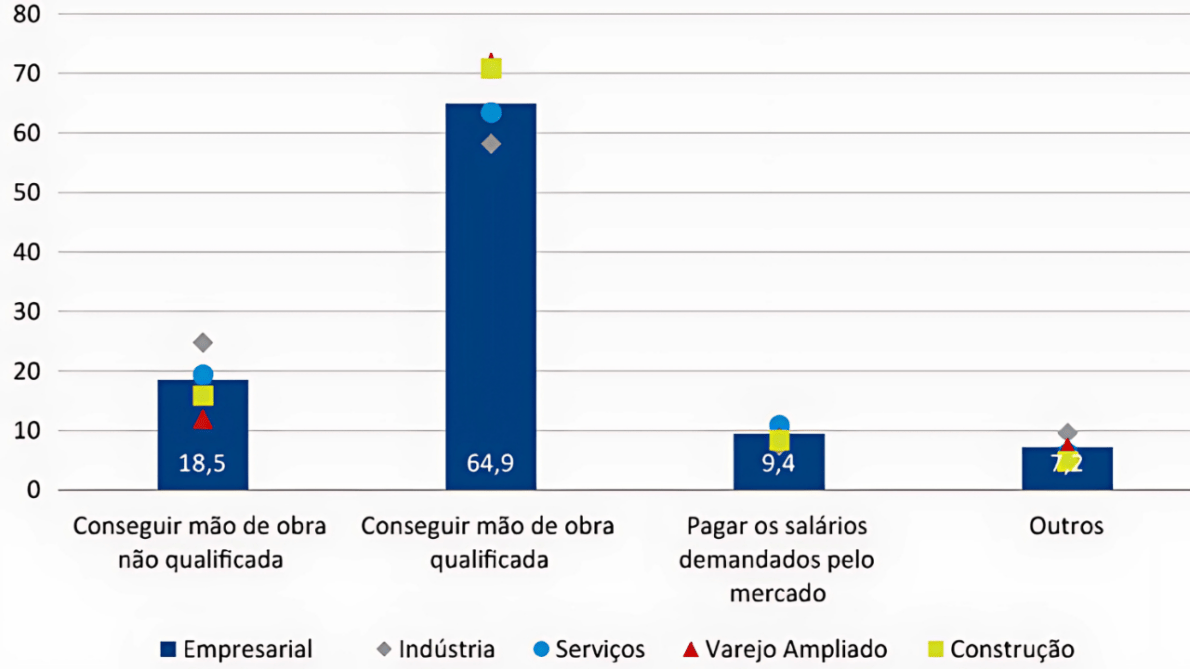
The labor shortage is causing 17.5% of companies to delay deliveries, while 8.4% are already rejecting new clients due to an inability to meet demand.
Additionally, 15.9% of companies are revising prices to compensate for rising costs with salaries and benefits.
Uberization and Generation Z Behavior Aggravate Scarcity Scenario
In addition to structural causes, behavioral factors also impact the job market. The so-called “uberization” of professional relationships attracts many less qualified workers to informal activities on transportation and delivery platforms, which offer greater flexibility and, in many cases, higher earnings than formal salaries.
Generation Z, which is now entering the market, also contributes to the change. Young people value flexibility more, remote work, and less formalization—which presents a challenge for sectors like supermarkets, traditionally seen as entry points for the first job.
Perspectives for the Future: Challenge Requires Coordinated Actions Between Companies and Government
To confront the labor shortage and ensure the filling of open job vacancies, specialists point to the need for joint actions between companies, government, and educational institutions.
Investment in professional training, modernization of social benefit rules, and adaptation of recruitment policies to new generations are paths highlighted to reverse the situation.
Without concrete measures, the lack of qualified professionals will continue to harm productivity, investments, and the growth of the Brazilian economy—and will keep thousands of job vacancies without a definite destination.
With information from InvestNews









Seja o primeiro a reagir!