





 Portuguese
  English
  Spanish
  6 min of reading
  0 comments


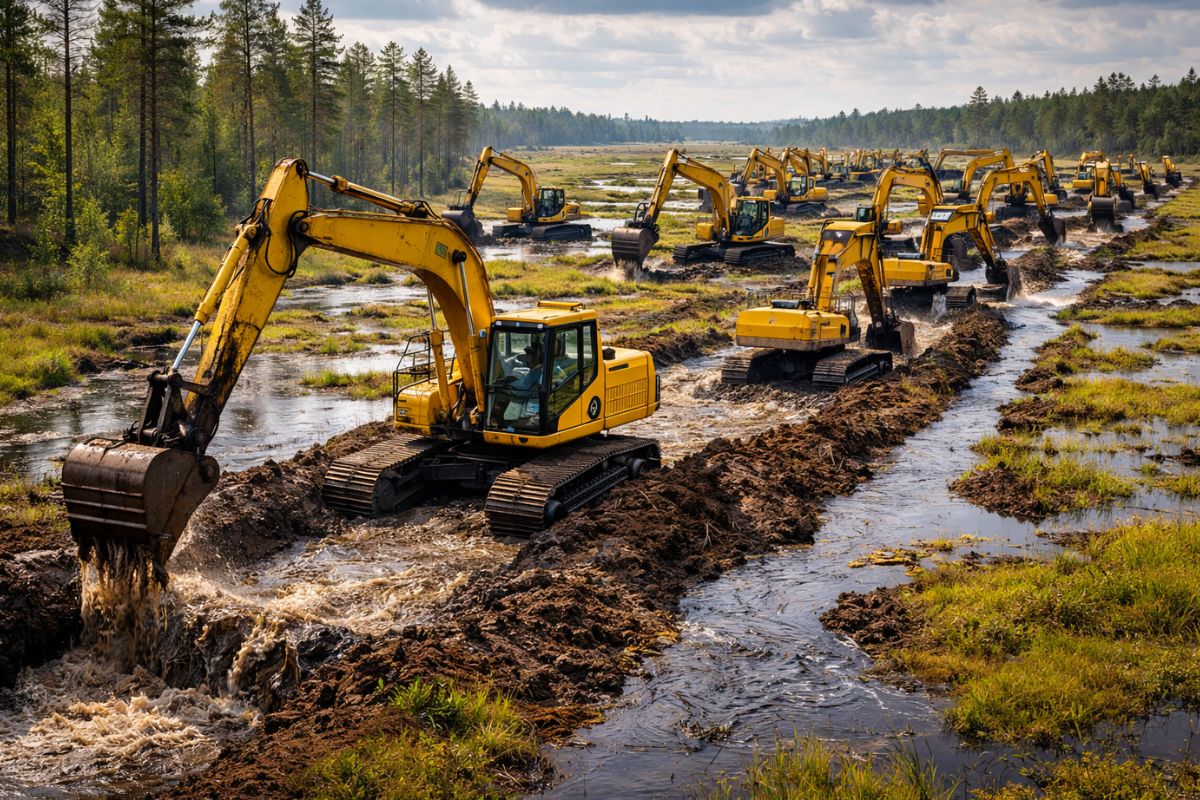
Used Excavators In Sweden Work On Open Drains Since The 19th Century And Deepened In The 20th Century To Rewet Turf Areas In Trollberget, Raise The Water Table, Block Artificial Channels And Measure If The Controlled Closure Of These Drains Really Recompenses The Hydrology Of A Wetland At Landscape Scale.
The excavators mobilized in Sweden to close drains in Trollberget are not just moving dirt. They operate on an artificial drainage network created over decades to dry out turf and increase production in certain areas, but that ended up altering the water table, accelerating water loss and dismantling the original dynamics of a wetland landscape.
At the center of the intervention is the demonstration area in Trollberget, where the Grip on Life project, in collaboration with the owner Holmen and monitored by SLU, decided to test in practice what happens when drains are blocked and filled. The goal is simple in formulation and complex in execution: reconnect the local hydrology, slow down the carbon loss mentioned in the project, contain subsidence, and produce enough evidence to decide where to clear, where to maintain, and where to close artificial channels.
How Sweden Drained Turf Areas And Created A Long-Term Hydrological Liability

The history of the drains helps to understand why the excavators have returned to the land now. In Sweden, the opening of channels began in the 19th century, first to create agricultural areas for a growing population.
-
A collector bought a black stone in Morocco in 2011 without knowing that he had in his hands a Martian meteorite 4.45 billion years old with ten times more water than any other fragment of Mars ever found on Earth.

-
European cities are building public climate refuges to cope with extreme heat.
-
Excavations for a highway uncovered an intact Celtic city with gold, jewelry, and ancient production structures.
-
Every pineapple you eat is actually up to 200 different fruits fused into one: discover the fascinating process in which each flower opens for just one day and produces the pieces that form the whole fruit over the course of 3 weeks.


Over time, this network was expanded to improve hay production in turf and then to increase forest production. In the 20th century, especially in the 1930s, the advancement of drainage gained strength with state subsidies used during the Great Depression to alleviate unemployment.
The accumulated effect was immense. Millions of hectares of wetlands were drained in Sweden, and although some of these areas recorded greater tree growth, this did not happen everywhere.
The problem is that drainage solved an economic demand of another time but left a permanent hydrological cost: water flowing faster, lower retention capacity in the landscape, and profound changes in turf that depended on constant saturation to maintain their structure.
This history also explains why the current decision is not treated as a symbolic gesture. Since 1986, new drainage systems require licensing, which shows how the issue has become more rigorously regulated.
In Trollberget, the debate is no longer just whether a drain still exists but whether it should remain active, be left unmanaged, or be closed by the excavators to again raise the water table.
The answer varies depending on the location. The very project is based on the idea that the correct measure needs to be taken at the right point. In unproductive drained areas, such as the Stormyran turf, blocking drains may be more coherent than insisting on the maintenance of artificial channels.
Restoration, in this case, does not erase the history of drainage but tries to correct its effects where they no longer make economic or hydrological sense.
What Excavators Have Done In Trollberget And Why The Water Table Became The Central Target

In Trollberget, the excavators were used to block and fill in drains previously opened in an unproductive wetland area.
The restoration operation in Stormyran was recorded in November 2020 and included an important additional step: trees from the turf itself were cut down to reduce evapotranspiration and then repurposed as blocking material within the channels.
It was not a visually spectacular work but a precise intervention on the infrastructure that drained water out of the area.
The focus on raising the water table is decisive because it summarizes the functioning of the entire landscape. While the drains continue to conduct water downstream, the land loses its capacity to remain saturated, and the turf stops operating as a saturated mass.
When the excavators close these drains, the water tends to be retained for longer, which can restore the previous hydrological behavior and reduce the need for continuous intervention.
This reasoning is even more relevant because the surface and groundwater of the area flows into the Vindel River, integrated into the European Union Natura 2000 network. This means that any action with the potential to affect protected species or habitats requires specific licensing.
It is not just about moving sediment or raising small barriers, but intervening in a landscape connected to a European-scale environmental protection system.
For this reason, the experiment also has methodological value. By showing how the excavators block drains, how the water table reacts, and how water begins to circulate after the intervention, Trollberget serves as a demonstration area for producers, managers, and researchers.
The declared intention of Grip on Life is to generate new knowledge so that the management of wetland and forest areas stops repeating automatic formulas and begins to respond to the real condition of each terrain.
How Monitoring Measures Water, Mercury, And Gases After Drain Closure

The project was not limited to the execution of the works. In autumn 2018, measuring stations were installed to monitor, before and after the treatments, the effects on water quality, water level, and mercury.
In addition, V-notch measuring stations were placed at the outlets of the micro-catchments to monitor the quantity and quality of water leaving each drainage network. Without this monitoring design, restoration would just be a gamble; with it, it becomes a comparable experiment.
Trollberget was divided into distinct treatments. One part received blocking and filling of drains; another underwent cleaning of drains after clear cutting; and another remained unmanaged after cutting.
This comparison is central because it allows observing not only if the restoration works but in relation to what it works better or worse. The project seeks to reduce decision uncertainty, not just to record localized improvement.
The infrastructure installed on site also integrates the Krycklan Catchment Study, a 68 km² catchment described as one of the most instrumented and monitored areas in the world. Research there has been conducted since the 1920s.
In other words, the excavators in Trollberget do not operate in a scientific void. They enter a landscape where long-term measurements allow connecting the closure of drains to changes in the water table, water discharge, and the chemical dynamics of the system.
Over time, other research projects have begun to use the area to observe effects on greenhouse gas emissions and other environmental indicators.
This directly relates to the central premise of the intervention in turf: rewetting can mean not only restoring water in the soil but also reducing losses associated with prolonged drainage.
That is why the water table is not a technical detail; it is the indicator that determines whether the landscape has returned to functioning as a wetland.
What Trollberget Is Trying To Prove About Forest Management And Restoration At Landscape Scale
The demonstration area of Trollberget was designed to respond to a practical question that is often treated simplistically: drains should be cleaned, left alone, or blocked? In productive forest lands, cleaning can still be used to maintain production benefits.
But the project itself recognizes that this management can increase turbidity and transport sediments to downstream lakes and waterways, aggravating impacts outside the point of intervention.
In drained and unproductive turf, the closure of drains appears as an alternative to improve water quality and increase the water retention capacity of the landscape.
The decision, therefore, is not ideological. It depends on location, productivity, hydrological risk, and downstream effect.
The main contribution of Trollberget is precisely to replace fixed rules with evidence measured in the field.
This model is interesting because it brings restoration and land use closer together, rather than treating them as absolute opposites. Grip on Life brings together authorities, landowner associations, and sector organizations to combine modern forest management with greater care for watercourses and wetlands.
The project runs from 2018 to 2025 and receives support from the European Union LIFE IP environmental program, which helps to give institutional scale to the experiment.









-

2 pessoas reagiram a isso.