





 Portuguese
  English
  Spanish
  6 min of reading
  0 comments


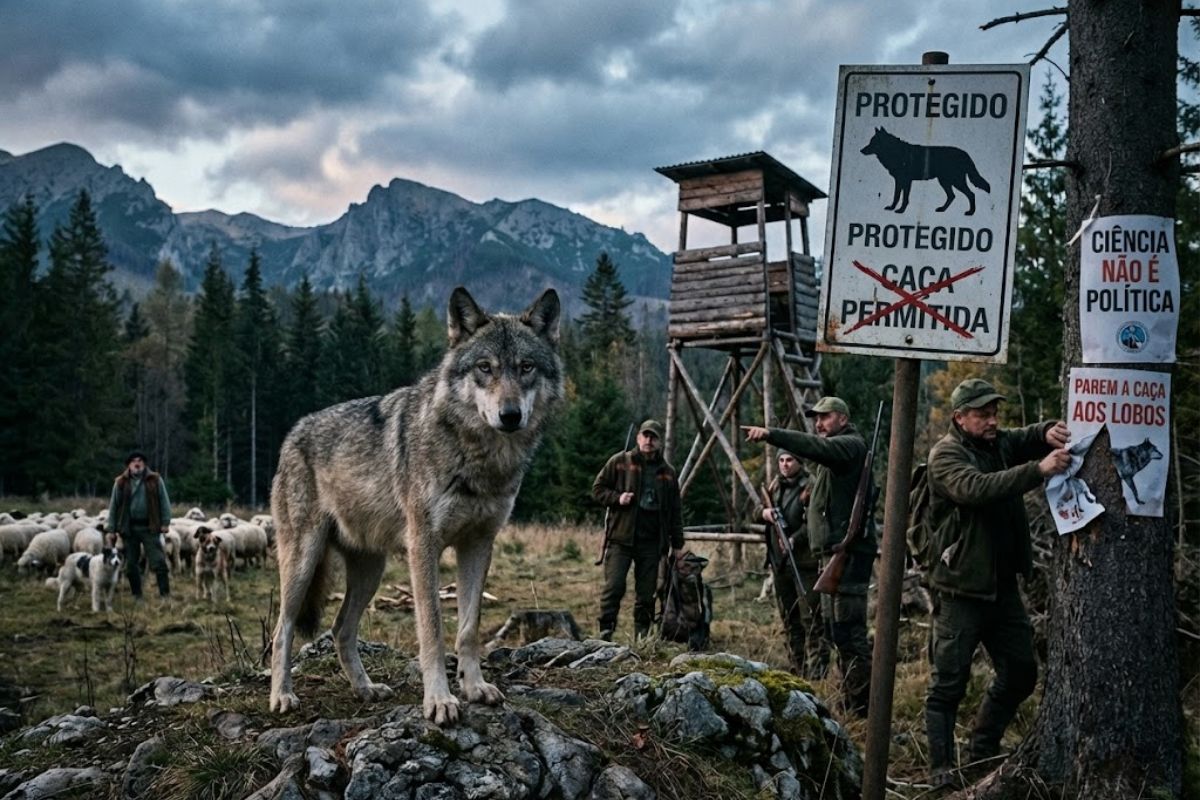
Slovakia Decided to Keep the Wolf Plan for the 2025 and 2026 Season, Authorizing the Killing of 74 Animals Despite Environmentalists Claiming that There is No Scientific Evidence that Hunting Reduces Damage to Livestock. Organizations Warn of Risk to Populations, Threat to Protected Areas and Possible Conflict with EU Regulations.
The decision to allow the killing of wolves in Slovakia provoked a strong reaction from conservation groups, who accused the government of yielding to hunting pressure and failing to protect a species considered iconic and ecologically important. The Ministry of Agriculture and Rural Development authorized the quota of 74 wolves for the upcoming season, and the measure was classified by environmentalists as unjustified, unprofessional, and potentially motivated by political interests.
At the same time, the controversy is growing because hunting is marketed as a solution to livestock attacks, but, according to organizations, this premise has never been scientifically proven. For critics, the decision does not offer real answers to farmers, may put populations of wolves in protected areas at risk and could open the door to disputes with EU environmental regulations.
The Decision that Triggered the Crisis and Who is Reporting It

The authorization for the killing of wolves was condemned by WWF Slovakia, the initiative My sme les, and the Aevis Foundation.
-
In Mexico, a 3,000-year-old Maya site with the dimensions of an entire city may have been built as a colossal map of the cosmos, created to represent the order of the universe and reveal how this people organized space, time, and rituals.

-
Japan wants to build a solar ring of 10,900 kilometers on the Moon to continuously send energy to Earth.

-
Weighing almost 1 ton, with temperatures of up to 3,000°C, the ability to launch 10,000 fragments within a radius of 1 km, capable of penetrating concrete and melting steel, Turkey’s terrifying bomb emerges as one of the most destructive non-nuclear weapons ever presented.
-
After a submarine disappeared beneath the “Doomsday Glacier,” scientists announce a new monstrous machine capable of operating at 3,000 meters depth to return to the heart of the ice and investigate a threat that could raise sea levels worldwide.


These groups argue that the quota has no scientific basis, does not solve rural problems, and directly threatens the populations of the species in the country.
In addition to criticizing the decision of the Ministry of Agriculture and Rural Development, environmentalists also targeted the Ministry of Environment and the State Agency for Nature Conservation.
The accusation is that the responsible bodies for protecting nature neglected the defense of wolves and, once again, would have succumbed to the interests of the hunting sector.
The Human-Wildlife Conflict and the Central Argument of Environmentalists

The debate revolves around the conflict between livestock farming and predators.
The killing of wolves is often presented as a way to reduce attacks on livestock.
The central point of environmentalists is direct: this assumption has not been scientifically proven.
They recall that experiences from previous years indicate that even mass killings have not produced the promised results.
According to the groups’ analysis, the damage remained at the same level and, in some regions, even increased.
This supports the criticism that the government would be adopting a measure of high ecological impact without being able to deliver the practical benefits that justify the policy.
What the Groups Say Would Work and Why It Matters in the Debate
In attacking the killing of wolves, environmentalists do not limit themselves to criticism.
They pressure the state to support farmers with systemic and preventive measures, pointed out as effective outside of Slovakia.
Among the solutions cited are electric fences, guard dogs, and other preventive tools.
The argument is that if the government truly wants to reduce damage, it should offer stable support and protection infrastructure to farmers, rather than responding with hunting quotas.
Milan Olekšák, from the initiative My sme les, summarized the point with a direct criticism: instead of yielding to hunting pressure, the government should ensure consistent support for farmers to reduce risks and compensate for possible damages.
Where the EU Comes In and Why This Could Become a Headache
One of the most sensitive points is the potential conflict with European regulations. Environmentalists claim that similar decisions have already triggered infringement proceedings by the European Commission against Slovakia.
In this context, the Ministry of Environment is described as guardian of the EU Habitats Directive, which increases the pressure on its stance. Katarína Butkovská, from WWF Slovakia, questioned whether the ministry advocated for a zero quota and positioned itself for nature conservation or yielded to demands considered unjustified.
The criticism is not only legal.
It suggests that the country could weaken its environmental commitments, generate institutional friction with the EU, and expose itself to political consequences if hunting is interpreted as incompatible with conservation obligations.
The Problem of Borders and the Risk to Protected Areas
The government reportedly declared that hunting would not be allowed in areas with the highest level of protection, in locations of European importance or in border regions.
For environmentalists, this does not solve the main problem: wolves migrate and do not recognize administrative borders.
They warn that there has already been hunting near protected areas in January, according to a map cited in the material. And they reinforce a crucial point: no buffer zones were created around hunting-free areas this season.
The absence of these zones is treated as an irresponsible approach because a wolf killed outside the protected perimeter may be part of a population that uses protected areas or circulates between territories with different protection levels.
This could endanger not only local populations but also populations in neighboring countries, as the animal does not limit itself to national borders.
The Criticism that the Policy is Incoherent with Its Own Objective
Environmentalists cite a practical contradiction that they consider explosive. A map of the killing of wolves in January 2025 reportedly showed that wolves were killed in districts where livestock damage was insignificant, while regions with greater losses did not register killings.
This detail reinforces the criticism of a lack of rationality in the policy’s design. If the measure is defended as protection for producers, killing wolves where there is little damage and not acting where there is more loss creates a narrative that the quota serves more the logic of hunting than a strategy to reduce attacks.
The same map would also have highlighted cases where hunting may have affected populations near Sites of European Importance, where wolves are a protected species. For environmentalists, this makes the legal and ecological risk even more relevant.
The Harshest Remarks and the Abuse of Power Accusation
Rastislav Mičaník, from the Aevis Foundation, stated that he considers the hunting of wolves a wrong decision, unprofessional, and politically motivated.
He said that the measure would serve hunting interests at the expense of nature conservation and would constitute an abuse of power.
In the group’s view, killing wolves does not solve the problem and may worsen it. The demand returns to the same axis: invest in effective prevention and compensation for damages instead of using hunting quotas.
The Regional Quota, The Timeline and How The Killing Will Occur
The Ministry of Agriculture and Rural Development approved the killing of 74 wolves in the hunting season 2025 and 2026. The quota was divided by regions:
- Banská Bystrica Region with 21 wolves
- Žilina Region with 25
- Prešov Region with 17
- Košice Region with 7
- Trenčín Region with 4
The hunting period is defined from September 1, 2025, to January 15, 2026, or until the quota is reached. For environmentalists, this quota and regional design does not adequately consider the real dynamics of animal movements, which can cross large areas and circulate between zones with different rules.
The Call to Hunters and the Symbolic Weight of the Wolf
In addition to demanding action from the state, conservation groups make a direct appeal to hunters and hunting associations not to participate in the killing.
The message is clear: the wolf is not a trophy, but a fundamental species and a symbol of Slovakia’s wilderness.
The campaign seeks to create social and moral pressure to reduce hunting participation, transforming the debate into something beyond public policy: a dispute over values, environmental identity, and the kind of coexistence the country wants to have with its wildlife.
What Is Really at Stake
At the center of this clash, there are three interconnected layers:
- The rural layer, with producers fearing losses and demanding state protection
- The environmental layer, which sees a direct risk to wolf populations and protected areas
- The European institutional layer, with potential conflicts with EU environmental rules and guidelines
By allowing the killing without scientific consensus, according to environmentalists, the government amplifies the risk of social unrest, weakens conservation, and may trigger legal disputes.
At the same time, if it does not provide effective prevention and stable support to farmers, tensions in the countryside are likely to persist.
Given all of this, do you think Slovakia should insist on the killing of wolves or prioritize preventive measures such as electric fences and guard dogs to reduce attacks on livestock?








-

-

4 pessoas reagiram a isso.