





 Portuguese
  English
  Spanish
  4 min of reading
  0 comments


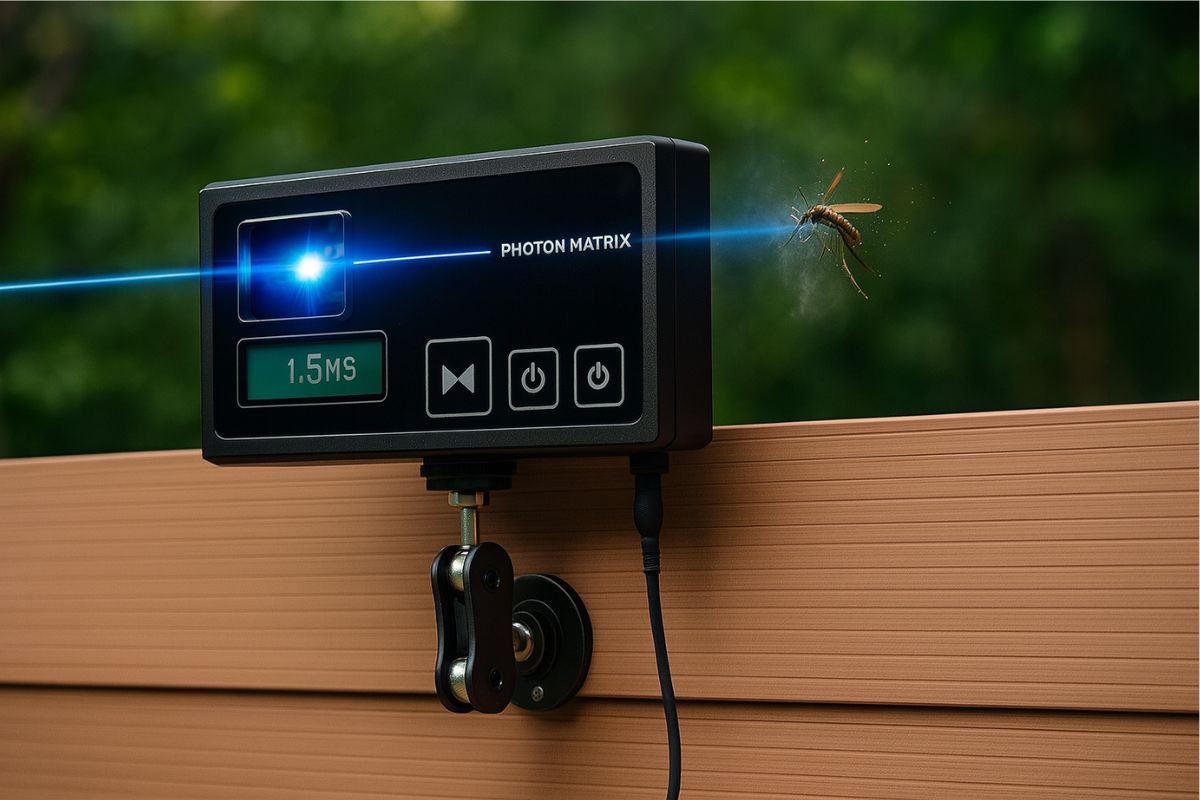
It Looks Like a Cell Phone, but Works Like a Military System: It Shoots Lasers at Mosquitoes and Disintegrates Them Before They Touch Your Skin
A small black box promises to do what no repellent or electric racket has achieved until now: detect, aim at, and eliminate mosquitoes in mid-flight using artificial intelligence and high-precision laser shots. Named Photonmatrix, the device is described by its creators as a true “domestic air defense system,” capable of destroying up to 30 insects per second with an accuracy reminiscent of science fiction movies.
But the proposal is serious. Developed by Chinese engineer Jim Wong and launched through a crowdfunding campaign on the Indiegogo platform, the Photonmatrix combines 3D sensors, AI, and LiDAR technology to detect the slightest sign of movement in the air. If the flying object is a mosquito, it is taken down in milliseconds by a laser pulse calibrated to be lethal only to insects — and totally safe for humans and pets.
An ‘Iron Dome’ Against Aedes Aegypti
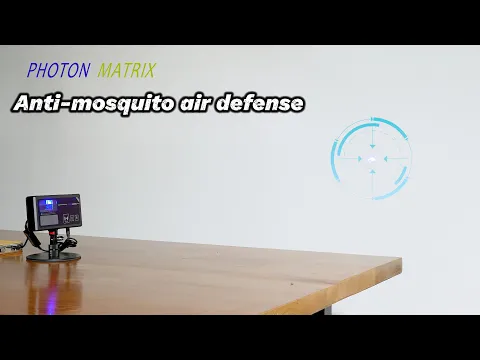

The device functions like a sort of mini anti-aircraft shield, inspired by the Israeli defense concept Iron Dome, but aimed at the skies of our homes. The goal: to eliminate disease-carrying mosquitoes like dengue, zika, and chikungunya — increasingly common outside the tropics due to climate change.
-
Drought may be creating stronger superbugs in the soil and helping antibiotic resistance reach hospitals, warns a study highlighting a problem that could grow alongside extreme weather.

-
The biggest scam in history: Napoleon’s France deceived the United States by selling them a territory that was Spanish.

-
Why is the Danakil Desert so dangerous? It has unstable terrain and how extreme temperatures and toxic gases turn the region into one of the most hostile environments on Earth.

-
With a height of 221 meters and a capacity for trillions of liters, Hoover Dam still holds a trick that makes water defy logic.

The operation is impressive. A LiDAR module emits thousands of laser beams per second. When one of them encounters a solid body in the air — like that of a mosquito — the photons return to the system, which calculates, with three milliseconds of precision, the size, distance, and speed of the target. Then, another laser comes into play and eliminates the insect with a precise pulse. None of this would be possible without the use of artificial intelligence to quickly distinguish the flight pattern of a mosquito from dust particles or visual noise in the environment.
Additionally, millimeter-wave radar sensors ensure that if a person or pet enters the action range, the laser is automatically disabled. Safety is one of the priorities raised by Wong, who claims that the system was designed with mandatory protection certifications — though he does not specify whether these are Chinese or international standards.
An Expensive Product, but with Potential to Become a Global Trend
The basic version of the Photonmatrix offers a range of three meters and 90 degrees of coverage. The professional version doubles this capacity, reaching six meters. Both models are water-resistant (with IP68 certification) and can operate even in complete darkness. Power can be supplied by electricity or a portable battery, with a runtime of 8 to 16 hours.
The price, however, is still steep: about $468 (approximately R$ 2,600) for the basic version and $629 (R$ 3,500) for the advanced version. For Wong, the high cost will only be overcome with production scale. “Manufacturing costs are still especially high,” admitted the engineer. Even so, the fundraising campaign on Indiegogo has already surpassed the initial goal of $20,000, signaling great interest in the project.
There is still no confirmed date for the delivery of the first devices. Like any product funded by crowdfunding, there are risks involved. But if the device delivers on its promises — and the demonstration videos are convincing — the global pest control market could be facing a revolution.

A Response to the New Geography of Tropical Diseases
The arrival of the Photonmatrix occurs at a time of international alert. The climate crisis has expanded the territory of disease-carrying mosquitoes. In 2024, the hottest year on record, Europe documented more than 300 indigenous cases of dengue — that is, contracted within the continent itself. This number surpasses the combined total of the previous 15 years.
The Aedes albopictus mosquito, also known as the Asian tiger mosquito, is already present in at least 13 European countries. Average temperatures of 24 to 26 °C during summers are becoming increasingly common — and are ideal for mosquito reproduction. Given this scenario, combat systems like the Photonmatrix become not just convenient, but necessary.
Other Complementary Methods
Despite technological advances, experts remind us that no single solution will be able to contain the proliferation of mosquitoes. The most effective strategy is called “stratified defense,” which combines different approaches: epidemiological surveillance, environmental control, traps, and now precision laser weapons.
Among the complementary solutions is the creative ovillanta, created by Professor Gérard Ulíbarri from Laurentian University in Canada. It is a simple and cheap system: pieces of tires with stagnant water and floating paper that serve as an ideal location for mosquitoes to lay their eggs. After attracting them, the contents are filtered to eliminate the larvae. Tests conducted in Guatemala demonstrated that the trap eliminates up to seven times more larvae than traditional methods, helping significantly reduce dengue cases.









-

-

3 pessoas reagiram a isso.