





 Portuguese
  English
  Spanish
 6 min of reading
  0 comments


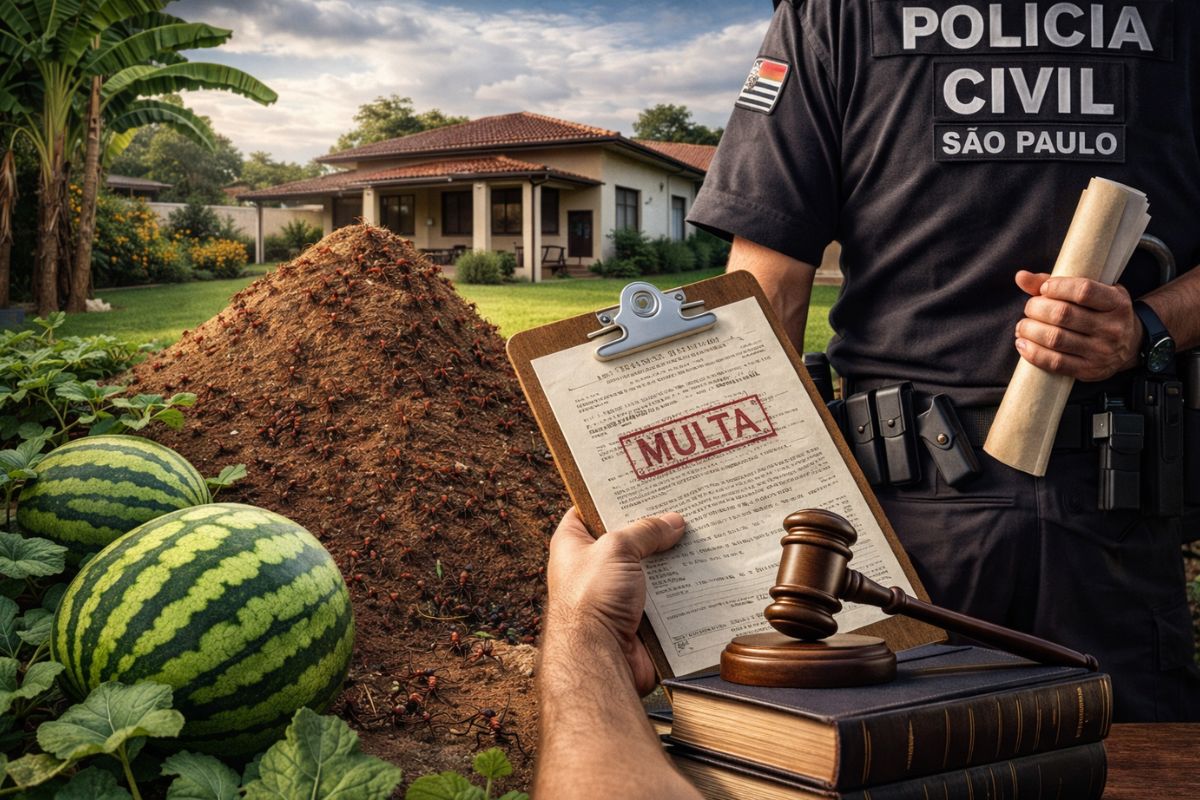
In Rio Claro, a city in the interior of São Paulo, Law No. 967 of 1965 provides for a fine for anyone who maintains an anthill at home, in a yard, or on a lot, created to reduce agricultural losses. The rule has fallen into disuse but has not been revoked. The same city already prohibited watermelon in 1894 there.
The city of Rio Claro, in the interior of São Paulo, carries a rare regulation in the Brazilian municipal repertoire: a law from 1965 that authorizes fines for residents who maintain anthills within their properties. Even outside of a routine inspection, the measure remains formally in effect and exposes a time when protecting crops was an explicit priority.
The case also places Rio Claro back on the map of uncommon local rules. The city had, at the end of the 19th century, a prohibition related to watermelons, influenced by misguided interpretations about diseases such as yellow fever. These are examples of how old public decisions continue to resonate in the present, even when they become a memory and not a practice.
Law No. 967 of 1965: Fine for Anthills and Focus on Crop Protection
In Rio Claro, the city maintains the registered Law No. 967, instituted in 1965, which provides for fines for anyone who keeps anthills on private property.
-
The Chamber opens a debate on driver’s licenses at 16 years old as part of a reform that includes around 270 proposals to change the Brazilian Traffic Code and may redesign rules for licensing, enforcement, and circulation in the country.

-
The new Civil Code could revolutionize marriages in Brazil with “express divorce” and changes that could exclude spouses from inheritance.
-
Banco do Brasil sues famous influencer for million-dollar debt and intensifies debate on delinquency, risks of seizure, and direct impact on Gkay’s credibility.

-
The Senate approves a bill that criminalizes misogyny, hatred, or aversion towards women, and includes the crime in the Racism Law with a penalty of up to 5 years.


The wording is seen as a mechanism to reduce losses attributed to ants, with the declared goal of protecting the crops and, consequently, the local agricultural economy.
The central point is the difference between existence and use.
The law exists, it is recorded, it has not been annulled, and it remains valid from a formal standpoint.
At the same time, application is described as nonexistent in practice, a combination that often generates doubts: if it is not used, does it count?
In administrative terms, the city does not need to enforce a regulation every day for it to continue existing, as long as it has not been revoked.
Another relevant detail is the scope: the law refers to property, which includes spaces such as homes, yards, and lots.
The regulation is not presented as an educational recommendation, but as a sanctioning instrument, designed to function as pressure on the resident and as a response to a problem that, in that context, was read as a threat to crops.
Why a City in São Paulo Created Such a Rule in 1965
The logic described for 1965 is straightforward: Rio Claro, as a city in the interior of São Paulo, sought to protect the local productive base from recurring damage.
The law emerges as an attempt to shield crops and prevent losses associated with ants, treating the anthill as a source of damage and not merely as a domestic nuisance.
When a municipality chooses this path, it signals a very specific public priority.
Instead of viewing only the yard as private space, the public authority begins to see the yard as part of the environment that impacts production, income, and economic stability.
In this framework, the anthill ceases to be an individual issue and gains status as a municipal theme.
The city also appears, in this episode, as an example of how local legislation can become time capsules.
They preserve the snapshot of what concerned the community in a given decade, what political responses were available, and what kind of solution seemed acceptable: punish to prevent.
Forgotten Law, But in Effect: What This Means in Daily Life in Rio Claro
The fact that the law is not enforced does not eliminate its existence.
In Rio Claro, the city coexists with a situation where a regulation remains in the municipal framework, but does not integrate into the daily routine of enforcement.
This type of scenario often occurs when operational priorities shift, when there is a lack of specific actions to implement the rule, or when the community itself begins to treat the regulation as a historical curiosity.
Even so, the practical consequence is simple: the legal basis remains there, ready to be activated if there is an administrative decision in that sense. This does not mean that there is active enforcement, nor that there is a campaign underway.
It merely means that, unless there is formal revocation, the municipality retains the legal opportunity to impose the predicted fine.
For the resident, the impact is more informational than immediate: understanding that the city has such a law helps explain why certain local regulations seem to “disappear” without vanishing.
They may stop being used but continue to exist in official records and archives.
Rio Claro Also Prohibited Watermelon in 1894, and the Reason Became a Symbol of the Era
Rio Claro is not known only for the anthill law.
The city appeared in historical records for a prohibition on watermelons in 1894, based on the misguided belief that the fruit would transmit diseases such as yellow fever.
The decision was influenced by disease outbreaks and a context of still-limited scientific knowledge at the time.
Here, the important detail is the contrast between intention and correctness.
The regulation connected to a real concern, public health, but relied on an incorrect interpretation.
This type of measure helps to understand how, at different times, cities made decisions based on what seemed plausible at that period, even if today it sounds absurd.
And there is an administrative conclusion: the prohibition regarding watermelon was revoked in 2025, closing a chapter that spanned generations as a normative curiosity.
This reinforces the central point: when a city revokes a regulation, it formally closes a door.
When it does not revoke, the door remains ajar, but still exists.
Peculiar Laws in Brazil: When Local Trumps the Common
The case of Rio Claro is part of a larger set of unusual municipal legislations in Brazil.
In Barra do Garças, Mato Grosso, there was the creation of the so-called “Discoporto”, an area reserved to receive supposed spacecraft, approved in 1995.
In Aparecida, in the state of São Paulo, there were behavioral regulation initiatives that also drew attention.
These examples do not arise out of nowhere.
In general, laws of this type are responses to specific local concerns, even when the format seems exaggerated.
In the case of the city of Rio Claro, the concern was economic and agricultural.
In other places, the motivation can be cultural, tourist, symbolic, or linked to moral panic and collective perceptions of the moment.
In the end, they become historical documents.
They reveal priorities, fears, beliefs, and disputes of each era, as well as how authorities attempted to translate a problem into written rule.
What These Norms Reveal About the City and Its Public Memory
When a city maintains a law without enforcement, it preserves a piece of the past within the present.
This can happen due to administrative inertia, a lack of systematic legal revision, or simply because no one has brought the issue up in recent political agendas.
In the case of Rio Claro, the anthill law serves as a reminder that the municipality once treated crop protection as a matter of domestic inspection.
And the watermelon story, with its revocation only in 2025, shows that old regulations can span more than a century until someone decides to formally end them.
To those observing from the outside, it may seem like folklore.
For those studying local policies, it is a clue: the city changes, but its records continue to tell what was once important enough to become law.
In Rio Claro, a city in the interior of São Paulo, Law No. 967 of 1965 remains a concrete case of a norm that is not revoked, even without daily application, while the old prohibition on watermelon was only officially closed in 2025.
To understand what is active and what has already fallen, the safest path is to consult the municipal legislative archive and demand transparency about which rules can still be used.
If you lived in a city in São Paulo with such a “asleep” law, would you prefer to revoke it outright or keep it on the books as a tool for potential future enforcement?








Seja o primeiro a reagir!