





 Portuguese
  English
  Spanish
  4 min of reading
  0 comments


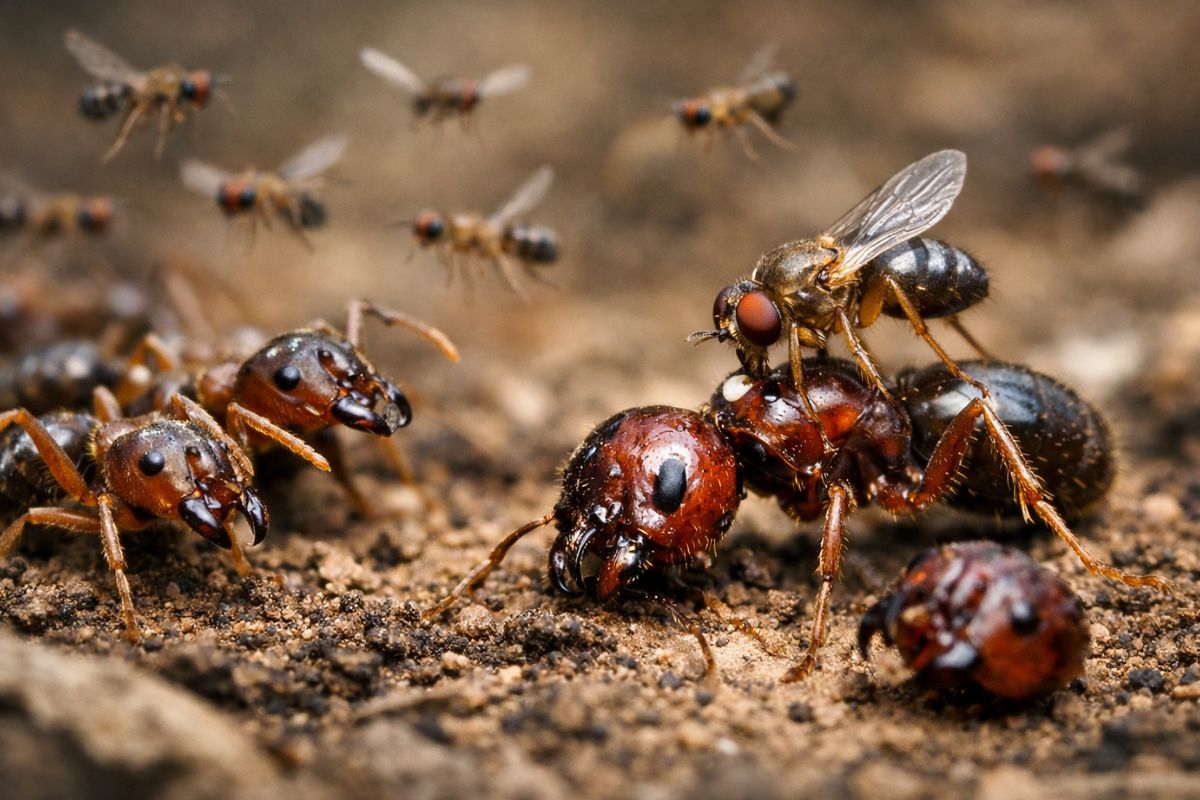
Researchers Use Parasitoid Flies Against Invasive Ants That Devastate Ecosystems, Crops, and Cities, Spread Billion-Dollar Losses and Resist Poisons, While Biological Control Causes Panic in Colonies and Weakens the Expansion of These Pests in Multiple Countries Today.
The invasive ants have spread across entire continents, formed gigantic supercolonies, and have become one of the most costly and difficult pests to control on the planet. They attack crops, invade cities, damage equipment, and cause environmental and economic impacts that reach billions.
Faced with the failure of poisons and traditional methods, scientists turned to an unexpected solution to combat the invaders (fire ants). Tiny flies have begun to be used as a natural biological weapon, exploiting behavior that causes fear, disorganization, and weakening within the colonies themselves.
The Silent Advance of Invasive Ants

The invasive ants (fire ants) form supercolonies with millions and even billions of interconnected individuals.
-
Archaeologists find an intact tomb over 2,500 years old, with more than 100 preserved objects, weapons, jewelry, and human remains never touched.
-
Volcanic lava transforms into threads as fine as human hair that travel over 30 kilometers by wind and fall like cutting rain on roofs and backyards in Hawaii and Iceland.

-
NASA issues a warning for the feared Godzilla El Niño that could change the planet’s climate in 2026 with extreme warming of the Pacific capable of causing devastating droughts in some regions and historic floods in others simultaneously.

-
Archaeologists discover a 100-meter ship graveyard in a submerged Greek city, and what has appeared on the seabed of Libya could change what was known about this ancient port.


They dominate enormous territories, expel native species, and transform entire ecosystems. In agricultural regions, they attack crops such as soybeans, corn, potatoes, and citrus seedlings.
Besides the damage to farmland, the invasive ants cause serious urban problems.
They invade electrical appliances, chew through wires, compromise transformers and air conditioning systems.
There are reports of interference even in sensitive structures, showing how the infestation exceeds the natural environment.
The financial impacts are gigantic. Countries have already invested hundreds of millions of dollars in control programs, while annual losses reach billions.
Even so, the invasive ants continue to expand into new regions, including Europe.
The Fly That Became a Biological Weapon

In the midst of this crisis, an unlikely ally has emerged against the invasive ants. They are tiny parasitoid flies from the family Phoridae, almost the size of an ant’s head.
They do not need poisons, traps, or complex machines. Their own life cycle is already a natural weapon.
These flies locate worker invasive ants in motion and carry out an extremely rapid attack.
In fractions of a second, they deposit an egg on the ant’s body and fly away. The colony often doesn’t even notice it has been hit.
From there, the larva develops inside the ant. Over time, the parasite compromises the normal functioning of the insect.
The worker stops working, ceases foraging for food, and withdraws from the colony’s activities, weakening the collective structure.
Panic Inside the Colonies

The most powerful effect of these flies on invasive ants is not merely the death of some workers, but the fear they provoke.
The mere presence of a fly hovering over the area already alters the behavior of the ants.
The workers stop feeding, become motionless, or adopt defensive postures. This drastically reduces food foraging and territory defense.
A single fly can disrupt the work of hundreds of ants at the same time.
With less food and less external activity, the colony loses strength.
Native ant species, previously dominated by the invasive ants, manage to regain space and balance the environment.
Biological Control Instead of Extermination
The flies do not completely eliminate the invasive ants, and this is intentional. If they exterminated all of them, they would lose their own host and also disappear.
The goal of biological control is different.
The focus is to maintain constant pressure on the colonies, reducing their capacity for expansion and impact. It is a war of attrition, not annihilation.
Fewer active workers mean less growth and less dominance over new territories.
Experiments have shown that the percentage of parasitized ants is small, but the behavioral effect is significant.
The constant stress caused by the flies weakens the competitiveness of the invasive ants against other species.
Mass Breeding and Planned Release
To amplify this effect, scientists have developed mass breeding programs for these flies. In laboratories, colonies of invasive ants are maintained so that the flies can complete their life cycle and produce new generations.
Afterward, the flies are released in infested areas. The release is not random. Researchers choose locations where the ants are active on the surface, increasing the chances of contact between flies and hosts.
Over time, the fly populations can establish themselves and spread on their own, following the distribution of the invasive ants.
Ecological Safety and Focus on Pests
A major concern was whether these flies could attack other species. Studies have shown that they are highly specific and primarily focus on the invasive ants of the target group.
They do not attack people, do not damage crops, and do not feed on garbage or human food. Their survival directly depends on the ants they parasitize, which limits their spread to other environments.
An Existing Biological War
Today, this strategy is part of actual pest control programs in various places. Faced with a threat causing billion-dollar losses and spreading rapidly, the use of natural enemies has become a viable and sustainable alternative.
Instead of increasing the load of poisons in the environment, scientists use the ecological balance itself to contain the invasive ants.
It is a silent biological war, fought at the insect level but with gigantic effects on agriculture, the economy, and ecosystems.
Do you think using insects to control other pests is a smart or too risky solution?









-

-

3 pessoas reagiram a isso.