





 Portuguese
  English
  Spanish
  3 min of reading
  0 comments


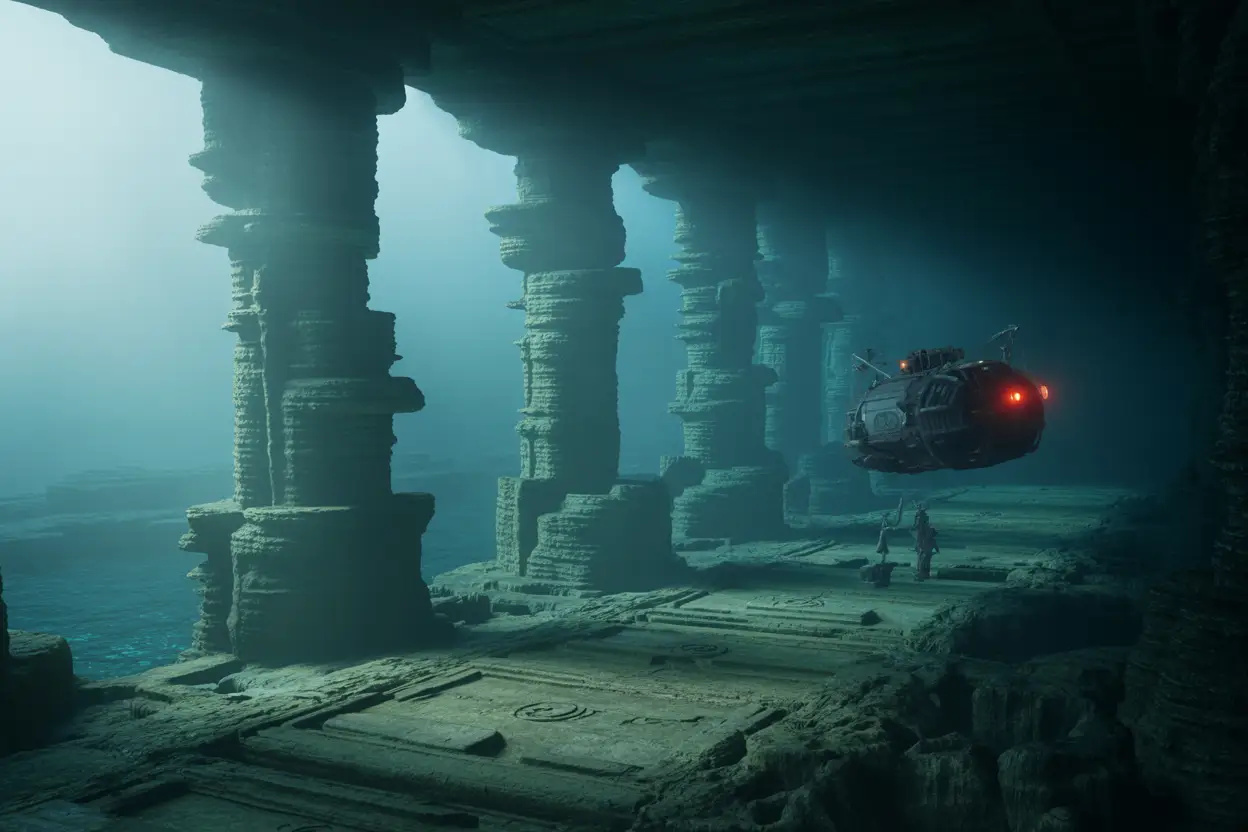
Discover How This Isolated Ecosystem for Millennia Can Help Reconstruct the Origin of Life, Now Threatened by Deep-Sea Mining
Imagine a world buried more than 700 m deep, where limestone towers rise like ruins of a forgotten civilization, without light, without oxygen, yet vibrant with life. This is the Lost City, a natural treasure that may offer valuable clues about the birth of life on Earth.
What Is the ‘Lost City’?
At the bottom of the Atlantic, on the flank of the Atlantis Massif, part of the Mid-Atlantic Ridge, the Lost City is the oldest hydrothermal field ever discovered with about 120 thousand years of continuous activity. Its colossal carbonate towers (some reaching up to 60 m high) arise from a chemical process called serpentinization, when seawater reacts with mantle rocks, producing hydrogen and methane.
Life in a Black Hole: Sunless Ecosystem
The fluids leaking from these chimneys reach temperatures of up to 90 °C and high pH — heat, chemical energy, and essential substances that gave rise to microbes capable of living in absolute darkness, without seeing or breathing. These microbes transform hydrogen and methane into food, creating a fascinating ecosystem where shrimp, snails, and sea urchins live on the outer surfaces of the towers.
-
He started running at 66 years old, broke records at 82, and is now a subject of study for having a metabolic age comparable to that of a 20-year-old, in a case that is intriguing scientists and inspiring the world.

-
Oldest tree on the planet reappears after 130 years of searches: Wattieza, 385 million years old, was 10 meters tall and had no leaves or seeds; Gilboa fossils in New York solved the mystery in 2007.

-
A 48-square-meter house assembled in hours with 4,000 bricks made of recycled plastic that does not absorb moisture, has natural thermal insulation, and costs less than 90,000 reais in a complete kit.

-
Luciano Hang revealed that Havan’s air fleet has already accumulated more than 20,000 landings, 10,000 flight hours, and 6 million kilometers traveled, and he says that without the planes, the company would never have grown so quickly.

Drilling the Mantle: Recent Advances
In 2024, an expedition led by the JOIDES Resolution ship drilled more than 1,200 m into the bedrock around the Lost City, reaching fragments of the Earth’s mantle for the first time, an unprecedented and significant achievement for understanding the chemistry and origins of life. Geologist Susan Lang stated:
“They made magic happen” by extracting an unexplored core that may contain organic molecules intact since the beginning of life on Earth.”
Window to Other Worlds
This combination of extreme geology and biology also attracts the attention of astrobiology. According to microbiologist William Brazelton, this ecosystem may be analogous to those that exist today on icy moons like Enceladus (Saturn) and Europa (Jupiter), environments where life may exist without sunlight.
Imminent Risk of Deep-Sea Mining
Despite being protected as a Significant Ecological Marine Area (EBSA) and under analysis by UNESCO as a World Heritage Site, the region faces a real threat. The International Seabed Authority (ISA) has authorized contracts for polymetallic sulfide exploration in nearby areas, including Poland, since 2017. Experts warn that mining could cause plumes of toxic sediments that would irreversibly harm the fragile web of underwater life.
Why Defend the Lost City?
- Scientific Heritage: the site is a unique natural laboratory on the chemical reactions that may have given rise to primitive metabolism;
- Rare Biodiversity: extremophile organisms present here are living models for studies of adaptability and the origin of life;
- Legal Protection: inclusion in the UNESCO World Heritage List would provide real protection against human interference.
The Topic Is Also in Recent Debates:
- In 2024, Greenpeace protested at the ISA meeting in Jamaica, advocating for a global treaty to prohibit mining in sensitive areas.
- Research such as Thermodynamic constraints on the citric acid cycle… (April 2025) compares the chemiosphere of the Lost City with extraterrestrial ocean environments, reinforcing its astrobiological relevance.
The Lost City is a geological and biological phenomenon and a portal for understanding how life arose on Earth, and perhaps in distant places under other stars. However, if we allow its destruction for economic interests, we will lose an irreplaceable trace of the emergence of life on Earth. The urgency for its protection is real.

And you? What do you think about conserving this submerged world? Leave a comment and share this article to broaden the discussion!








-

-

-

3 pessoas reagiram a isso.