





 Portuguese
  English
  Spanish
  2 min of reading


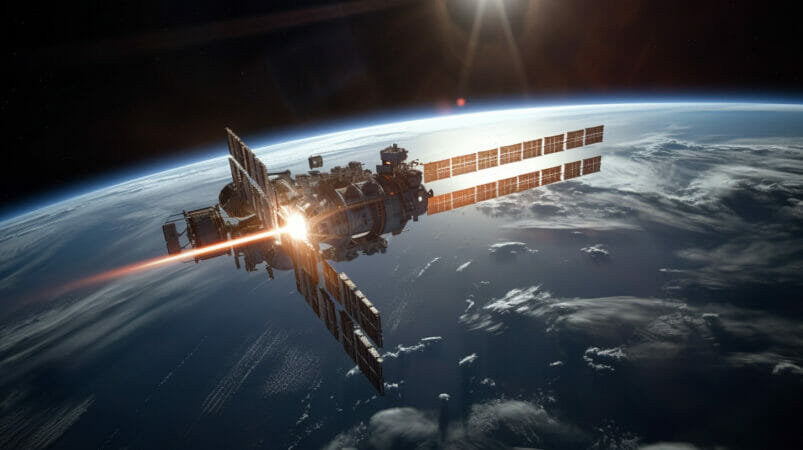
ISS Receives ILLUMA-T Technology, an Innovation from NASA in Partnership with SpaceX.
SpaceX, under contract with NASA, has the mission to launch CRS-29. But this isn’t just any cargo flight to the International Space Station (ISS). It will carry on board a game-changer in the world of space communications: the ILLUMA-T.
What Is ILLUMA-T?
ILLUMA-T is the English abbreviation for “Integrated Modem and Low Earth Orbit Amplifier Terminal.” In other words, it is NASA’s first end-to-end bi-directional laser communication system. That’s right, you read it correctly. Laser Communication in Space.
”Witness the future of space communications”
ARTICLE CONTINUES BELOWSee also
If the trip to the Moon were a hoax, it would be necessary to keep the secret among 400,000 people for more than 50 years and to deceive even the Soviet Union, which was tracking the radio signals coming from the exact direction of the satellite during each Apollo mission.

Artemis 2 launches at 7:35 PM with four astronauts and ends a 50-year fast in lunar orbit: the SLS rocket departs from Florida, the mission lasts 10 days, circles the far side, and tests Orion in a free-return trajectory.
China is testing a train that will operate at 400 km/h in daily service, which is 80 km/h faster than the French TGV, and uses carbon fiber, magnesium alloys, and more than 4,000 sensors to become the fastest commercial train on the planet.

Forget about having an air fryer, electric oven, and steam pot taking up space in your kitchen because a 30-liter smart oven combines all these functions, automatically selects the ideal temperature, and even turns off by itself when cooking is done.

Bill Nelson – NASA Administrator
Advantages of Laser over Radio Waves
Until now, space missions, whether crewed or not, have always used radio waves to communicate. It works, but let’s face it, it has its limitations. The laser system is lighter and consumes less energy. Additionally, the capacity to transmit data is greater due to shorter wavelengths. In summary: it is more efficient and powerful.
How ILLUMA-T Will Work on the ISS
Once ILLUMA-T is installed on the International Space Station, it will start sending data to the LCRD (Laser Communication Demonstration Device) at a rate of 1.2 gigabits per second. This will be done via infrared laser.
From there, the LCRD will relay the information to two ground stations, one in Hawaii and the other in California, strategically chosen to avoid cloud interference, the laser’s weak point.
What’s Coming Next
If all goes well, this technology could open doors for other missions that require high-speed and efficient communication. Who knows, in the future, astronauts might be able to make a “DR” via laser, even while millions of kilometers away?
Time will tell if NASA and SpaceX’s bet will truly change the game. But one thing is certain: we are one step closer to revolutionizing communications as we know it. So, ready for the future?





Seja o primeiro a reagir!