





 Portuguese
  English
  Spanish
  6 min of reading
  1 comment


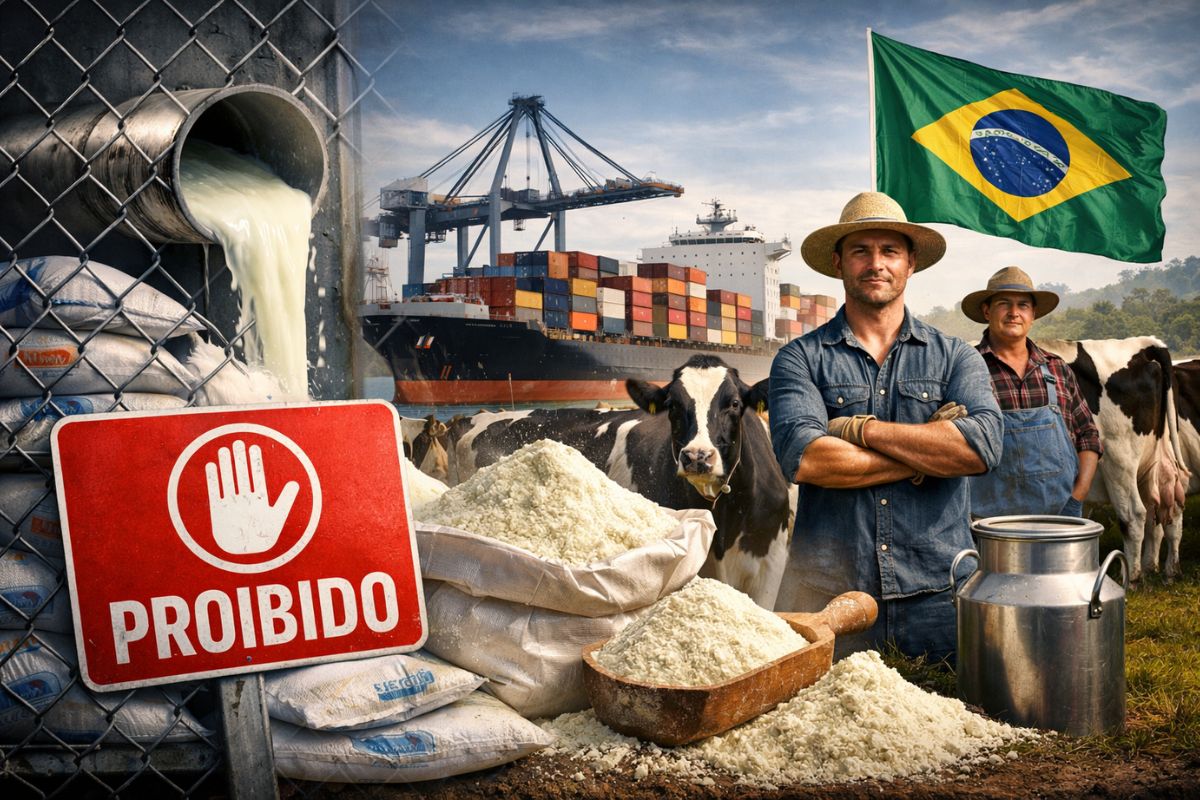


Sanctioned By Jorginho Mello Bans Reconstitution Of Foreign Powdered Milk And Derivatives In SC To Protect Local Producers. Sector Fears Impact On Supply, Risk Of Retail Price Increase And Reaction From Neighboring States
Santa Catarina decided to intervene directly in the milk market by enacting a law that prevents the reconstitution of imported powdered milk for sale as liquid milk. The measure was presented as a shield for local producers, who complain about cheaper foreign competition and the drop in the price paid per liter within the dairy chain.
The new rule affects industry, farmers, and consumers by cutting off a source of supply that helped keep costs lower. Without the option of reconstituted milk made from imported powder, pressure increases for domestic production to meet demand, and this could influence retail prices, company margins, and political disputes with neighboring southern states.
Where It Happened And What The Law Really Prohibits

The change occurs in Santa Catarina, with the law enacted on Wednesday (21) by Governor Jorginho Mello.
-
Russia cut fertilizers, China cut fertilizers, and oil prices soared with the war in the Middle East: sugarcane producers in the interior of São Paulo are seeing costs explode from all sides and warn that the effects will take months to be absorbed.
-
It does not come from flowers, is produced only every two years, and more than 90% goes straight to Europe: meet the bracatinga honeydew honey from Santa Catarina, considered one of the rarest in the world and overlooked by Brazil itself.
-
They said no to 26 million dollars and would do it all over again: mother and daughter from Kentucky reject a million-dollar offer from a mysterious company that wants to build the largest data center in the state on more than 2,000 acres of rural land.
-
While corn requires rain and is expensive, sorghum produces almost the same volume per hectare at a cost up to 80% lower and uses less water, and it is revolutionizing dairy farming in the Triângulo Mineiro, where producers save hundreds of reais per hectare.

The focus is to prevent imported powdered milk from being transformed back into liquid milk within the state and sold as if it were fluid milk.
The ban does not only apply to powdered milk.
The reconstitution of powdered milk compound, whey powder, and other powdered dairy products is also prohibited, closing loopholes that would allow part of the practice to continue using similar inputs.
How The Proposal Advanced And Who Led The Restriction
The project was approved in Alesc in December before being sanctioned by the state government.
The political and economic justification of the text is based on the idea that reconstituted foreign powdered milk sold as liquid milk created direct competition with fresh milk obtained from rural producers in Santa Catarina.
In defense of the proposal, Deputy Oscar Gutz argued that this practice represented unfair competition with fresh local products because it allows for the market entry of reconstituted milk that could have a lower cost and compete for shelf space and contracts with the industry.
The Central Argument: Foreign Competition With Lower Cost
The most sensitive point of the debate is that imported powdered milk can be cheaper due to tax incentive policies in other countries, reducing production costs and making the product more competitive when reconstituted.
In the view of the law’s supporters, when this reconstituted milk enters the market as liquid milk, it pressures the price of fresh milk and weakens the income of rural producers.
In a dairy chain already described as being in prolonged crisis, this effect is seen as a type of shock that undermines margins and pushes families out of the activity.
The Size Of The Sector In Santa Catarina And Why The State Reacted
Santa Catarina ranks as the fourth largest milk producer in the country, with more than 24,500 producers.
In 2024, the state’s production reached 3.3 billion liters, equivalent to 9% of national production.
These numbers help explain why the discussion gained strength.
A state with this scale of production tends to feel any price distortion quickly, especially when the income of thousands of families depends directly on the price paid per liter and the stability of purchases by cooperatives and industries.
Food Security, State Economy, And The Competitiveness Discourse
The law was also defended as a mechanism to maintain the competitiveness of the sector.
Deputy Altair Silva stated that preserving this competitiveness would be essential for food security, regional balance, and state economy.
This kind of argument seeks to broaden the issue beyond a commercial clash between imported and local products, positioning the dairy chain as a strategic structure for supply, employment in the countryside, tax collection, and the maintenance of rural activity in smaller municipalities.
Fines And Where The Collected Money Goes
The regulation provides for the application of fines in case of non-compliance.
The collected amounts will be allocated to the State Rural Development Fund.
The destination of the money is relevant because the text indicates that the resources should return to the production chain itself, supporting funding and technology programs.
In practice, this signals a second arm of the policy: not only to restrict reconstituted imported milk but also to use the revenue to strengthen local producers through technical support and productive incentives.
What Could Change In Practice For Industry And Supply
The ban alters the supply dynamics because part of the fluid milk offered in Santa Catarina came from the reconstitution of imported powdered milk, typically associated with lower costs.
Without this alternative, the industry is likely to depend more on milk produced within the state.
The problem is that local production faces rising costs and margin reductions, which could create tension in negotiations between industry and producers, especially if there are spikes in demand or processing bottlenecks.
The capacity of the industries to process becomes a decisive factor.
Even with high production, logistics, collection rates, and industrial efficiency determine whether the market can maintain a stable supply without resorting to imported powder.
The Risk Of Impact On Retail And Why The Consumer Enters The Dispute
Economists and industry organizations point out that the price to consumers could rise if internal supply fails to adequately meet market volume.
The impact, however, varies according to the three factors mentioned: the volume produced in the state, the processing capacity of the industries, and the behavior of demand.
This places the consumer at the center of the conflict.
If the retail sector perceives an increase in costs and passes it on to consumers, the measure could become the target of criticism for making a basic item more expensive.
At the same time, supporters of the law tend to argue that the cost of inaction would be the collapse of producers and the weakening of state production in the long run.
Crisis In The Dairy Chain And The Background Of The Protests
The approval occurred amid a prolonged crisis in the dairy chain that has already prompted protests from Santa Catarina producers.
The central complaint is that the excess of imported milk, mainly from Argentina and Uruguay, aggravates the financial situation of those who depend on the activity and drives down the price paid per liter.
This perception reinforces the climate of urgency.
For the producer, the problem is not only reconstituted powdered milk but also the impact of imports in volume on price formation, which can compress income in the countryside and reduce the continuity of production.
Domino Effect And The Example Of The Neighboring State
The decision of Santa Catarina does not occur in isolation.
Paraná, a neighboring state, also approved a similar law, indicating a regional trend of reaction to external competition via reconstituted powdered milk.
This detail adds a political and federative component: when states begin to adopt similar rules, the dispute tends to shift from technical debate to a model war, where each region tries to protect its producers and industry, with possible indirect effects on interstate trade and companies’ purchasing strategies.
The Dilemma That Remains Open: Protect Now And Pay Later, Or The Opposite
The law was designed to protect local producers and prevent unfair competition but creates an inevitable dilemma.
If internal supply adequately meets the market, the measure could strengthen the chain and reduce dependency on reconstituted imports.
If it does not meet supply, the pressure may fall on retail prices and on the industry, which loses a lower-cost input.
In the midst of this, farmers are trying to survive, companies recalculating supply, and consumers watching whether prices rise on the shelves.
Do you think the ban will really save local producers, or will consumers end up footing the bill at retail in Santa Catarina?








Ótima iniciativa! O produtor precisa ser protegido, ainda mais caracterizada a concorrência desleal. A agricultura familiar depende do leite, e muitos municipios já enfrentam problemas econômicos e sociais terríveis. Engraçado que o Governo Federal protege muitos setores, último é a indústria nacional de placa solar com a taxação sobre o importado da China, e esquece o produtor nacional de leite, setor que prende a família no campo e gera renda e faz a economia girar no interior.