





 Portuguese
  English
  Spanish
  4 min of reading
  1 comment


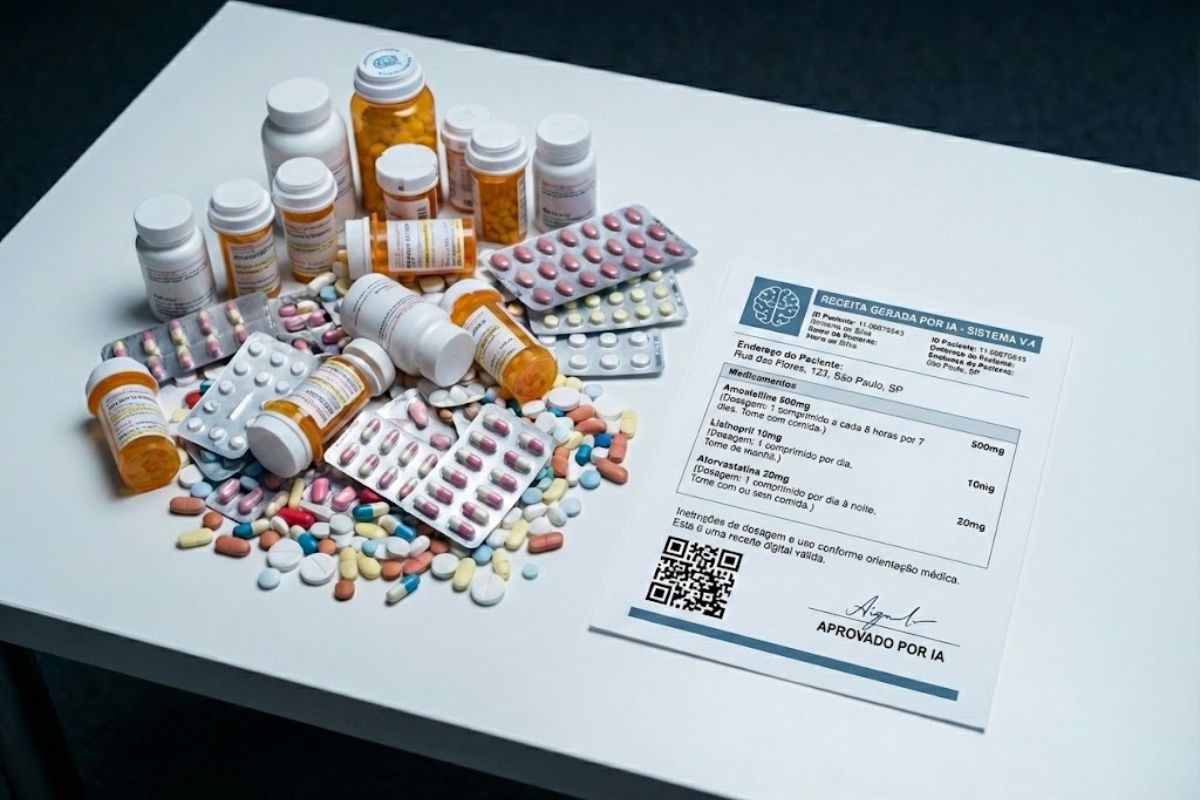

A State In The United States Has Begun Allowing Artificial Intelligence Systems To Renew Prescriptions Without The Presence Of A Doctor, Charging US$ 4 Per Online Visit And Releasing Almost 200 Common Medications, A Measure That Caused Reactions And Concerns Among Health Professionals.
The initiative puts technology directly into the prescription renewal process, a step that previously required mandatory contact with a human professional. The model was launched as a pilot program and is already raising discussions about ethical limits, clinical safety, and the future of digital care.
The use of artificial intelligence to renew prescriptions began operating in the state of Utah, USA, in partnership with the digital health startup Doctronic. The proposal is to test how far automated systems can take on functions traditionally performed by doctors.
Authorities classify the project as a high-risk experiment, created to assess AI’s ability to handle routine prescription demands without in-person or video consultation with a healthcare professional.
-
Archaeologists have discovered a colossal submerged wall in the Atlantic, dating back 7,000 years and weighing 3,300 tons, regarded as the largest prehistoric submerged structure ever found in France.

-
Scientists have discovered a gigantic magnetic anomaly hidden beneath the soil of Australia that mirrors the shape of the entire continent and holds geological records of two and a half billion years that could change what we know about the Earth.

-
The heatwave that has been affecting Brazil in recent weeks is coming to an end: a cyclonic vortex is moving in during Holy Week with heavy rains, and a cold air mass is already threatening to lower temperatures in the South starting in April.

-
(VIDEO) Cameras from an astronomical observatory captured two meteors falling over Santa Maria in Rio Grande do Sul with only a one-minute difference and such close trajectories that scientists are now investigating whether the two objects have the same origin.


How The System That Renews Prescriptions Works
The prescription renewal process begins with the patient accessing an online platform. Before proceeding, the system confirms that the person is physically in the state of Utah, a legal requirement for using the service.
Next, the artificial intelligence cross-references the patient’s history and presents a list of eligible medications for new prescriptions.
The AI conducts a series of clinical questions, similar to those asked in traditional consultations, assessing current symptoms, possible side effects, and changes in health status.
If the responses are within the parameters defined by the protocol, the prescriptions are renewed automatically and sent to the pharmacy chosen by the patient.
Which Medications Are In The Program
The pilot includes about 190 common ongoing medications, such as treatments for high blood pressure, cholesterol, and other chronic conditions.
These drugs are part of the group of prescriptions that can be renewed by the AI without immediate human evaluation.
Excluded are controlled medications, opioid pain relievers, ADHD medications, injectable drugs, and other categories that require greater scrutiny.
The exclusion seeks to limit the risks associated with automatic renewal of prescriptions.
How Much It Costs To Use AI For Prescriptions
Each renewal of a prescription through the system costs US$ 4, a promotional price during the testing phase. After interacting with the AI, the patient may still choose a video consultation with a human doctor, at a cost of US$ 39.
This combination of automation and traditional care is presented as a way to expand access to prescriptions, especially for people living in areas with few healthcare professionals.
Arguments In Favor Of Automation
Utah authorities argue that the use of AI in renewing prescriptions can reduce the burden on the healthcare system. The idea is to free doctors from repetitive tasks, allowing them to focus on more complex cases.
It is also argued that the model can decrease costs and facilitate access to prescriptions for patients who face difficulties scheduling in-person appointments.
Concerns From Doctors And Health Entities
The partial replacement of doctors by AI in issuing prescriptions has generated criticism. Representatives from the medical profession warn that without the active involvement of professionals, there is a risk of failures in identifying drug interactions and subtle changes in the clinical picture.
Another concern is the misuse of the platform and the absence of more subjective clinical evaluation, which often depends on the experience and direct observation of the doctor during the consultation to decide on prescriptions.
The Utah government itself acknowledges that the model involves risks but states that the goal is precisely to measure these impacts before any possible expansion.
Data On System Performance
Doctronic claims that its system was compared to the performance of human doctors in 500 urgent care cases.
According to the company, the AI achieved a 99.2% agreement rate on the decisions analyzed.
Cases that present any level of uncertainty are automatically referred for human evaluation, which, according to the developers, creates an additional layer of safety in the prescription issuance process.
The advancement of artificial intelligence in medical tasks raises a central question about trust and safety.
Would You Feel Comfortable Renewing Prescriptions Just By Talking To An AI System, Without Speaking To A Doctor?








De jeito que o serviço médico está no Brasil, acho a ideia espetacular!