





 Portuguese
  English
  Spanish
  6 min of reading
  8 comments





An American State That Once Symbolized Wealth Now Faces Extreme Poverty. Understand What Caused This Transformation in Less Than a Century
In the U.S., a country widely recognized for its economic prosperity and opportunities, social inequalities still pose a challenge. Amid economic growth and technological advancements, some regions remain marked by high poverty rates, food insecurity, and limited access to basic services such as health and education. Throughout this text, we will see all the details of the poorest state in the United States.
These areas face structural difficulties that reflect not only economic issues but also a historical legacy of exclusion and inequality that still shapes the reality of millions of residents in the poorest state in the United States.
The Poorest State in the United States
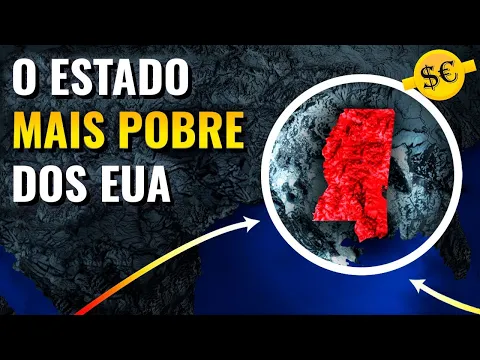
Among the fifty states that make up the United States, Mississippi stands out as a symbol of inequality, poverty, and persistent social challenges, being widely known as the poorest state in the United States.
-
Brazilian city bets on the business environment to generate jobs and attract investments in the energy sector — secretary reveals strategy at Macaé Energy 2026.

-
50 viaducts, 4 tunnels, 28 bridges, and 40 kilometers of bike paths: BR-262 in Espírito Santo will receive 8.6 billion reais for the largest engineering project in the state’s history, inspired by the Immigrant Highway in São Paulo.

-
Brazil produces too much clean energy and doesn’t know what to do with it: over 20% of solar and wind capacity was wasted in 2025 while investors flee and 509 renewable generation projects were abandoned in the last year.

-
Piauí will produce a new fuel that replaces diesel without needing to change anything in the truck’s engine and reduces pollutant gas emissions by half: truck drivers from all over the Northeast are already celebrating the news that will arrive later this decade.


Located in the southern region of the country, the state, also known as the “Magnolia State” for its iconic flowers, carries a complex and painful historical legacy. The combination of historical, economic, and structural factors has solidified its position as the poorest state in the U.S., a reality that affects millions of residents in their daily lives.

The State Was Once Very Wealthy
The state of Mississippi was once one of the wealthiest states in the United States prior to the American Civil War (1861-1865), thanks to its economy based on cotton production. During the 19th century, Mississippi was part of the so-called “Cotton Belt”, which led the world’s cotton production.
This wealth, however, was largely built on slave labor, which sustained the large plantations. The abolition of slavery, followed by the Civil War and its economic consequences, contributed to a decline in the state’s economic prosperity.
The lack of economic diversification, combined with a lag in infrastructure and education, caused Mississippi to become one of the poorest states in the U.S. in the decades that followed.
Poverty in Mississippi
In 2024, Mississippi recorded the highest poverty rate among U.S. states: 18.7% of its population lives below the poverty line, in contrast with the national average of 11.5%.
This percentage means that about 564,000 residents face deprivations that undermine their quality of life, with 8% of the population living in extreme poverty, a rate also higher than the national average of 5%. These alarming statistics reveal that the state continues to struggle to meet the basic needs of a significant portion of its citizens.
The situation is even more concerning when it comes to children. The child poverty rate in Mississippi jumped from 5% in 2021 to 12.4% in 2022.
Experts point out that the end of emergency assistance programs implemented during the COVID-19 pandemic significantly contributed to this increase. These data reflect a scenario of growing social vulnerability, where children – the future of the state – face barriers that hinder their physical, emotional, and educational development.

Food Insecurity
Poverty in Mississippi is intrinsically linked to food insecurity. In 2022, the food insecurity rate in the state was 15.3%, well above the national average of 10.4%. Some regions reach an astounding 32%, solidifying Mississippi as the hungriest state in the United States. For many families, access to nutritious and sufficient food is a daily challenge.
The average household income in the state also reflects these difficulties. In 2022, the amount was only US$ 48,610, significantly below the national average of US$ 74,580. This disparity directly impacts families’ purchasing power, making it difficult to access essential resources such as decent housing, quality education, and adequate healthcare.
Historical Inequalities of the State
The history of Mississippi is filled with events that shaped the racial and economic inequalities observed to this day. Before the American Civil War, the state heavily relied on agricultural production on plantations that employed slave labor.
After the abolition of slavery, many African Americans acquired land in the Delta region of Mississippi. However, economic crises and racist political policies resulted in the loss of these lands, exacerbating socioeconomic disparities between whites and blacks.
Today, Mississippi has the highest proportion of Black population in the U.S., representing 37.6% of its residents. African Americans face disproportionate rates of poverty, unemployment, and food insecurity, reflecting the inequality.
Health and Education of the Poorest State in the United States
Beyond poverty, Mississippi faces serious issues in the areas of health and education, fundamental sectors for the development of any society. The state has the highest infant mortality rate in the country, at 9.6 deaths per thousand births, a number that surpasses countries like Russia, Lebanon, and China.
The life expectancy in the state is the lowest in the United States, at just 71.9 years, highlighting the challenges of accessing medical care and the high prevalence of diseases such as diabetes, hypertension, and obesity.
The educational system in Mississippi also faces serious issues. Only 23.2% of the adult population holds a bachelor’s degree, compared to the national average of 37.7%. This educational deficit directly affects the state’s ability to attract industries and create well-paying jobs, perpetuating a cycle of poverty and limited opportunities.
Corruption and Mismanagement
Poverty in Mississippi cannot be dissociated from the mismanagement and corruption that have marked the state public administration. Between 2016 and 2019, the state was involved in one of the largest public funds embezzlement scandals in U.S. history.
Millions of dollars allocated to the federal Temporary Assistance for Needy Families (TANF) program were diverted to luxury projects and influential individuals while impoverished families remained underserved.
John Davis, former director of the Mississippi Department of Human Services, pleaded guilty to diverting funds for initiatives that included building a volleyball court and gym classes for public employees.
Meanwhile, program beneficiaries struggled to access resources, reflecting the disconnect between public policies and the real needs of the population.
A Cycle of Economic Challenges
Historically, Mississippi’s economy has been based on agriculture, focusing on cotton, corn, and other agricultural products. However, the excessive reliance on this sector and reluctance to invest in infrastructure and industrialization have stalled the state’s development. While other southern states thrived with the expansion of railroads and industries, Mississippi remained stagnant.
Today, the state struggles to diversify its economy. Although sectors such as forestry, catfish farming, and sweet potato production are relevant, they do not generate enough jobs to meet the population’s demand. The lack of investment in innovation and technology also contributes to Mississippi’s low economic competitiveness.
A Future Filled with Challenges
Mississippi is a clear example of how poverty, when associated with structural, historical, and administrative problems, can become a difficult cycle to break. Although efforts are being made to improve infrastructure, invest in education, and diversify the economy, the state still faces significant obstacles.
To overcome these challenges and cease to be the poorest state in the United States, a collective commitment will be necessary.
Strengthening inclusive public policies, combating corruption, and investing in health and education are essential steps for Mississippi to reverse decades of inequalities and build a more promising future for its residents.
Meanwhile, Mississippi remains a portrait of the complexities that define the United States. A country of immense opportunities, but also of deep inequalities that challenge the ideal of a truly equal nation.








Quem escreveu este artigo certamente nunca foi ao Mississippi. Não é absolutamente verdade está questão da pobreza naquele estado. Mesmo que seja o menos rico dos EUA ainda assim está anos luz dos estados mais pobres do Brasil
Concordo com você tudo no estado do Mississippi está mal mais em comparação aos Estados Unidos. Se o Mississippi ficasse no Brasil seria rico começando pela renda per Capita perto de 50 mil dólares. Por isso muita gente faz de tudo pra ir pra lá. O pobre ganha 300 mil reais. Isso está ruim? E o Brasil?
Mississipi: PIB(per capita em dólares) 47k vs SP 10k
IDH 0.893 vs 0.826
Mississipi é 4x mais rico e muito mais desenvolvido que SP.