





 Portuguese
  English
  Spanish
 5 min of reading
  28 comments





The Authorization for Oil Exploration Off the Coast of Amapá Reignites the Debate on Brazil’s Energy Future and Places the Equatorial Margin at the Center of the Country’s Economic and Environmental Attention.
The Ibama authorization for exploratory oil drilling in the Equatorial Margin, off the coast of Amapá, has reignited projections about a possible change in the Brazilian economic landscape.
The new energy frontier, according to experts, could transform the state into one of the most significant hubs in the sector and alter the balance of wealth in the country in the coming decades.
Geophysicist and science communicator Sérgio Sacani claims that studies indicate reserves with potential of up to 5.6 billion barrels of oil, a volume that, if confirmed, would be more than double the estimated reserves of the pre-salt.
-
The government requests the Federal Revenue Service for a new system to automate the income tax declaration, reducing errors, time, and bureaucracy for millions of Brazilians.

-
Pix in installments, international Pix, and contactless payment without internet: the Central Bank revealed the new features coming to the tool that is already used by almost every adult in Brazil.

-
Mercado Livre has just started selling medications with delivery in up to three hours to your door, and this move could completely change the way Brazilians buy medicines on a daily basis.

-
In Dubai, rising tensions from the war in the Middle East are causing super-rich individuals to leave the Gulf and direct their fortunes to a new financial refuge in Asia.

He assesses that the Equatorial Margin “could redefine Amapá’s role in the national economy,” provided that geological data is positive and operations advance sustainably.
Pre-Salt Decline Opens Space for New Oil Frontiers
The National Agency of Petroleum, Natural Gas and Biofuels (ANP) had already warned that pre-salt production is expected to start declining from 2027, which reinforces the search for new exploratory areas.
The ANP’s Director-General, Rodolfo Saboia, recently reiterated that diversification of the production matrix is essential to maintain the country’s energy self-sufficiency.
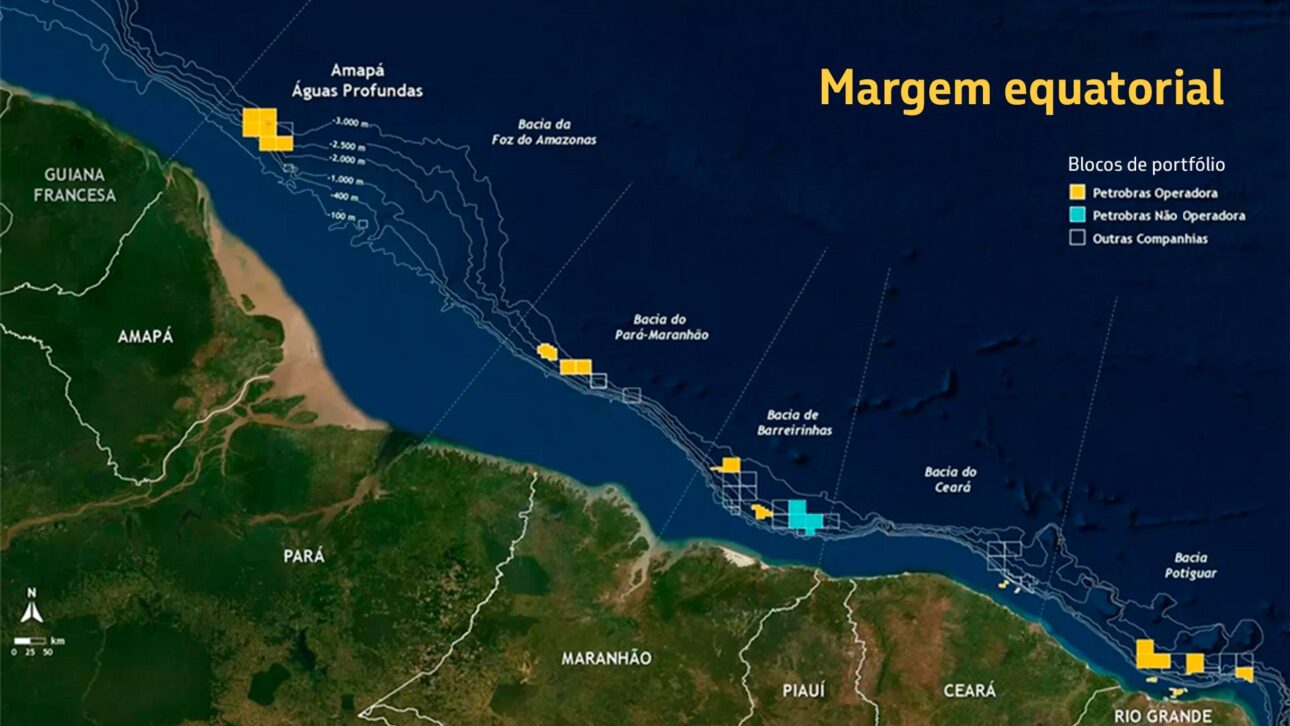
In this context, the Equatorial Margin, a strip from the coast of Amapá to Rio Grande do Norte, has become Petrobras’ main bet to compensate for the expected decline of pre-salt.
The company began drilling the first exploratory well in block FZA-M-59 on October 21, 2025, located about 175 kilometers off the coast of Amapá, in deep waters.
The drilling is expected to last about five months and aims to identify the presence of commercially viable reserves.
This phase does not involve oil extraction or commercial production yet.
Environmental License Marks New Phase for Amapá
Until 2024, drilling was halted due to environmental impasses.
With the authorization issued by Ibama on October 20, 2025, Petrobras commenced operations under a set of strict environmental conditions.
The agency required emergency plans and continuous monitoring of fauna and water quality, due to the sensitivity of the ecosystems near the mouth of the Amazon River.
The start of activities represents a significant change for Amapá, according to economists in the energy sector.
The state, which has one of the least diversified economies in the country, may benefit from royalties, special participations, and taxes if the exploration proves economically viable.
Economic Potential and Environmental Risks of the Equatorial Margin
According to experts consulted by universities and Petrobras itself, the oil from the Equatorial Margin has light characteristics, which reduces refining costs and increases potential financial returns.
However, effective commercial exploitation will depend on the results of the drilling and a new round of licensing specific for production, which may take up to ten years.
The Energy Research Company (EPE) estimates that the complete cycle—from the start of exploration to effective production—may last between seven and ten years, provided the results are positive.
Thus, even in a favorable scenario, the first barrel produced in the region would only reach the market in the 2030s.
Environmentalists, on the other hand, remain concerned about the impacts on sensitive areas.
Entities affirm that the risk of accidents and leaks must be permanently monitored, as the region hosts complex ecosystems such as mangroves and the Amazon reef.


Petrobras Investments and Next Steps
Petrobras expects to invest US$ 3 billion between 2025 and 2029 in the Equatorial Margin, drilling up to 15 exploratory wells during this period.
The aim is to enhance geological knowledge of the basin and confirm the productive potential of the region.
The state-owned company reported that the work is being conducted with “the most rigorous practices of safety and environmental protection.”
The first well in FZA-M-59 will serve as a reference for future drilling campaigns.
If the results are positive, the company will need to request new licenses for the development and production phase.
Logistical and Infrastructure Challenges in Amapá
Despite the progress in exploration, energy and logistics experts point out that the region still lacks adequate infrastructure to support large-scale operations.
Amapá does not have specific port bases nor offshore support centers on a scale compatible with the major production hubs in the Southeast.
Analysts emphasize that the development of the production chain and local workforce will be essential to ensure that the state benefits directly from investments.
Without this structure, part of the operation may end up concentrated in other regions with better logistical capacity.
Fiscal and Strategic Impacts for Brazil
The EPE and the ANP assess that the Equatorial Margin could help Brazil maintain its energy self-sufficiency and reduce oil imports in the long term, especially if the pre-salt confirms the anticipated rate of decline.
In addition to royalties, the new hub could increase tax revenue and generate indirect effects on the national economy.
For sector analysts, the advancement of the Amazon frontier is also strategic from the standpoint of energy sovereignty, as it diversifies production sources and reduces dependence on a single province.
Comparison with São Paulo and Economic Perspectives
The possibility of Amapá surpassing São Paulo in wealth, mentioned in public debates and by experts, is considered remote in the short term.
São Paulo has the highest GDP in the country and has a diversified economy supported by industry, services, and technology.
However, economists argue that the exploration of the Equatorial Margin could place Amapá at a different level of development.
If production materializes and the resources are invested in infrastructure, education, and innovation, the state could reduce inequalities and increase its share of national GDP.
A New Cycle for the Brazilian Oil Industry
The discovery and initiation of drilling in Amapá inaugurate a new stage for the oil and gas industry in Brazil.
For experts, this is a milestone comparable to the start of pre-salt in 2006, with potential to reposition the country in the global energy market.
The success of the Equatorial Margin will depend on balancing economic development, environmental responsibility, and regulatory stability.
The challenge lies in whether Amapá will be able to transform exploratory advancement into sustainable prosperity and whether the new energy frontier will be sufficient to keep Brazil among the industry’s powers.








Esquecido?
Tem três Senadores com musculatura política, um deles é íntimo do STF e outro presidente do Senado….
Muito dinheiro é transferido para o Amapá e muito também é desviado.
Ao ponto de não existir uma ligação física com o Brasil, mas sim com a vizinha Guiana……
Fica nada! Enquanto PT governor esse país, so iremos pra trás! Não administratam bem, só roubam tudo é enfiam no cool de quem já é rico.
O BRASIL ENTREGOU DE GRAÇA O PRÉ SAL, E AGORA QUER FAZER PROSPECÇÃO EM ÁREAS AMBIENTAIS!
O Pré-sal, se é que está acabando,ocorre porquê foi loteado DE GRAÇA para o mundo todo explorar. Assim não tem petróleo que chegue. Mas lembro muito bem de que esse papo de que iria baixar a produção não existia antes de privatizar em tudo e o que se dizia é que eram as maiores reservas de petróleo do mundo!
Tomara que o Brasil não abra as pernas novamente e entregue novamente esse novo potencial para as empresas estrangeiras como fez com o pré-sal.
Espero que esse povo equino do Brasil não vote novamente em outro entreguista e hitlerista, como fez com o Bolsonaro e o Temer.