





 Portuguese
  English
  Spanish
  4 min of reading
  0 comments


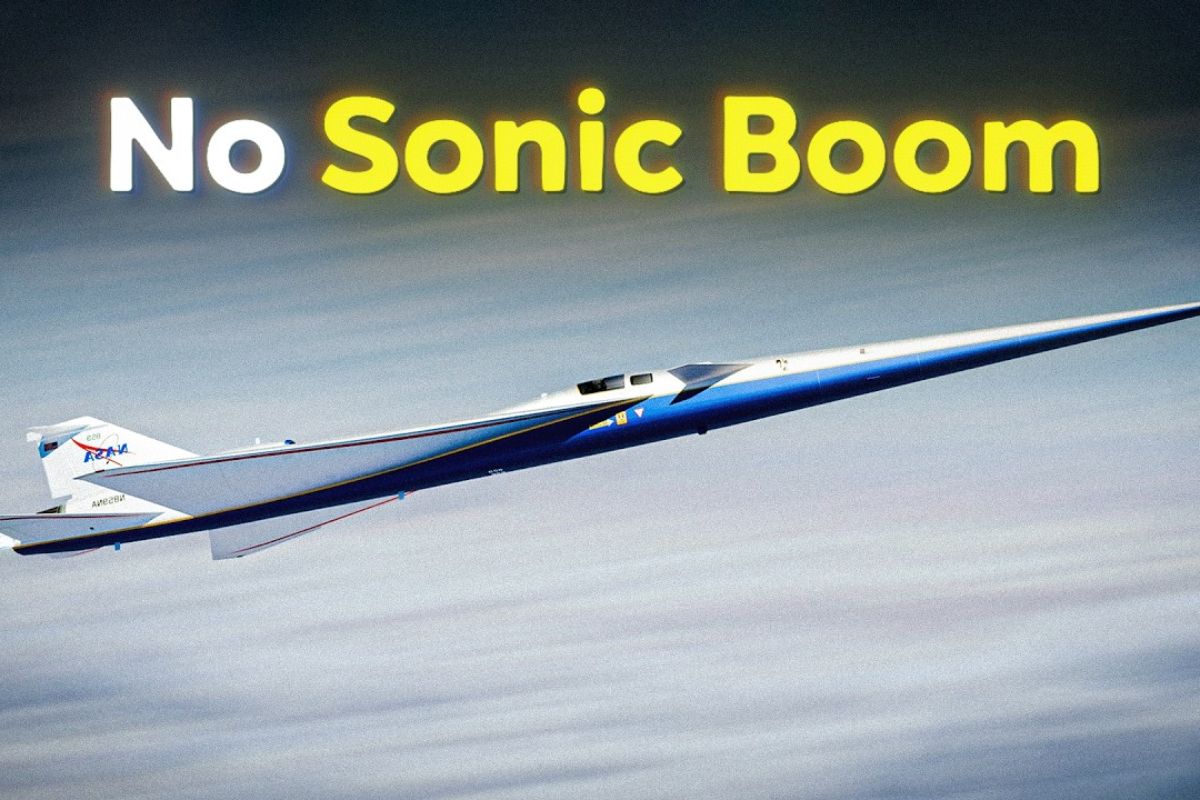
With Innovative Design, The Most Advanced Airplane In The World Was Created To Fly Above The Speed Of Sound With Noise Comparable To The Slam Of A Car Door
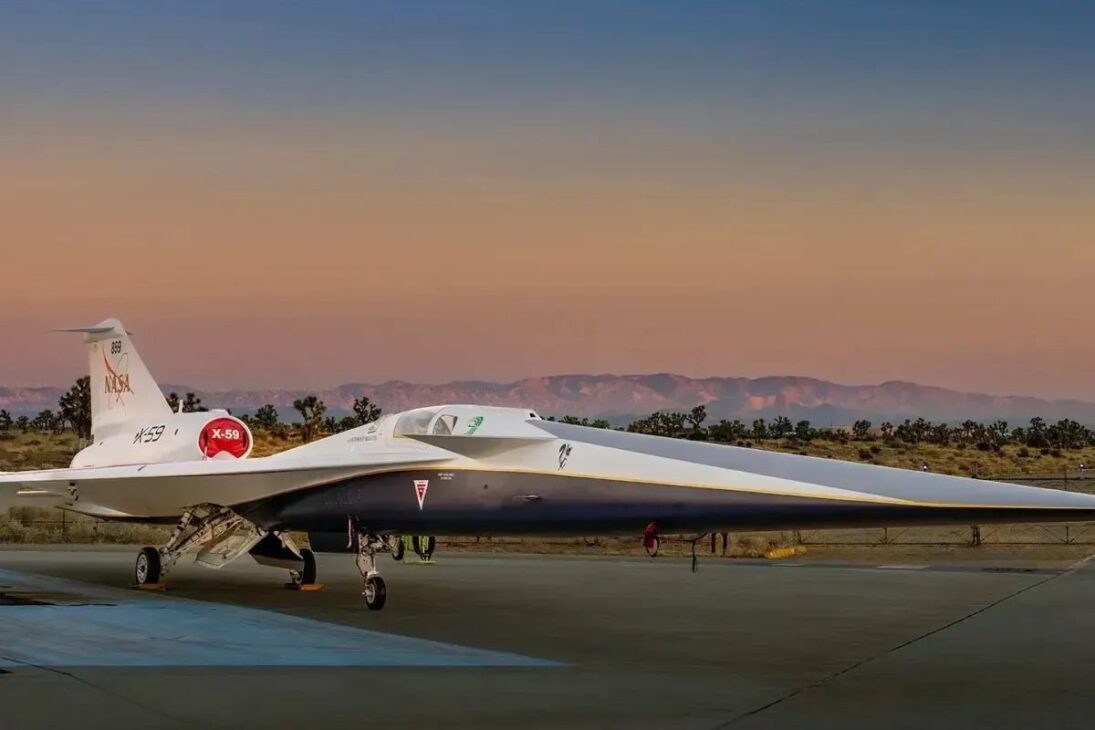
The most advanced airplane in the world, the X-59, is NASA’s bet to reinvent supersonic aviation without the sonic booms that limited the flight of the legendary Concorde. The result of decades of research, the project combines extreme aerodynamics, computational intelligence, and ultra-light materials into a unique structure, with an 11-meter nose, no front windows, and an engine mounted on the fuselage.
The goal is to solve one of the greatest challenges in aerospace engineering: to eliminate the sonic boom, the explosive noise that accompanies any aircraft when it surpasses the sound barrier. With the X-59, NASA aims to prove that it’s possible to travel at over 1,600 km/h without disturbing those on the ground, a milestone that could transform how the world connects.
The Problem Of The Sonic Boom
Since 1947, when Chuck Yeager first broke the sound barrier, engineers have tried to control the acoustic impact accompanying supersonic flight.
-
A new AI collar technology for cattle eliminates physical fences, creates virtual barriers, monitors animals 24/7, and detects changes in behavior and health.

-
For a few weeks each year, an entire country blooms with billions of tulips, creating a mosaic of colors visible from the sky, while a single garden gathers more than 7 million flowers and attracts visitors from around the world to one of the most impressive shows in Europe.

-
Bokashi, a Japanese technique of controlled fermentation, becomes the organic fertilizer that revitalizes the soil: it activates microorganisms and earthworms, improves pH and moisture retention, gradually releases nutrients, and helps prevent pests in the garden.

-
Archaeologists found giant shoes over 30 centimeters near Hadrian’s Wall that survived nearly two thousand years buried and now raise a mystery: who were these Roman soldiers so different from the others?

The phenomenon known as sonic boom is caused by shock waves that form around the aircraft and merge into a single explosive noise.
The noise can exceed 100 decibels, equivalent to a thunderclap, and has been the cause of complaints, broken windows, and flight bans over populated areas for decades.
The Concorde, the ultimate symbol of that era, combined elegance and power by crossing the Atlantic in just over three hours. But its glory was short-lived.
The high operational costs and deafening noise made the model unviable on land routes. After the 2000 accident, the world witnessed the supersonic dream fade away.
Until the most advanced airplane in the world, the X-59, reignited that ambition.
The Engineering Behind The X-59
To create a silent supersonic jet, NASA had to completely redefine the concept of aircraft design.
The key was to understand how shock waves form and interact.
With the help of supercomputers and high-precision wind tunnels, engineers discovered that by elongating and redistributing the fuselage, it was possible to spread the waves and reduce their impact on the ground.
The result was a structure of unprecedented proportions.
The X-59 has an 11-meter nose, nearly a third of its total length, that shapes the air like a blade, smoothing the shock waves.
The engine is positioned above the fuselage, which helps deflect sound away from populated areas. Every detail was digitally simulated and adjusted with margins of error in millimeters.
An Airplane Without Windows And With Electronic Vision
The radical shape of the most advanced airplane in the world presented an unusual challenge: the pilot cannot see what is ahead.
The solution came from an external vision system (XVS) made up of high-definition cameras and optical sensors that project a forward view on screens inside the cockpit.
It acts as a digital windshield, capable of providing more information than human vision during supersonic flight.
Should the system fail, the X-59 has redundant data and side windows to ensure a safe landing.
This combination of automation and redundancy represents the future of piloting, where artificial intelligence and sensors replace direct vision without compromising safety.
Precision Assembly At The Legendary Skunk Works
The construction of the X-59 takes place in one of the most secretive locations in aviation, the Skunk Works of Lockheed Martin in Palmdale, California.
Each part is made with ultra-light composite materials and cut with lasers, as any imperfection could reactivate the boom that engineers want to eliminate.
With only one prototype in existence, the airplane has been undergoing ground tests and calibration since 2024.
The engine, derived from an F-18 Hornet, has been modified to achieve Mach 1.4, around 1,600 km/h, and has successfully passed static tests.
The next step is the inaugural flight, scheduled for the end of 2025, when it will be assessed whether the X-59 truly fulfills its promise of supersonic silence.
Public Testing And The Future Of Supersonic Flight
The flight tests will occur at the Edwards Air Force Base in the California desert, the only location authorized for such experiments.
NASA plans to conduct noise measurements in neighboring communities without prior notice, seeking spontaneous reactions to the sound or its absence.
The expected noise is only 75 decibels, similar to the closing of a car door.
If the result is positive, the X-59 could change the rules of global aviation.
The final report will be presented to the International Civil Aviation Organization (ICAO) and the FAA by 2027, aiming to allow the return of supersonic flights over land areas.
This would mean, for example, reducing the time between New York and Los Angeles from 5 hours to just over 2.5 hours, without broken windows, complaints, or scares.
A Leap Into The Future Of Aviation


The most advanced airplane in the world is not just a technological experiment, but a rehearsal for the future of global transport.
If the X-59 proves that it is possible to break the sound barrier discreetly, it will pave the way for a new generation of commercial aircraft capable of shortening distances without increasing environmental or noise impact.
The project shows that innovation is not just in speed, but in the harmony between progress and coexistence.
And perhaps, with the X-59, humanity is about to reclaim the dream of crossing the world in a few hours, this time without the boom that scared generations.
What about you? Do you believe that supersonic flights will become part of our daily lives in the coming years?







-

-

-

3 pessoas reagiram a isso.