





 Portuguese
  English
  Spanish
  6 min of reading
  0 comments


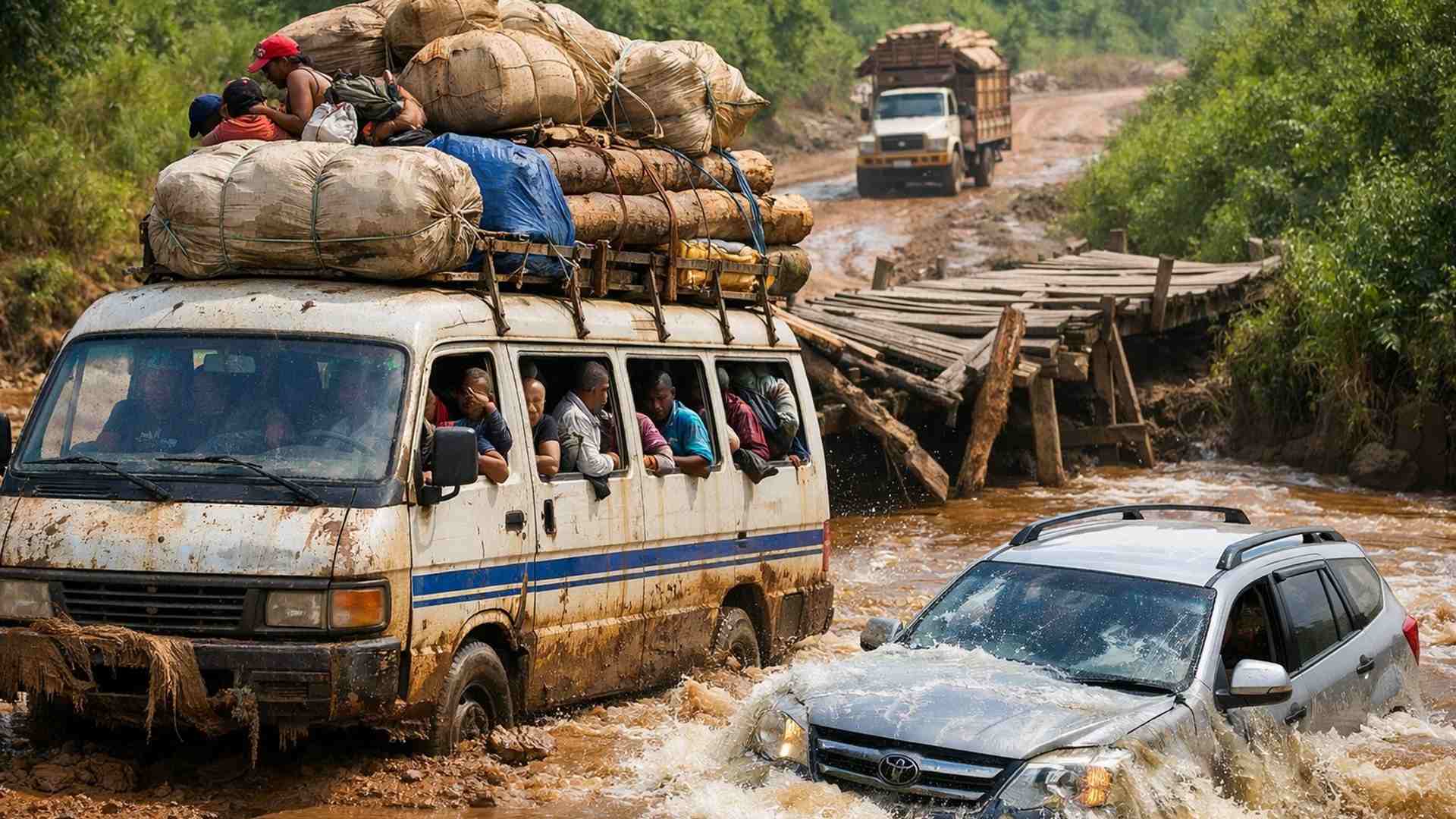
The National Road N5, with about 250 kilometers of dirt between Marranchesh and Tamatave, concentrates overloaded transport, unimproved ferries, rosewood smuggling, artisanal sapphire mining, and daily risks that shape the informal economy and the survival of thousands of residents in Madagascar
The National Road N5 in Madagascar connects Marranchesh to Tamatave over about 250 kilometers of dirt track and concentrates overloaded transport, illegal logging, artisanal mining, and precarious crossings, affecting thousands of people and conditioning the local economy to daily survival.
The N5 as a Axis of Mobility and Permanent Risk
The N5 is one of the most difficult routes in Madagascar and can only be traversed by four-wheel-drive vehicles. The path connects isolated communities to the main port on the eastern side of the country but imposes frequent delays, mechanical breakdowns, and constant risks to passengers.
Without structural maintenance since independence over 50 years ago, the road alternates between deep potholes, mud, makeshift bridges, and flooded sections. At several points, passage depends on artisanal ferries or direct crossings of rivers, with vehicles entering the water up to the engine level.
-
He started running at 66 years old, broke records at 82, and is now a subject of study for having a metabolic age comparable to that of a 20-year-old, in a case that is intriguing scientists and inspiring the world.

-
Oldest tree on the planet reappears after 130 years of searches: Wattieza, 385 million years old, was 10 meters tall and had no leaves or seeds; Gilboa fossils in New York solved the mystery in 2007.

-
A 48-square-meter house assembled in hours with 4,000 bricks made of recycled plastic that does not absorb moisture, has natural thermal insulation, and costs less than 90,000 reais in a complete kit.

-
Luciano Hang revealed that Havan’s air fleet has already accumulated more than 20,000 landings, 10,000 flight hours, and 6 million kilometers traveled, and he says that without the planes, the company would never have grown so quickly.


Drivers start their journeys before dawn to avoid the intense heat. Even so, the journey can take several days. Any technical failure turns the path into an indefinite wait since there are no tow trucks, structured workshops, or state support along the route.
Improvised Public Transport and Daily Overcrowding
The shared taxi is the main means of transport along the N5. Vehicles designed for 15 passengers often carry 19 or 20 people, along with luggage and various loads. Each additional kilogram compromises the suspension and increases the risk of getting stuck or mechanical failure.
Passengers squeeze in as best they can, many in the rear compartment, using ropes to hold on during the most unstable sections. Some pay more for cushioned seats, but discomfort is widespread and constant motion sickness is part of the journey.
Stops for vomiting are common, and in some cases, passengers give up the trip within the first few hours. Nonetheless, demand remains high since the road is practically the only regular connection between villages and urban centers in the region.
Delays are accepted as part of the process. When accidents occur, such as submerged engines or impassable bridges, passengers themselves help push vehicles, dig detours, or wait hours until an improvised solution is found.
Degraded Infrastructure as an Indirect Containment Policy
According to local authorities, the precarious state of the N5 is not merely a result of neglect. The lack of work also serves as a mechanism to hinder the transport of precious wood, especially rosewood, illegally harvested from the forests of eastern Madagascar.
The justification is that a well-maintained road would allow the use of large trucks, accelerating smuggling. In practice, however, road degradation affects the entire population, makes products more expensive, limits services, and economically isolates the region.
Wooden bridges have never been fully rebuilt, and some show visible movement under the weight of vehicles. Drivers report falling passengers on previous crossings, resulting in serious injuries and long delays in travel.
In several sections, crossing rivers has become the least risky alternative. To reduce weight, passengers get off the vehicles, which then go alone through the water, often with the engine partially submerged and a high risk of total failure.
Illegal Logging of Rosewood and Accumulated Environmental Impact
Along the N5, illegal rosewood exploitation is one of the main informal economic activities. The logs, highly valued in the international market, can weigh up to 500 kilograms and require days of manual transport in steep and slippery terrain.
The extraction occurs within remaining forests and involves cutting down trees that take more than 100 years to grow. To fell a single marketable log, other trees are often cut down to clear the fall or make way.
Local estimates indicate that for every 100,000 precious trees harvested, about 500,000 others are indirectly sacrificed.
The process accelerates environmental degradation and drastically reduces forest cover in already pressured areas.
Former forest guards are among those involved. After losing formal jobs, many turned to smuggling due to a lack of alternatives. A single log can yield up to $5,000, a sum sufficient to support a family for four to six months.
Extreme Journeys and Risk of Death in Wood Transport
Transporting rosewood to the rivers can take more than 30 hours of continuous effort. The logs are tied with long ropes and pulled by groups of barefoot men along steep trails where any mistake can be fatal.
On steep descents, the log can gain speed and crush anyone in front. Local reports confirm recurring deaths during the process, although there are no consolidated official records on the number of annual victims.
When someone dies, the body is prepared in an improvised manner and sent to the family. The transportation is done in rice sacks due to the distance and the absence of funeral services in the most remote forest areas.
After reaching the river, the wood is transported in makeshift rafts made from air chambers. Currents have already caused drownings, and the pilots control the descent with fragile paddles or with their hands, depending on the situation.
Artisanal Sapphire Mining and Economy of Hope
Besides wood, artisanal sapphire mining attracts thousands of people to southern Madagascar. Regions like Ilakaka and Ensoa have emerged rapidly, concentrating over 10,000 inhabitants in conditions of extreme precariousness.
The allure is the possibility of finding a stone valued at up to $5,000 or $6,000, more than 40 times the national average salary. Most, however, earn less than two dollars a day working for mine owners.
Families live in huts of about five square meters, sharing a single cooking utensil and without beds. The money earned is rarely saved, being quickly spent on food and immediate needs.
The excavations reach depths of 30 meters, with tunnels up to 60 centimeters high. Temperatures reach 40 degrees, oxygen is scarce, and there are no adequate ventilation systems, increasing the risk of collapse and asphyxiation.
Subterranean Work, Improvisation, and Frequent Accidents
Mining requires extreme physical effort. Workers spend hours digging and transporting bags of earth, often until nightfall. Tools break frequently and are replaced with improvised solutions.
Ventilation depends on simple tubes that do not always reach the deeper areas. When air runs low, miners ask for water or stop working, but they do not always manage to get out in time in case of an emergency.
Collapses are common and have already caused multiple deaths. Even so, the activity continues to attract new workers, driven by the expectation of finding a single stone capable of completely changing their living conditions.
Religious belief is central. Many attribute success or failure to divine will, reinforcing persistence in work despite known risks and the low probability of finding a high-value sapphire.
The N5 as a Symbol of Structural Isolation
The N5 synthesizes the dilemmas of Madagascar. While connecting strategic regions, it exposes the population to constant insecurity and conditions the local economy to informal and dangerous activities.
The absence of investment in infrastructure limits tourism, increases the cost of transporting food and medicine, and reinforces dependence on illegal practices. The road functions as a logistical bottleneck and as a boundary between survival and collapse.
Even after delays of over 36 hours, passengers rarely demand compensation. The collective understanding reflects the normalization of risk and the lack of viable alternative transport options across much of the territory.
Amid broken bridges, rivers without safe crossings, and overloaded vehicles, the N5 remains a vital route and, at the same time, a portrait of the structural fragilities of the country and the daily journey of its population.








-

-

-

8 pessoas reagiram a isso.