





 Portuguese
  English
  Spanish
  3 min of reading
  0 comments


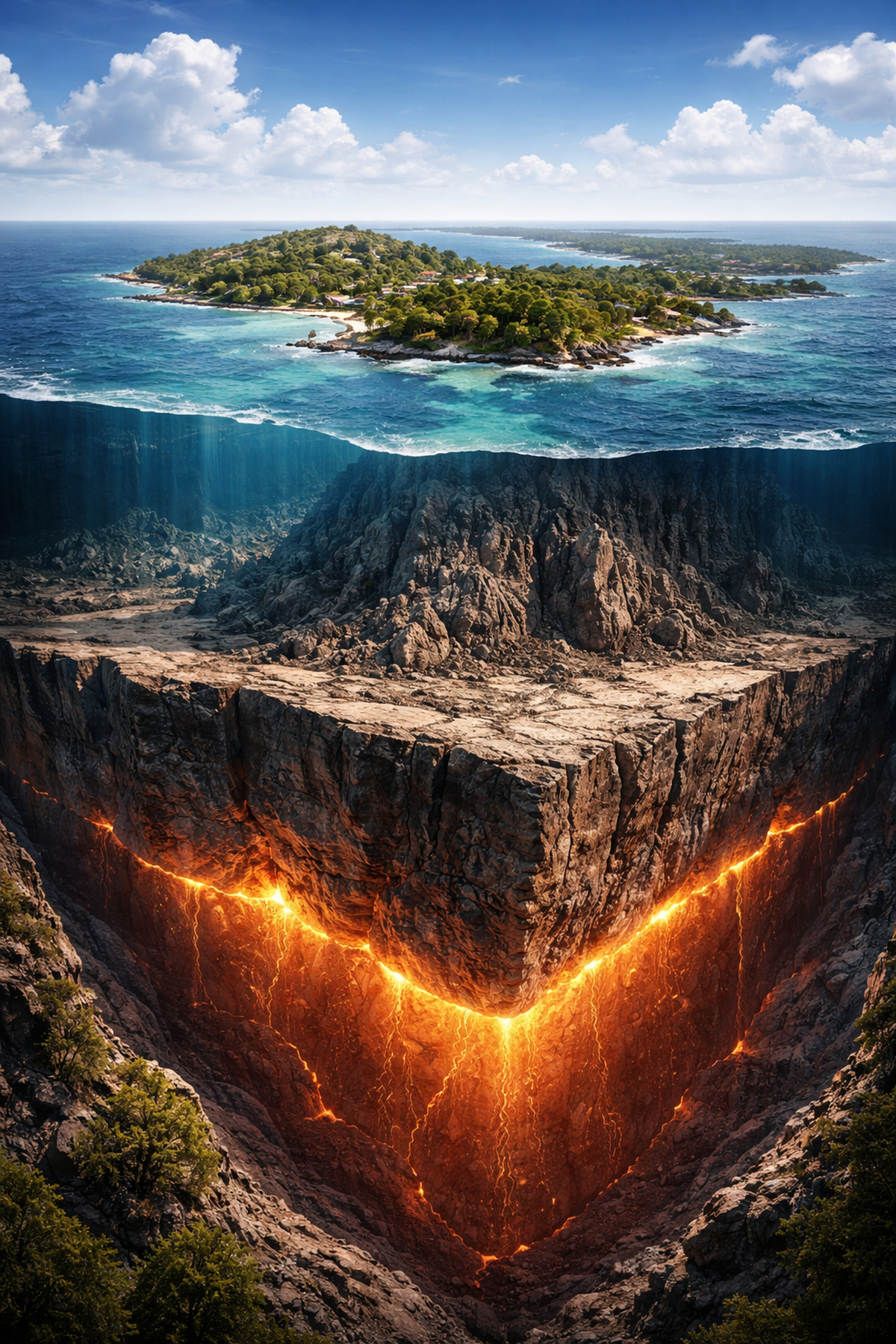
Seismic Research Reveals A Unique Geological Structure Beneath Bermuda Capable Of Supporting The Islands Above The Ocean Even After More Than 30 Million Years Without Active Volcanism
A significant scientific discovery has provided new answers to one of the most well-known enigmas of the North Atlantic. Scientists have identified a giant and unprecedented geological structure beneath Bermuda. This base supports the archipelago above the expected ocean level. Thus, even after more than 30 million years without volcanic activity, the islands remain elevated.
Researchers from Yale University in the United States conducted the study. The scientific journal Geophysical Research Letters published the findings. The data indicates an extra layer of rock approximately 20 kilometers thick. This formation is located below the oceanic crust and within the tectonic plate where the Bermuda Islands are situated.
In general, the oceanic crust rests directly atop the Earth’s mantle. However, in Bermuda, this pattern does not occur. Scientists found an intermediary layer between the crust and the mantle. No other region on the planet has shown a similar configuration. Therefore, this case stands out in geology.
-
Motorola launched the Signature with a gold seal from DxOMark, tying with the iPhone 17 Pro in camera performance, Snapdragon 8 Gen 5 that surpassed 3 million in benchmarks, and a zoom that impresses even at night.

-
Satellites reveal beneath the Sahara a giant river buried for thousands of kilometers: study shows that the largest hot desert on the planet was once traversed by a river system comparable to the largest on Earth.

-
Scientists have captured something never seen in space: newly born stars are creating gigantic rings of light a thousand times larger than the distance between the Earth and the Sun, and this changes everything we knew about stellar birth.

-
Geologists find traces of a continent that disappeared 155 million years ago after separating from Australia and reveal that it did not sink, but broke into fragments scattered across Southeast Asia.

Seismic Identification Reveals Unprecedented Structure
To reach these conclusions, the researchers analyzed seismic waves from major earthquakes in various regions of the world. Using these records, they generated detailed images of the rocks. The images show materials about 50 kilometers below the Bermuda Islands.
The data reveal a layer of rock that is extremely thick and less dense than the surrounding material. This characteristic indicates that the formation acts as a geological platform. In this way, it supports the oceanic elevation where the archipelago is located.
According to William Frazer, one of the study’s authors, the configuration deviates from the known pattern. “Normally, the base of the oceanic crust appears and, right below it, the mantle emerges,” he explained. “In Bermuda, however, there is another layer within the tectonic plate itself.”
Volcanic Remnant Has Supported The Islands For Millions Of Years
The scientists point to this intermediary layer as the remnant of ancient volcanic material. It formed during the last phase of volcanic activity in the region. Over time, the material solidified. Thus, it began to function as a structural base for the islands.
The geologist Sarah Mazza reinforced this interpretation in a statement to Live Science. According to her, there is still material from the period of active volcanism beneath Bermuda. This remnant helps maintain the region as a high-relief area in the Atlantic Ocean.
Bermuda Triangle And Natural Explanations
Historically, the Bermuda Triangle has concentrated reports of mystery. The region lies between the United States, Bermuda, and Puerto Rico. Throughout the 20th century, stories reported the disappearances of ships and aircraft. Many also cited failures in navigation instruments.
However, scientists explain that the location gathers intense natural phenomena. Fast tropical storms, strong ocean currents, and the possibility of giant waves frequently occur. These factors explain many of the recorded episodes.
Next Steps In The Research
Now, the researchers plan to analyze other oceanic islands around the world. They want to see if similar structures appear in other parts of the planet. Otherwise, the Bermuda Islands may represent a truly extreme phenomenon.
As highlighted by William Frazer, understanding the formation of Bermuda helps differentiate common geological processes from rare events.
This advancement broadens understanding of the Earth’s deep dynamics — but how many other islands still hide structures capable of challenging what science knows today?








-

Uma pessoa reagiu a isso.