





 Português
  Inglês
  Espanhol
  3 min de leitura
  0 comentários


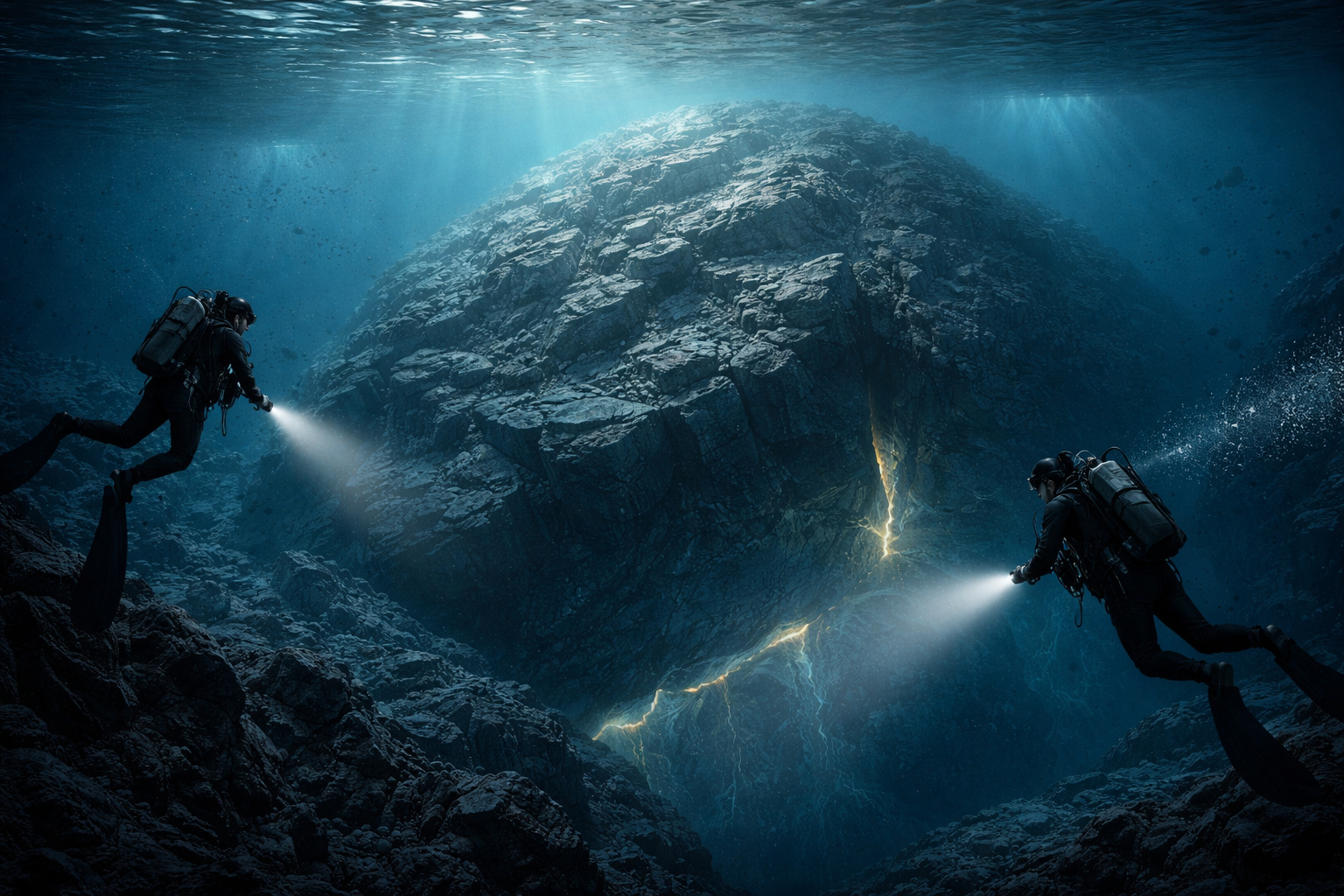
Recent Study Identifies Previously Unknown Rock Formation, Alters Explanations About the Elevation of Bermuda and Broadens Knowledge About Deep Earth Processes
A significant scientific discovery was announced in November 2025, attracting international attention to the region known as the Bermuda Triangle. Researchers identified a massive and unusual rock structure, located beneath the oceanic crust near the island of Bermuda in the North Atlantic. The finding was presented in a study published in the scientific journal Geophysical Research Letters, led by William Frazer from Carnegie Science and Jeffrey Park from Yale University. Since then, the discovery has begun to reorganize established interpretations regarding the geological formation of the area.
The analysis revealed a rock layer about 20 kilometers thick, positioned between the oceanic crust and the Earth’s mantle. This configuration, according to the authors, has no parallel in any other known region of the planet, which immediately sparked interest in the scientific community.
Seismic Readings Reveal Previously Unknown Layer Beneath Bermuda
The identification of the structure occurred primarily through the analysis of seismic waves generated by distant earthquakes, recorded by a station set up in Bermuda. As these waves pass through different materials, they undergo changes in speed and trajectory. Based on these variations, researchers managed to map the underground down to about 50 kilometers deep.
-
Found in one of the most radioactive places on Earth, this Chernobyl fungus may be doing something with radiation that no one has been able to explain to this day.

-
A bright yellow mushroom imported from Asia escaped from a cultivation farm in the United States in 2010 and is now aggressively spreading across 25 states, destroying entire communities of native fungi in American forests.

-
Buried under China, a colossal machine weighing 20,000 tons began operating as the largest neutrino detector on the planet and, in just 59 days, surpassed results that science took half a century to achieve.

-
Iran enters the center of a climate alert after the war emitted 5.6 million tons of CO2 in two weeks, surpassing the annual pollution of entire countries.


The data indicated the presence of a layer less dense than expected, located beneath the oceanic crust. This result surprised scientists, as the thickness and composition of the formation completely diverge from traditional geological models used to explain isolated oceanic islands.
Structure Helps Explain Persistent Elevation of the Island
The discovery sheds new light on an old geological enigma. Bermuda remains elevated relative to the ocean floor, despite not having volcanic activity for approximately 31 million years. Under normal conditions, islands of this type tend to gradually sink when they are no longer fed by magma from hot spots in the mantle.
However, the research suggests that this thick layer of rock acts as a structural support, helping to maintain the island’s elevation. Indirectly, this formation serves as an element of geological buoyancy, keeping Bermuda above the expected level for the local oceanic crust.
Relationship with Ancient Earth Processes
Additionally, scientists point out that the origin of the structure may be linked to very ancient geological events. Geochemical evidence indicates a connection with processes associated with the formation and fragmentation of the supercontinent Pangaea, which occurred between approximately 900 million and 300 million years ago.
Previous studies on lavas from the region had already suggested an unusual composition, compatible with materials originating from deep layers of the Earth’s mantle. Now, the new seismic analysis reinforces this hypothesis, connecting Earth’s deep geological past to the current configuration of the North Atlantic.
Scientific Impact and Next Steps
The discovery significantly alters the understanding of how oceanic islands can form, evolve, and remain elevated over millions of years. Therefore, the authors of the study indicate that new investigations will be conducted on other oceanic islands to verify whether similar structures exist in different parts of the planet.
This advancement broadens knowledge about the Earth’s internal dynamics and demonstrates how deep processes can influence the surface over extensive geological timescales.
In light of this scenario, to what extent can discoveries like this transform the current models used to explain the evolution of oceans and islands around the world?







-

-

4 pessoas reagiram a isso.