





 Portuguese
  English
  Spanish
  3 min of reading


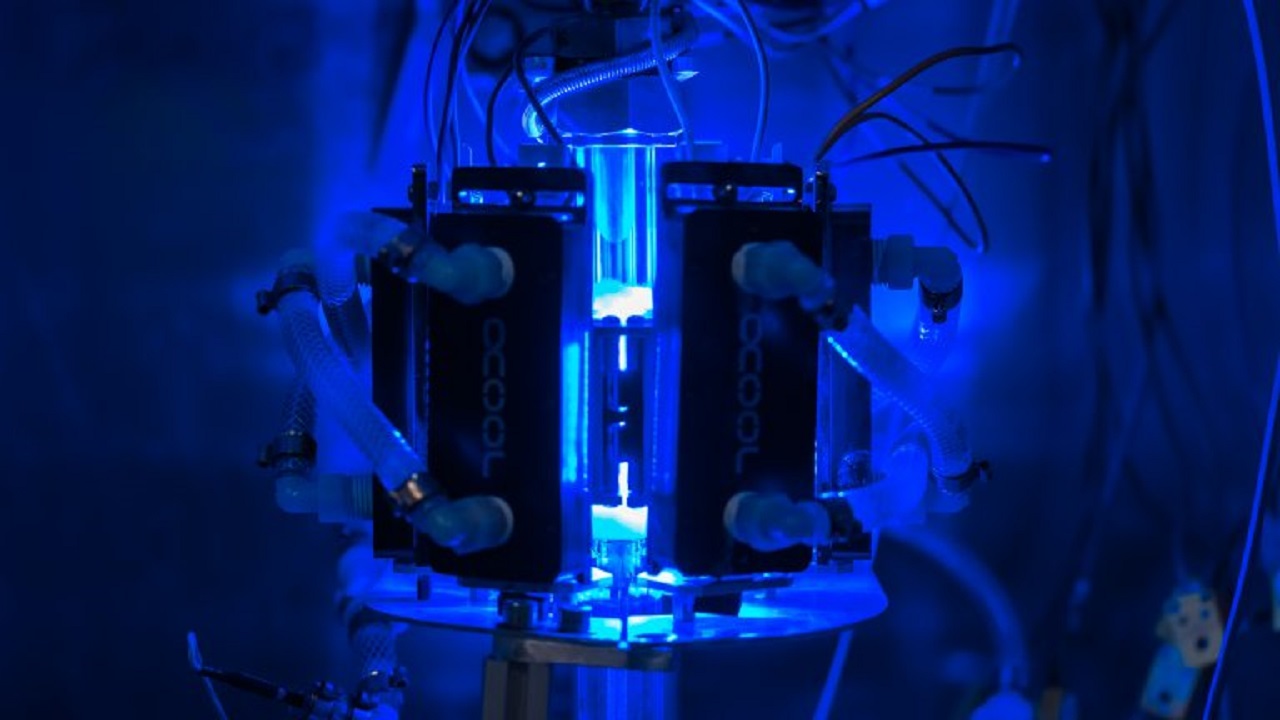
Students Develop Catalyst That Uses LED Light for Green Hydrogen Production. The Technology Uses Low-Cost Materials.
Students have developed a new catalyst made only from low-cost and commercially available materials, using only the power of LED light to transform ammonia into green hydrogen, the clean fuel of the future. This is the second innovation in the segment within a few months; however, the work of Yigao Yuan and colleagues from Rice University in the US is the closest to commercial use compared to hydrogen production through photocatalytic water splitting, recently presented by a team of students from the University of Vienna in Austria.
Tests Show 500 Times Greater Efficiency with LED Use
Yuan and other students developed a photocatalyst made with copper and iron, replacing the expensive ruthenium, a noble metal from the platinum group. After testing the functioning of photocatalysis in the laboratory using lasers, the team was able to replicate the feat using reactors illuminated by LEDs, which are already being sold on the market.
The tests conducted by the students show that the catalysts maintained their efficiency under LED illumination and on a scale 500 times greater compared to the laboratory setup. According to Naomi Halas, professor and coordinator of the team, transition metals, such as iron, are generally poor thermocatalysts, therefore, this study with green hydrogen shows that they can be efficient plasmonic photocatalysts, and it also demonstrates that photocatalysis can be efficiently performed with low-cost LED photon sources.
-
The Himalayas continue to grow to this day, with tectonic plates advancing 5 cm per year, mountains rising up to 10 mm annually, and the 2015 earthquake that killed 9,000 people may have increased the risk of an even larger seismic mega-event.

-
At an altitude of 400 km by astronauts from the International Space Station, Paris transforms at night into a golden mesh so precise that it reveals the outline of the Seine River, avenues, and entire neighborhoods like a luminous map drawn over the Earth.

-
iPhone 17 reaches historic low price with 256 GB, 120 Hz display, and drops to R$ 5,703 on Shopee, featuring A19 chip, dual 48 MP cameras, battery life of up to 30 hours, and advanced AI features.

-
Trip to Mars getting closer: Pulsar Fusion, from the UK, advances with plasma ignition in fusion engine and could drastically reduce space travel time, making crewed missions faster, safer, and economically viable.
The best thermocatalysts are made from platinum and precious metals from the same group, such as palladium, ruthenium, and rhodium. However, the students have been focusing for several years on light-activated metallic nanoparticles, or plasmonic nanoparticles. This name comes from surface plasmons, a kind of electricity generated by light on the surface of metals.
Replacement of Precious Metals with Common Metals
Although the best plasmonic photocatalysts are also made with rare metals, such as gold and silver, the team has discovered that plasmonic nanoparticles emit short-lived, high-energy electrons, known as hot carriers, which led to the generation of hybrid particles, combining plasmonic nanoparticles with catalytic nanoparticles, creating what the students call antenna-reactors, as the particles capture light from the LEDs as if they were an antenna, and use their energy to generate chemical reactions with high precision.
Now, the team has managed to replace rare metal catalysts with cheaper metals, building antenna-reactors with copper and iron particles, demonstrating that they are highly efficient in producing green hydrogen from ammonia, a highly available chemical compound used by the chemical industry.
Decentralized Green Hydrogen Generation
The significant step in transforming this discovery from a laboratory curiosity into a practical application came when the results were replicated in common reactors illuminated by LEDs. According to Naomi, this is the first report capable of showing that photocatalysis with LEDs can generate gram-scale quantities of hydrogen gas from ammonia, which could pave the way for a complete replacement of precious metals in plasmonic photocatalysis.
Although the team is excited that it will be possible to scale up the technology from grams to tons, the concept is already interesting for decentralized hydrogen fuel generation using low-cost, small reactors.
According to team member, Professor Peter Nordlander, this discovery paves the way for sustainable, low-cost hydrogen that can be produced locally instead of in large centralized plants.
Source: Article: Earth-abundant photocatalyst for H2 generation from NH3 with light-emitting diode illumination








Seja o primeiro a reagir!