





 English
  Francês
  Alemão
  Italiano
  Japonês
  Norueguês
  Portuguese
  Spanish
  4 min of reading
  0 comments


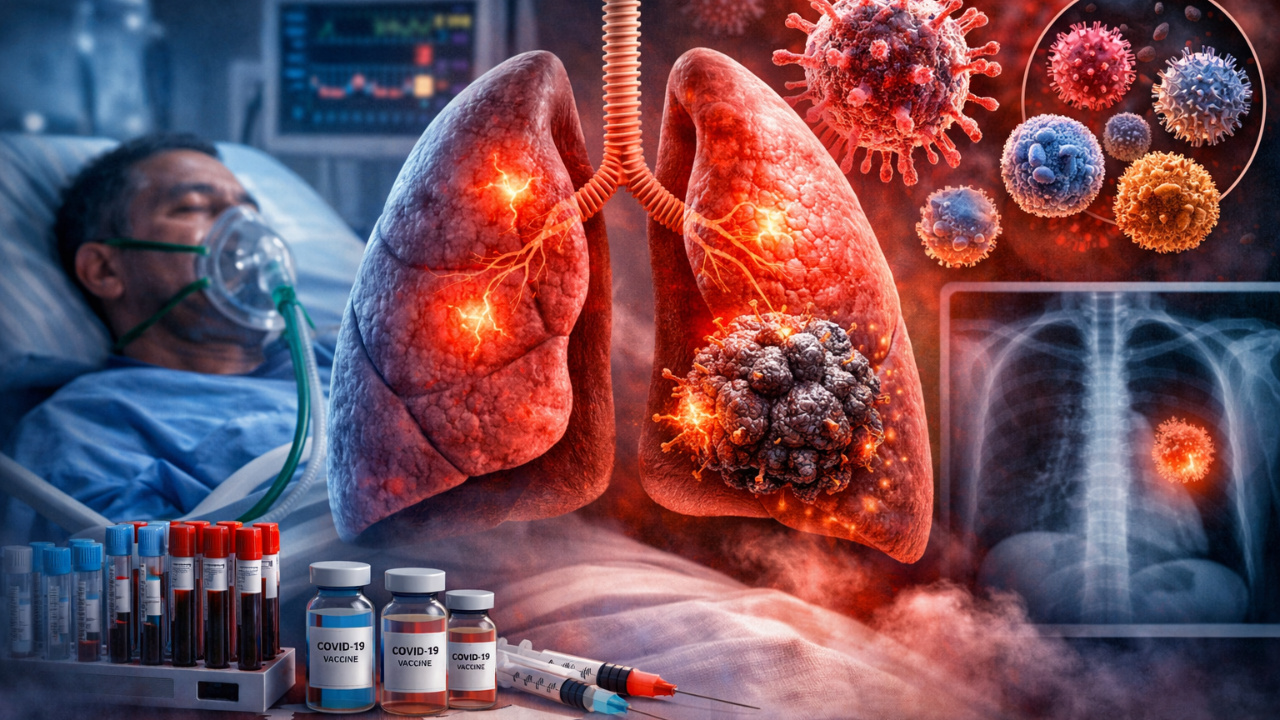
Severe Covid 19 Cases Can Lead to Prolonged Lung Inflammation and Increase the Risk of Lung Cancer, Study Finds.
A study conducted by researchers from the University of Virginia (UVA), in the United States, revealed that people who had severe Covid 19 or other severe forms of respiratory infection, such as the flu, may have a higher risk of lung cancer in the future.
The research was published in the scientific journal Cell in March and analyzed data from hospitalized patients and laboratory experiments.
According to the scientists, intense respiratory infections can cause prolonged lung inflammation, creating a favorable environment for tumor development months or even years after the illness.
-
350-year mystery may have been solved: remains of a soldier who inspired the hero of The Three Musketeers found beneath a church in the Netherlands.

-
NASA photographed a nearly perfect square with 3 km sides on Mars, 13 times larger than the Great Pyramid of Giza, but the official explanation is natural erosion; still, no one has explained why the four sides have almost identical lengths.

-
Starlink breaks the barrier of 10,000 satellites in orbit and takes its expansion to an unprecedented level, with a direct impact on global internet, technological competition, and the race for space.

-
Japan finds an alternative to oil amid rising prices by transforming ocean balance into electricity with a new technology that maintains efficiency even when the sea changes.
The researchers observed that changes in the immune system of the lungs after a severe respiratory infection may promote the emergence of cancer cells.
Thus, the study suggests that patients who faced severe Covid 19 should receive more attentive medical follow-up over time.
Prolonged Lung Inflammation May Increase Cancer Risk
According to the scientists, the link between severe respiratory infection and lung cancer is related to persistent inflammation in lung tissues.
Normally, the body uses defense cells to fight viruses and bacteria. However, when there is intense lung inflammation, some of these cells may remain active for a long time.
This prolonged inflammatory state creates conditions that facilitate tumor growth.
“A severe case of Covid or the flu can leave the lungs in a ‘prolonged inflammatory’ state that facilitates the establishment of cancer later,” explained Jie Sun, co-director of the Carter Center at UVA and a member of the Division of Infectious Diseases and International Health at the university.
Moreover, the researchers identified changes in the cells that line the lungs and in the small air sacs responsible for breathing.
These changes contribute to keeping lung tissue in constant inflammation.
Study Finds Increased Risk of Lung Cancer After Severe Covid 19
To better understand the relationship between severe Covid 19 and lung cancer, scientists analyzed data from hospitalized patients and also conducted experiments with mice.
In laboratory tests, animals that suffered from severe lung infections showed a higher likelihood of developing tumors in the lungs later.
Additionally, these rodents had a higher mortality rate associated with the disease.
Among humans, the results also drew attention.
Patients who needed to be hospitalized for severe Covid-19 had about 24% more lung cancer diagnoses compared to people who did not have severe respiratory infections.
Interestingly, this increase in cancer risk appeared independently of traditional factors such as smoking or other illnesses.
Changes in Immune Cells Explain the Phenomenon
According to the researchers, the increase in lung cancer risk may be linked to changes in immune cells called neutrophils and macrophages.
These cells usually help protect the lungs against infections. However, after a severe respiratory infection, some of them start to act differently.
Instead of just combating viruses, they may contribute to maintaining a constant inflammatory environment.
This scenario favors the emergence and multiplication of cancer cells.
Therefore, persistent lung inflammation emerges as one of the main mechanisms explaining the link between severe Covid 19 and lung cancer.
Vaccination May Reduce Lung Inflammation and Cancer Risk
Despite the concern, the study also brought good news.
The researchers noted that vaccines against respiratory viruses, such as Covid-19 and influenza, can help prevent many of the lung changes associated with cancer risk.
This happens because vaccination allows the immune system to respond more quickly to the virus.
Consequently, the infection tends to be less severe and causes less damage to the lungs.
Thus, vaccination can reduce both prolonged lung inflammation and cellular changes that facilitate tumor development.
Mild Infections Do Not Present the Same Risk
Another important point identified by scientists is that not all respiratory infections increase the risk of lung cancer.
The data show that the problem primarily arises in severe cases that require hospitalization.
People who had mild infections did not show this increased risk. In some cases, there was even a slight reduction in disease incidence.
This reinforces the idea that the severity of respiratory infection plays a crucial role in prolonged lung inflammation.
Monitoring Can Help in Early Detection of Lung Cancer
In light of the findings, experts argue that people who had severe Covid 19, severe flu, or pneumonia could benefit from more frequent medical monitoring.
This monitoring may include imaging exams, such as lung CT scans, to identify possible tumors still in the early stages.
The physician-scientist at UVA Jeffrey Sturek, who collaborated on the study, emphasized that the findings could influence the clinical follow-up of these patients.
According to the researchers, future studies should still determine which groups are most vulnerable and which monitoring strategy is most effective.
Nevertheless, experts agree that detecting lung cancer early significantly increases the chances of successful treatment.
See more at: Severe Cases of Covid-19 and the Flu Increase Lung Cancer Risk and Sequelae of Covid 19 or the Flu: Patients Have a Higher Chance of Developing Lung Cancer After Severe Infection







-

-

-

-

5 pessoas reagiram a isso.