





 Portuguese
  English
  Spanish
  4 min of reading
  0 comments


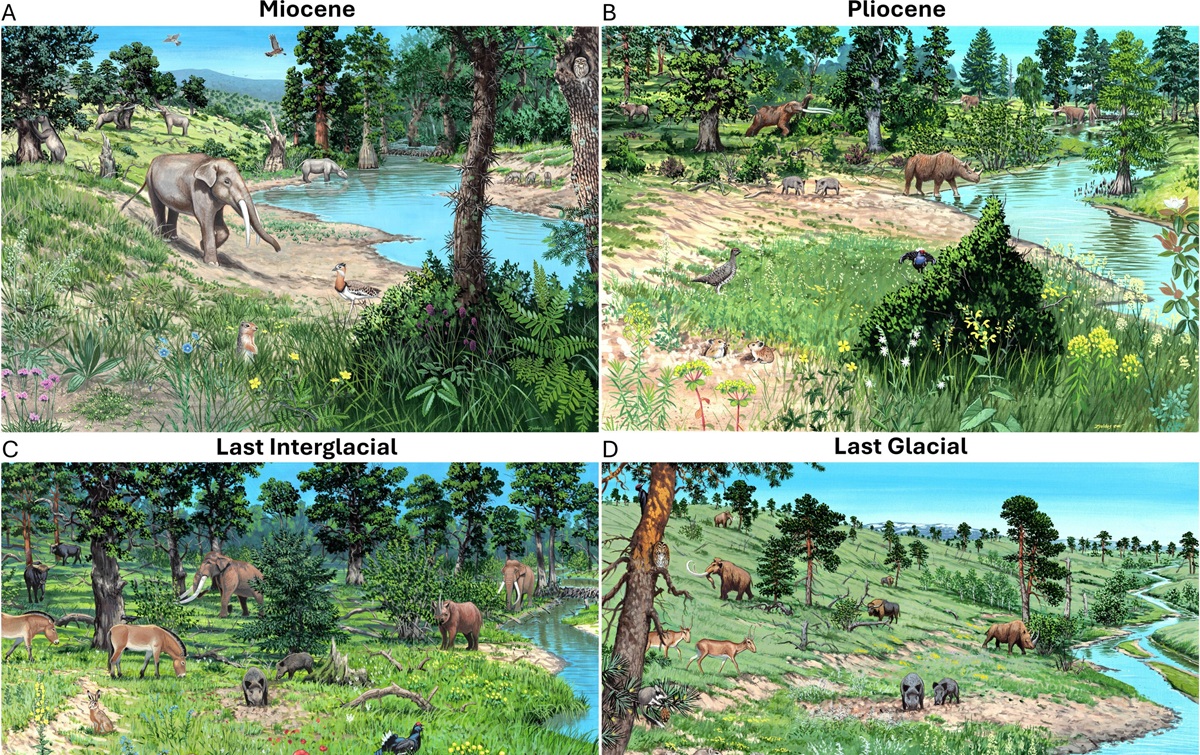
Analysis of Records Covering 23 Million Years, From the Miocene to the Pre-Industrial Era, Indicates That Dense Forests Were Not Predominant in Europe and That the Landscape Was Shaped by Mosaics of Pastures, Scrubs, Open Woodlands, and Large Wild Herbivores Over Time
The dense forests of Europe are pointed out as a modern phenomenon by a study led by Aarhus University, which analyzed 23 million years of vegetation and concluded that, from the Miocene to the pre-industrial era, mosaic landscapes predominated.
The work, published in the journal Biological Conservation, gathers long-term paleoecological evidence and suggests that reforestation based on dense forests contradicts the continent’s historical ecological trajectory.
According to researchers, for more than 20 million years, the European landscape was characterized by a combination of pastures, scrubs, and woodlands of varying density, forming open environments rich in wildflowers.
-
Motorola launched the Signature with a gold seal from DxOMark, tying with the iPhone 17 Pro in camera performance, Snapdragon 8 Gen 5 that surpassed 3 million in benchmarks, and a zoom that impresses even at night.

-
Satellites reveal beneath the Sahara a giant river buried for thousands of kilometers: study shows that the largest hot desert on the planet was once traversed by a river system comparable to the largest on Earth.

-
Scientists have captured something never seen in space: newly born stars are creating gigantic rings of light a thousand times larger than the distance between the Earth and the Sun, and this changes everything we knew about stellar birth.

-
Geologists find traces of a continent that disappeared 155 million years ago after separating from Australia and reveal that it did not sink, but broke into fragments scattered across Southeast Asia.

The image of a primitive forest, dark and with a closed canopy, where sunlight barely reaches the ground, would not correspond to the predominant reality for most of this period.
Dense Forests as a Recent Phenomenon in European History
From an ecological perspective, dense forests are described as a very recent condition. The study indicates that, over the past 20 million years, the dominant configuration has been that of dynamic mosaics, with scattered trees and interspersed open areas.
These environments were primarily shaped by the action of large grazing herbivores, which maintained the semi-open and diverse vegetation instead of allowing for continuous canopy closure.
Professor Jens-Christian Svenning, from the Center for Ecological Dynamics in a New Biosphere at Aarhus University, states that current reforestation practices are following a misguided path.
He emphasizes that, in Denmark, subsidies are only granted for planting dense forests, and that this could be detrimental to biodiversity and contradictory to the type of ecosystem in which European species evolved over millions of years.
Svenning adds that the so-called closed forest paradigm has dominated nature management and the understanding of what would be natural in Europe before human intervention for decades.
Evidence of Dense Forests and the Mosaic Since the Miocene
The study represents an advancement over previous research by covering the entire period from the Miocene, which began around 23 million years ago, to the pre-industrial era.
The researchers gathered all available paleoecological evidence, combining multiple scientific indicators to reconstruct the structure of vegetation and ecological processes of the past.
Among the data analyzed are pollen records, macrofossils of plants, charcoal particles from ancient fires, stable isotope analyses of teeth and bones of herbivores, fossils of insects and mammals, and ancient environmental DNA preserved in sediments.
Szymon Czyzewski, lead author and doctoral student in the ECONOVO program at Aarhus University, explains that each indicator offers a specific perspective, but combining these data sets over time allows for a more confident assessment of whether landscapes were dominated by dense forests, open fields, or a mix.
According to him, this approach enabled tracking long-term changes in vegetation and the role of large herbivores with greater confidence than studies based on a single method.
The conclusion presented is that, during this extensive period, the typical European landscape was a rich mosaic of trees and flowers, maintained by large wild herbivores such as elephants, rhinoceroses, aurochs, and bison.
This pattern would have occurred in both temperate climates similar to the present and in warmer or colder periods.
A Continent Without Large Herbivores
The study also points out that present-day Europe is ecologically atypical compared to most of the last 20 million years.
Czyzewski states that contemporary ecosystems lack the large wild herbivores that shaped the landscapes and supported biodiversity for millions of years.
He highlights that the most drastic change occurred largely in the last hundred years, with the disappearance of traditional extensive grazing in vast areas.
The researchers also indicate that several species now associated with cultural landscapes may have evolutionary roots in ancient open woodland systems.
These include skylarks, magpies, and the European hamster. Poppies, currently linked to fields, grew in places disturbed by herbivores within ancient woodlands.
According to the study, the sharp division between forests and open habitats, common in modern conservation, would be a recent construct.
Implications for Reforestation and Restoration Beyond Dense Forests
The conclusions have direct implications for nature and biodiversity management in temperate Europe, especially in the context of forest planting aimed at mitigating climate change.
If the goal is to restore ecosystems similar to those that shaped the evolution of European species, the study indicates that dense and uniform forests would not be the solution most aligned with the historical trajectory.
Svenning states that restoration efforts should prioritize the creation and maintenance of mosaics of woodlands and open habitats.
He concludes that this can be achieved primarily through the restoration of large herbivores living in their natural habitats.
The study reinforces evidence accumulated in previous research in the same scientific environment, indicating that the European past was more heterogeneous and heavily influenced by large animals than previously thought.
In this context, the idea of a primitive, dark forest dominated by dense forests loses one of its main foundations in light of the evidence gathered over 23 million years.







-

-

-

-

10 pessoas reagiram a isso.