





 Portuguese
  English
  Spanish
  4 min of reading
  2 comments





In The United States, a 1960 Study from The University of Illinois Projected Population Collapse in 2026 and Indicated November 13, 2026 as a Critical Date, Using a Mathematical Model Based on Growth Rates of The Time, Now Contested by Methodological Limits and The Context of The Cold War
In The United States, the theme population collapse in 2026 has resurfaced following the release of an old study that treated uncontrolled demographic growth as a central threat to sustainability. The research, conducted at The University of Illinois in 1960, used mathematical models to extrapolate trends from the period and pointed to a specific milestone: November 13, 2026.
At the same time, the warning began to be reevaluated by scientists due to inherent limitations of forecasts based on growth curves and the intellectual environment of The Cold War, when projections about global risks were multiplying.
The current debate does not describe an imminent end of the world, but rather the need to read the model within its historical and technical context.
-
Darkness can surpass light in an optical phenomenon confirmed by scientists, which expands the understanding of relativity and reveals new behaviors of waves in the universe.

-
A Brazilian scientist created a pen that touches human tissue and identifies cancer cells in seconds using a drop of water and artificial intelligence, and Lívia Eberlin’s invention has already been used in over 400 surgeries in the United States and Brazil.

-
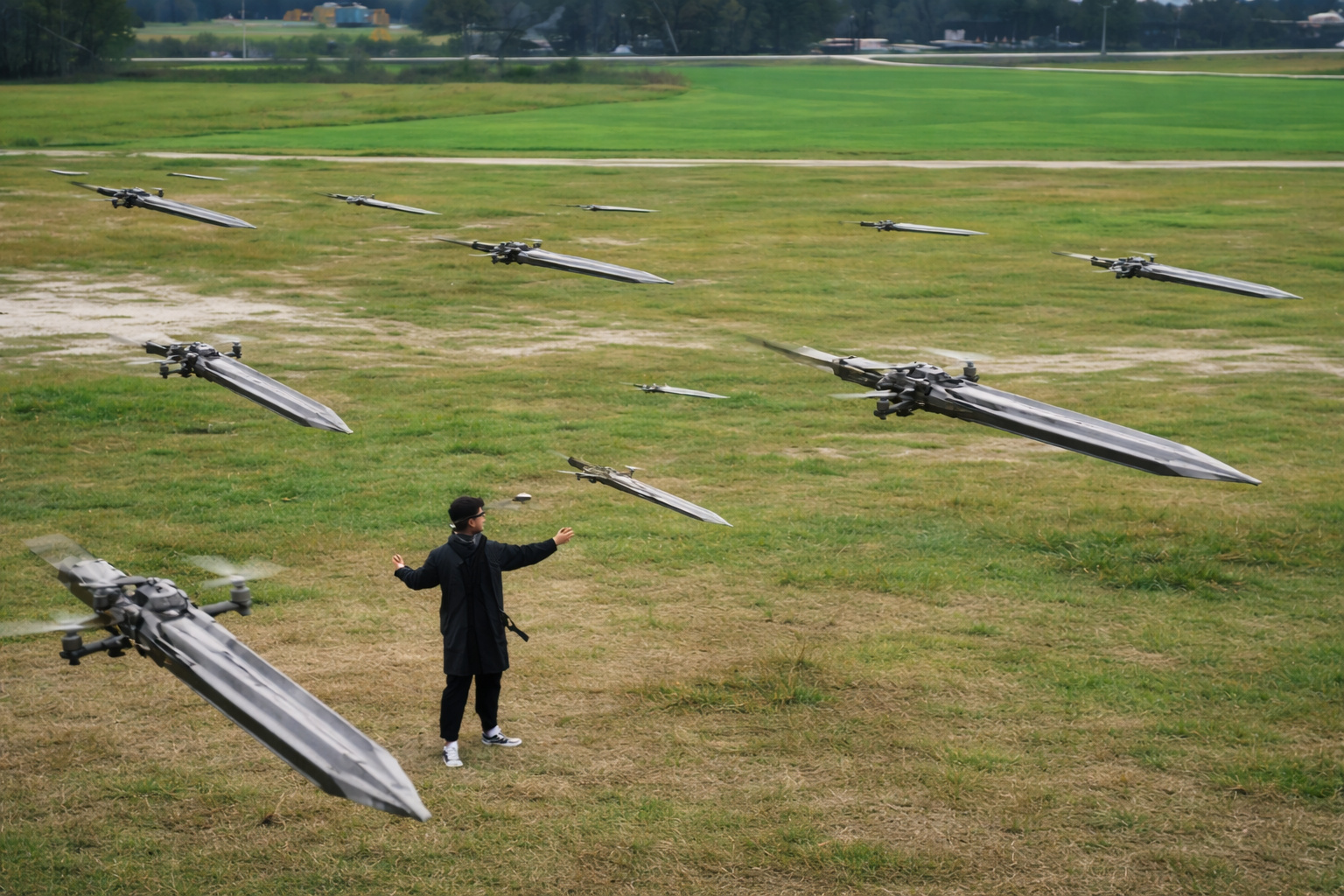
An inventor in China creates flying drones shaped like swords that respond to hand gestures in real time, with technology based on motion sensors transforming interaction into a scene worthy of a movie and redefining the control of machines in the air.
-
100 times less energy consumption: the innovation that could solve the huge energy crisis of AI.


Who Signed The Study and What The Model Tried to Measure
The 1960 study was led by Heinz von Foerster, Patricia Mora, and Lawrence Amiot, researchers who applied a mathematical model to estimate the impact of population growth if the rates of the time were maintained for decades.
The central hypothesis was that population collapse in 2026 could occur when demographic expansion exceeded the planet’s capacity to sustain so many lives.
The reading of the study connected the growth curve to increasing pressure on resources, with the risk of social and environmental rupture.
Why 2026 Was Included in The Calculation and Why The Text Mentions November 13
The disclosed calculation pointed to a symbolic date, November 13, 2026, as a concerning reference for a global collapse, should the demographic trajectory continue at the same rate observed in the mid-20th century.
This type of prediction directly depends on the behavior of the chosen curve and the data set available in 1960.
Therefore, population collapse in 2026 appears in the debate as a result of mathematical extrapolation, not as an inevitable timeline of a unique physical event.
Population in 1960 and Today: The Contrast That Rekindles Fear
The report reminds us that, in 1960, the world population was approximately three billion people.
Today, the population is over eight billion, and the issue of overpopulation continues to be treated as alarming, especially when linked to pressure for food and resources.
Within this comparison, population collapse in 2026 becomes a headline due to the numerical leap over the decades.
But the original argument of the study itself relies on historical rates and a production and consumption scenario that has also changed.
Food, Resources, and The Idea of Rupture: The Axis of The Alert
The study related accelerated demographic growth to potential food production insufficiency, citing the gap between a growing population and available resources.
Medical advances appear as a factor that would drive population increase and thus amplify pressure on sustainability.
In this logic, population collapse in 2026 is not described as a sudden explosion, but rather as a condition of unsustainability that could lead to the breakdown of social and environmental systems.
The strength of the alert lies in the chaining of variables, even though the model cannot capture changes in policy, technology, and behavior over time.
The Context of The Cold War and The Limits of Mathematical Predictions
The Illinois alert is presented as based on scientific data, but it also arises in a specific historical context, when projections of global risks gained weight in public debate.
The Cold War fueled a culture of extreme scenarios and models that attempted to measure threats on a planetary scale.
Therefore, in reevaluating population collapse in 2026, scientists highlight classical limits of mathematical models when applied outside their context: extrapolations assume a continuation of trends and can fail when the world changes due to innovation, public policies, economic transformations, and changes in birth and mortality dynamics.
Why An Old Prediction Does Not Mean An Imminent End of The World
The text also recalls a history of apocalyptic predictions repeated over the centuries, many with religious origins or free interpretations, and differentiates this type of prophecy from the mathematical warning of 1960.
Yet, the presence of a specific date facilitates distorted readings.
In practice, the current discussion about population collapse in 2026 treats the study as a signal of concern for sustainability and demographic growth, not as proof of an imminent global end on a closed calendar.
The date functions more as a model output rather than as a verdict.
Do you believe that population collapse in 2026 should be read as a serious alert for long-term policies, or as a classic example of mathematical extrapolation that becomes a headline out of context?








Se houve um estudo manifestando essa preocupação em 1960, com aplicação de tecnicas e estatísticas, deveriam não ter arquivado, mas atualizar ao longo das décadas, sempre considerando tantas tragédias e mortes, bem como número de nascimentos, para atestar a progressão ou regressão ou ainda a estabilização da idéia de colapso.
A data é como diz o texto, mero parâmetro. Podendo ser a qualquer momento.
Um dado é relevante, estamos testemunhando a queda na produção alimentícia há anos. E nada se fez ou faz para a proteção desta importante produção.
Quem viver verá, testemunhara, e, se puder, prevenir-se, será sábio.
Ta aí um texto que fala muito e não diz nada.