





 Portuguese
  English
  Spanish
  5 min of reading
  0 comments


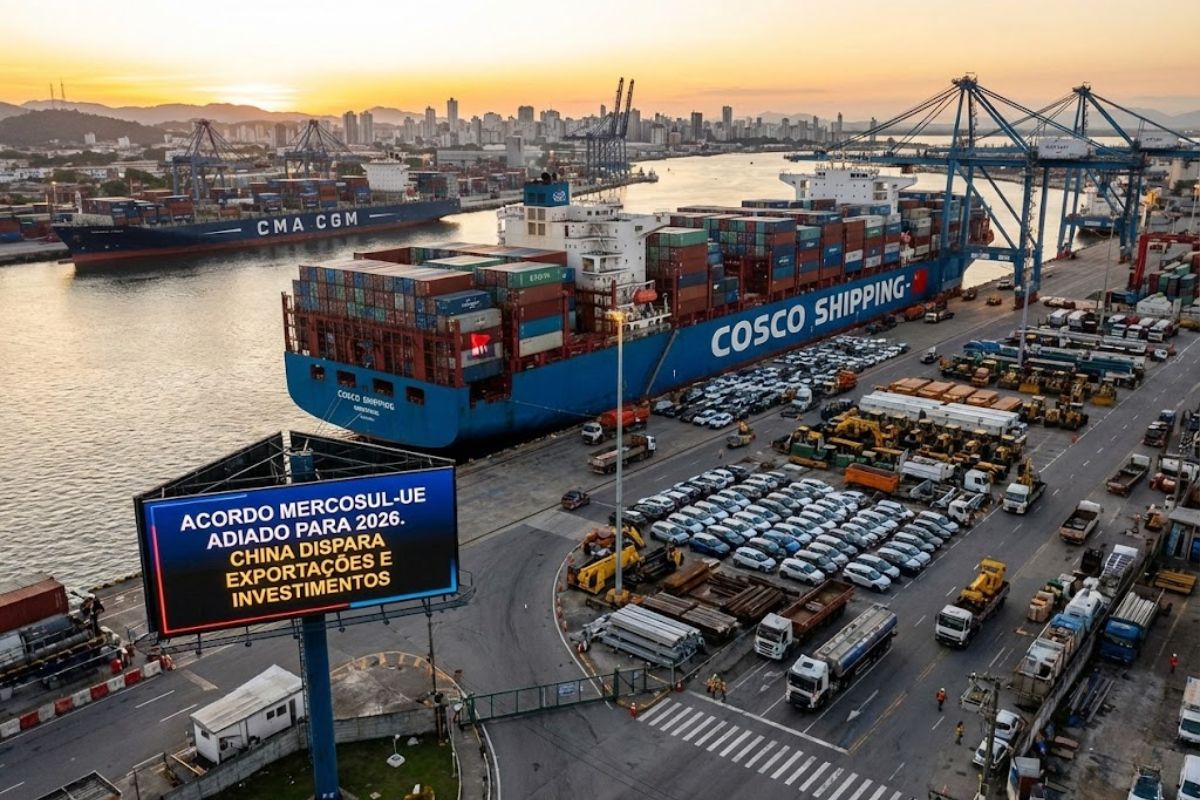
With The Agreement Between European Union and Mercosur Pushed for Signature Only in January 2026, Brussels Study and BusinessEurope Pressure Expose Loss of Space to China, Competitive Threat to Brazil and Risk of Investment Flight to Beijing in Trade with South American Block in The Years.
Last Thursday, the European Union decided to postpone the signature of the trade agreement with Mercosur until mid-January 2026, just as China has been the largest partner of the block since 2017 and continues to expand its participation in trade with Brazil, Argentina, Paraguay, and Uruguay. The decision raised alarm in the European industry, which sees the window of opportunity closing.
At the same time, a new study by the EU Directorate-General for Trade, completed in 2024, details how Europeans have fallen from a dominant position in Mercosur in the late 1990s to a clear second place behind China, with a concrete risk of losing even more market and investments in the region if the agreement does not materialize.
Europe Loses Historical Space in Mercosur to Beijing
At the beginning of the agreement negotiations in June 1999, the European Union was the main trading partner of Mercosur: accounting for nearly 30% of the block’s imports and about 25% of the destination of its exports.
-
Brazilian city bets on the business environment to generate jobs and attract investments in the energy sector — secretary reveals strategy at Macaé Energy 2026.

-
50 viaducts, 4 tunnels, 28 bridges, and 40 kilometers of bike paths: BR-262 in Espírito Santo will receive 8.6 billion reais for the largest engineering project in the state’s history, inspired by the Immigrant Highway in São Paulo.

-
Brazil produces too much clean energy and doesn’t know what to do with it: over 20% of solar and wind capacity was wasted in 2025 while investors flee and 509 renewable generation projects were abandoned in the last year.

-
Piauí will produce a new fuel that replaces diesel without needing to change anything in the truck’s engine and reduces pollutant gas emissions by half: truck drivers from all over the Northeast are already celebrating the news that will arrive later this decade.


China accounted for less than 5% of both purchases and sales with Mercosur.
Since then, Beijing has steadily gained market share, eventually surpassing Europeans between 2016 and 2017.
In a quarter of a century, the EU has shifted from being an absolute protagonist in trade with Mercosur to a supporting player in the background, seeing China take the lead in relations with the Southern Cone.
In 2000, sales by European companies to Mercosur were about six times larger than those of Chinese companies.
Today, China’s relative participation is approximately 40% greater than that of the EU in trade with the block, highlighting a profound change in the region’s trade landscape.
Brussels Study Calculates Certain Loss Without Agreement
The study by the Directorate-General for Trade concludes that, without the bi-regional agreement with Mercosur, the European Union will continue to lose space to China.
The trend is for the continued expansion of Chinese imports and exports to the block, while Europeans would fall further behind in a strategic market for industrial goods, services, and investments.
However, with the treaty in place, the situation would reverse. Instead of losing another 2.5 percentage points of share in exports to Mercosur by 2040, the EU could gain 7.3 percentage points in sales to the block.
In practice, this would place Europeans back in a position similar to what they had 25 years ago, even with the strong Chinese presence.
According to the document, the agreement would create a stable framework for trade between the two blocks, reducing uncertainties, facilitating the exchange of goods and services, and stimulating investment in export-oriented sectors.
All of this would strengthen the so-called European “strategic autonomy,” by diversifying supply chains and reducing dependence on essential raw materials from other suppliers.
How The EU Held China in Other Latin American Markets
The same study shows that the loss of European space has not been repeated in Latin American countries that already have free trade agreements with the EU, such as Chile, Mexico, Peru, Colombia, Ecuador, and Central American countries.
In these markets, China’s share in imports jumped from 2% in 2000 to over 20% in 2024, a tenfold increase.
Even so, this Chinese expansion primarily occurred at the expense of other partners, especially the United States, whose share of imports fell from 62% in 2000 to 34% in 2024.
Meanwhile, the European share remained relatively stable, fluctuating between 9% and 11%, precisely because preferential agreements protected the EU’s position.
The reading in Brussels is straightforward: where there is an agreement, the EU can preserve and even expand its space against China; where there isn’t, as in Mercosur, Beijing advances while Europeans retreat.
Risk of Brazil Seeing Investments Migrating to China
The delay in the agreement with Mercosur does not only concern the European Union. For the South American block itself, especially Brazil, the risk is seeing productive investments and value chains shift to countries where European companies already have more competitive conditions, or even being replaced by Chinese groups.
Without clear, predictable rules and with lower tariffs between the EU and Mercosur, European companies may continue to evaluate that it is more worthwhile to bet on other markets in Latin America or deepen connections with already consolidated partners.
For Brazil, this means losing opportunities for industrial plants, technology, and higher value-added jobs.
At the same time, China continues to finance infrastructure, buying commodities, and increasing exports of manufactured goods to Mercosur, reinforcing the perception that the economic center of gravity in the region is increasingly tilting towards Beijing.
Pressure From European Industry and Impatience of Mercosur
In light of this scenario, BusinessEurope has been pressuring the governments of the 27 EU countries to stop delaying the decision and sign the treaty with Mercosur as soon as possible.
The organization argues that the agreement is essential to prevent the erosion of Europe’s position in the region, in a context of trade war, protectionism, and reconfiguration of global supply chains.
On the South American side, patience is wearing thin. Mercosur leaders see the successive postponements as a delaying tactic by Europe and are demanding a resolution.
As BusinessEurope itself admits, it is no longer possible to ask the block to continue waiting while it loses real economic ground to China.
Betting on Approval in 2026 is Still Uncertain
The European Commission claims that this time it will have the qualified majority needed to approve the treaty with Mercosur: 55% of member states, equivalent to 15 of the 27 countries, representing at least 65% of the EU’s population. The promise is that this majority will be reached in the vote expected next month.
Still, many diplomats, companies, and governments in Mercosur are taking a cautious stance and reiterate that they will only believe it when the agreement is finally signed and enters the ratification process. Until then, China continues to advance and occupy the spaces left by European delays.
And you, do you think Mercosur should continue betting on Europe or accelerate towards a deeper rapprochement with China?








-

-

-

15 pessoas reagiram a isso.