





 Portuguese
  English
  Spanish
  5 min of reading
  0 comments


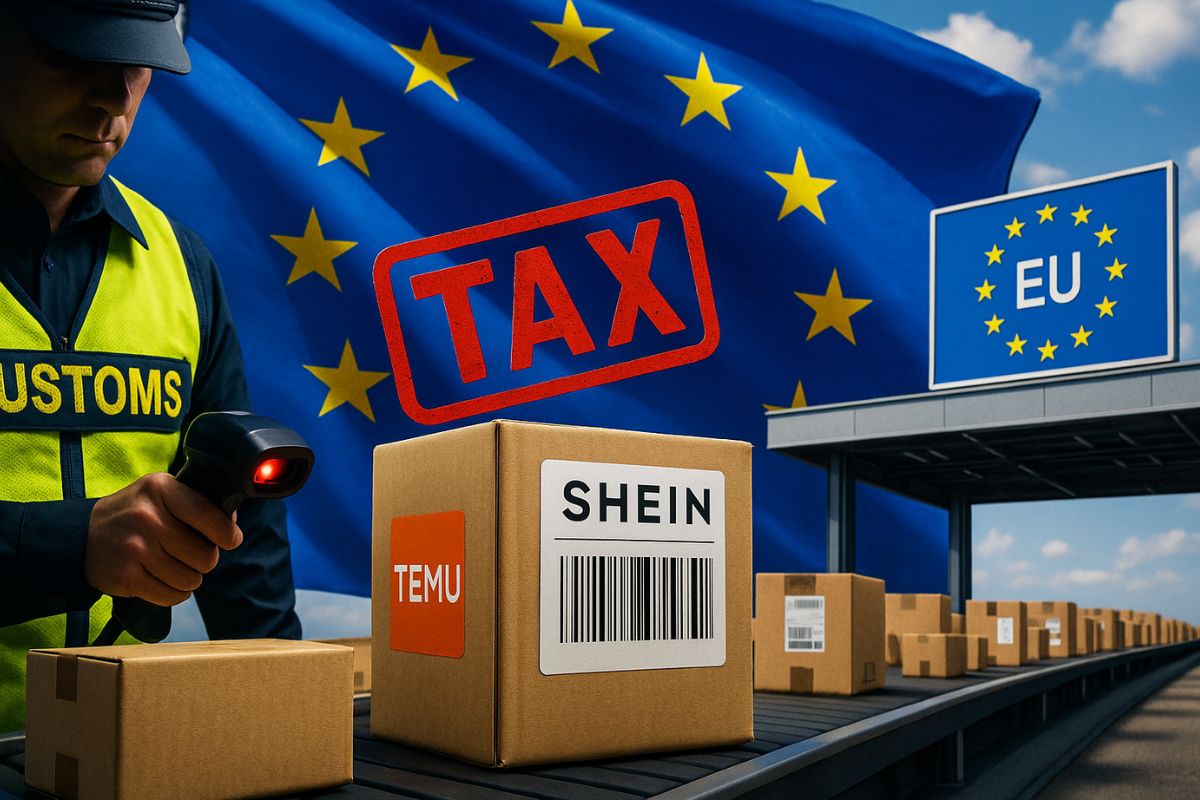
Europe Approves Blouse Tax and Rushes to Charge Package by Package from Temu and Shein as Early as 2026
The so-called blouse tax has ceased to be just a Brazilian discussion and has begun to also guide the trade policy of the European bloc. The finance ministers of the European Union have approved the end of the exemption for small imported packages, directly targeting platforms like Temu and Shein and tightening control over low-value imports from China.
In practice, the European blouse tax is expected to come into effect temporarily starting in the first half of 2026, with the possibility of including an administrative fee of around 2 euros per package. The measure is seen as a strategic step to protect the internal market, reduce the flow of cheap products that escape safety regulations, and bring the bloc closer to the tax model already seen in Brazil.
What the European Union Approved with the New Blouse Tax
The decision by the 27 countries of the European Union ends the tariff exemption for small packages coming from outside the bloc, which is currently widely used for purchases on digital platforms.
-
BRICS is building its own payment system that could be operational by 2030, and experts say it could increase trade between the countries by up to 10% per year and add 3% to the GDP of each member of the bloc.

-
Government suspends over 3 million traffic fines in Brazil and drivers breathe a sigh of relief.

-
Iran has just approved toll charges for ships in the Strait of Hormuz and has completely prohibited the passage of vessels from the United States and Israel in the world’s most important maritime route for the global energy market.

-
Government cancels R$ 25 million “celebration” for Brasília’s anniversary and allocates funds to health.


The change directly impacts imports from China made by European consumers for low-value orders, which often arrived without paying import tax.
According to the political framework already presented, the blouse tax functions as a fiscal and regulatory filter.
Instead of allowing the free entry of small packages, the European Union will tax even the lowest value purchases, bringing the practice closer to what already occurs with larger orders.
The central idea is that there will no longer be a “tax shortcut” simply because the order was split into several cheap packages.
Why Temu and Shein Became Direct Targets of the Blouse Tax
Platforms like Temu and Shein have become the symbol of this type of operation: high volume of orders, low unit prices, and a strong connection with imports from China.
For European authorities, the combination of very low prices, tight margins for local trade, and doubts about regulatory compliance has created a competitive imbalance that is hard to sustain.
In political communication, the blouse tax is presented as a response to this scenario.
Temu and Shein are cited as examples of companies benefiting from the current exemption, flooding the market with small packages that arrive with virtually no tax barriers.
By removing the benefit, the European Union is attempting to reduce the cost advantage associated with imports from China, bringing the final price of the platforms closer to that of physical stores and traditional European e-commerce.
France Leads the Charge and Pressures for Speed in the European Union
Among the 27 countries of the European Union, France has taken on the role of primary sponsor of the new blouse tax.
The French government has publicly advocated the need to curb the flow of cheap products and strengthen the protection of the internal market, especially in cases where items sold by platforms like Shein violate local standards.
The French pressure even included threats to suspend Shein in its territory amid controversies involving products sold online.
This political environment has helped create consensus to expedite the timetable.
The original proposal from the European Commission envisioned implementation only around 2028, but member countries decided to advance the agenda and work towards starting in the first quarter or the first half of 2026.
How the Collection Will Work: Blouse Tax and Administrative Fee per Package
In addition to ending the exemption, the blouse tax comes with an additional idea: creating a administrative fee per package.
The proposal discussed in Brussels includes charging a fixed amount per order, suggested at 2 euros per package, to cover customs processing costs for thousands of small shipments linked to imports from China.
In practice, this means that each order sent by platforms like Temu and Shein to a consumer in the European Union may incur two types of costs: the import tax itself and this administrative fee.
Even if unit prices are low, the sum of these additions tends to reduce the price advantage that has driven the explosive growth of small international purchases.
Brazil, Europe, and the Demonstration Effect of the Blouse Tax
The European movement occurs against a backdrop in which Brazil has already become a reference with its own blouse tax, adopted in 2024 to tax imported products via large e-commerce platforms.
Abroad, the Brazilian case is cited as an example of regulatory response to a common phenomenon: the explosion of cheap small-volume orders coming from abroad.
By adopting its own blouse tax, the European Union aligns itself with this trend of closing fiscal and regulatory loopholes exploited by imports from China on a large scale.
The logic is similar: dissuade the splitting of orders, reduce the asymmetry with local trade, and reinforce control over safety and product compliance standards.
In this context, platforms like Temu and Shein will operate in a more predictable but also stricter tax environment.
What Changes for Consumers and Global Digital Commerce
For European consumers, the main impact of the new blouse tax will be the increased cost of low-value international purchases.
Orders that currently arrive almost tax-free may incur both import duties and the administrative fee per package, reducing the appeal of purchases driven solely by price.
For companies like Temu and Shein, the challenge will be to reposition their pricing and logistics strategies in a scenario where imports from China no longer have a “tax shortcut” within the European Union.
This may mean portfolio adjustments, a greater focus on regulatory compliance, and, in some cases, even a review of business models based on extremely cheap packages sent at scale.
From a geopolitical and economic standpoint, the European blouse tax adds to other global initiatives aimed at rebalancing the competition between low-cost Asian production and local value chains.
It’s not just about revenue generation, but about how each region defines the operating space for its retailers, manufacturers, and digital platforms.
With the approval of the blouse tax, the European Union sends a clear signal that the unlimited growth cycle of imports from China via platforms like Temu and Shein has entered a new phase.
The end of the exemption, combined with an administrative fee per package, is likely to reshape the prices and logic of low-value international purchases starting in 2026.
If a blouse tax similar to the European one significantly raises the cost of purchases on international platforms, would you continue importing or opt for more national retail, and why?










Seja o primeiro a reagir!