





 Portuguese
  English
  Spanish
  8 min of reading
  4 comments


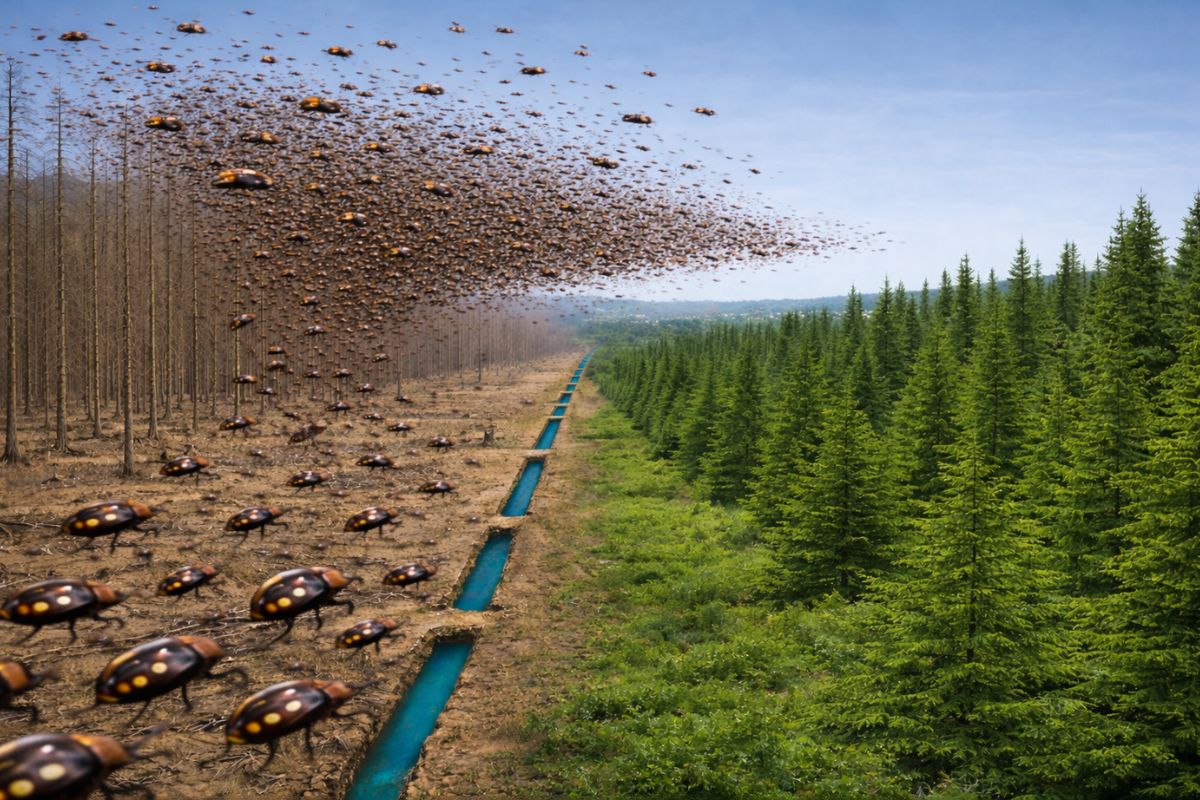


How Beetles Destroy Abies Monocultures, Transform European Forests Under Climate Change, and Lead Scientists to Bet on Assisted Migration.
When beetles destroy Abies monocultures in Europe, at first glance, it all looks like a catastrophe: mountains of dead trees, brown slopes, more intense fires, loss of timber, and billion-dollar losses. But for many scientists, this collapse is not the end of the forest; it’s the end of a production model that turned complex ecosystems into artificial plantations.
Europe is seeing its green heart dry up at an alarming rate. In Germany, about 500,000 hectares of forest perished in just a few years, while satellites record brown spots spreading across the continent. What appears to be an unprecedented environmental tragedy is seen by researchers as a rare opportunity to correct a historical mistake and reinvent the future of forests.
The invisible biological machine that takes down entire forests

Behind this collapse is an unlikely agent: the bark beetle. It is the size of the tip of a matchstick but acts like a perfectly coordinated army.
-
While the world looks at oil, the war with Iran is already disrupting helium supply from Qatar, affecting car and iPhone chips, threatening AI expansion, and putting pressure on aluminum packaging at the highest value in four years.

-
Global warming will expose a treasure hidden under the ice of Antarctica and may spark an international dispute over gold and valuable minerals.

-
A street vendor from Praia Grande built a robot made of scrap from scooters and washing machines that pulls his popcorn cart on the beach, emits sounds, and interacts with customers, becoming an attraction on the coast of São Paulo.

-
The specifications of the Xiaomi 18 Pro Max have been leaked, and the highlight is a dual 200 MP camera with a new 22-nanometer technology that promises to consume less energy and capture details in shadows and bright areas using LOFIC HDR.


When these beetles destroy monocultures of weakened trees, it is not a random attack; it’s a high-precision biological operation.
It works like this:
A pioneering beetle finds a stressed tree and releases pheromones into the air, a powerful chemical signal.
In no time, thousands of other beetles are attracted to the same target. They bore through the bark and open tunnels to lay eggs. Along with them comes a deadly ally: a fungus that invades the tree’s vascular system.
This fungus acts like a blockage in the bloodstream: it clogs the channels that bring water and nutrients. The tree dies of thirst with its roots still embedded in moist soil.
Previously, trees could react by producing resin to expel invaders. Now, in aged, stressed, and artificially planted forests, that no longer works.
The combination of weak trees, warmer weather, and overcrowded beetles has created a perfect storm that is bringing down millions of trees at once.
How Global Warming Fuels the Beetle Attack
What is happening in Europe is not an isolated phenomenon. The same logic is appearing elsewhere in the world, like North America, where vast forest areas have already been destroyed by similar beetles, fueling large fires and exacerbating the climate problem.
The common point is simple: a warming climate favors insects and weakens trees.
With longer droughts and more intense heatwaves, forests experience severe water stress. Trees have less water to produce resin, lose internal pressure, and cease to react to attacks.
At the same time, higher temperatures accelerate the beetles’ life cycle. Where once a pair of insects generated one or two generations per year, they can now produce three or even four generations in a single summer.
In a favorable scenario, a single couple can give rise to tens of thousands of descendants in no time.
The result is a biological wave spreading at an exponential rate, impossible to contain with manual traps or traditional management.
But as destructive as it seems, this attack did not arise in a vacuum: it is the direct consequence of a human choice made 80 years ago.
The Historical Mistake of the “Green Desert” in Europe


After World War II, Europe needed to rebuild quickly. Houses, bridges, roads, and entire cities required wood in large volume and short-term. The question was: which tree grows fastest, straighter, and yields the most profit?
The answer was the fir tree. It became the favorite species of German and European forestry. Instead of restoring natural and diverse forests, the choice was made to create immense fir monocultures, organized like industrial plantations: same species, same age, same height, the same fragilities.
Viewed from above, this forest looked healthy, green, and homogeneous. But beneath the canopies, the reality was different:
- Little or no natural regeneration
- Soil acidified by needles
- Almost no variety of plants, shrubs, and animals
- Shallow root system, sensitive to drought and wind
These forests were not ecosystems; they were wood factories. And factories have something in common: when a critical part fails, the entire system collapses at once. That’s exactly what happened when the climate changed and the beetles found in these monocultures a perfect banquet.
When beetles destroy Abies monocultures, they brutally expose that these areas were never truly resilient forests, but rather high-risk investments disguised as “nature.”
Economic Shock: Cheap Timber, Ships to China, and Owners in Crisis

The mass attack of the beetles did not only devastate the landscape: it shook the timber market in Europe. Suddenly, enormous volumes of dead or condemned trees flooded the market at once.
With such an abundance, the price of timber plummeted. Private owners, who saw their fir trees as “green savings” for future generations, found themselves trapped in a dilemma: sell quickly for much less than expected or let the wood rot.
Here arises another symbolic scene: ships leaving European ports loaded with infested logs, traversing the world to Asia to become packaging or paper, as they no longer met the standards for high-quality construction.
What should have been a long-term forest heritage turned into depreciated stock, hastily offloaded. And all because we depended too much on a single tree species, in a climate that is no longer the same.
When Letting Die is the Strategy: The Bet of Hars National Park
While many places reacted with saws, tractors, and “cleaning” plans for affected areas, a national park in Germany made a radical decision: to do nothing.
In Hars National Park, the management opted to let the beetles complete their work and let the trees die naturally, without felling trunks, without removing fallen wood, without visually “tidying up” the forest.
At first, the reaction was one of shock. Locals and tourists looked at slopes filled with dead trees and believed the forest was lost. But time showed another story. In just a few years, something began to change:
- Sunlight began to touch the ground again after decades of constant shade
- Dead trunks started to function as sponges, retaining water and reducing heat at ground level
- Decomposing fungi transformed wood into nutrient-rich humus
- Millions of native seedlings started to sprout on their own
Oaks, chestnuts, birches, maples, and other broadleaf species appeared in mass, carried by the wind and birds. What seemed like a graveyard of trees turned into a spontaneous nursery.
Animals that could not live in monocultures, like lynxes, European wildcats, and three-toed woodpeckers, began to reappear.
The forest became chaotic again, irregular, full of different niches, deep roots, varying shadows, and diverse microclimates.
Recent comparisons show that this natural forest in reconstruction is much more drought-resistant than the old fir plantations.
When beetles destroy monocultures, they effectively make room for the wild forest to reclaim the place that has always belonged to it.
Assisted Migration: Planting Today for Tomorrow’s Climate Forest

Even with this natural rebirth, there is a problem: the speed of climate change is much greater than the capacity of trees to migrate on their own.
Climate zones are shifting northwards, while trees spread their seeds slowly, often by just a few meters per year.
If nothing is done, species that today are in one region may simply not be able to keep up with the climate shift.
That is why teams like the one led by Nico Frisbiere in Thuringia are betting on a bold strategy: the so-called assisted migration. The idea is simple yet risky:
- Study what the climate in the region will be like in a few decades
- Import seeds from trees adapted to the warmer and drier environments that already exist today
- Mix local species with new, more drought- and pest-resistant species
A new cast comes into play: Turkish fir, Oriental chestnut, Lebanon cedar, along with candidates from North America, like Douglas fir.
These trees have deeper roots, thicker bark, and more robust defense mechanisms against beetles and heat.
The logic now is not to find the “perfect tree,” but to assemble a diversified forestry portfolio, much like diversifying investments to reduce risks.
If one species fails under extreme drought, another may survive. If a group of conifers is attacked by beetles, broadleaf species may hold the system up.
When beetles destroy monocultures, they illuminate this new approach: forests as portfolios of distributed risk, rather than a single bet on a “miracle” species.
The Carbon Paradox: Dead Forests Also Pollute
However, there is an uncomfortable side to this transitional process. Forests are often seen as major carbon sinks, absorbing CO₂ from the atmosphere.
But when millions of trees die at the same time, that carbon is released back into the atmosphere as the wood decays or burns in fires.
A recent study pointed out that, due to the bark beetles and forest fires, some European forests temporarily stopped being sinks and became net emitters of carbon.
This complicates the climate equation right at a time when the world urgently needs to cut emissions.
At the same time, there is another pressure: demand for sustainable wood is increasing. Building with wood is seen as a less polluting alternative to using concrete and steel.
But how to reconcile this need with the time the forest needs to regenerate and become truly resilient?
The answer lies in a profound shift in consumer and industry mentality:
- Accepting harder, less standardized, and more difficult-to-process woods
- Valuing mixed, multifunctional, and slower-growing forests for wood production
- Understanding that the value of a tree is not just the cubic meter of logs, but its capacity to store water, harbor life, and moderate the local climate
In other words: it is no longer possible to separate forest economy from forest ecology.
The Global Lesson: The Cost of Treating Forests as Factories
What is happening today in European forests is a small-scale warning for the rest of the planet. From the taiga to the north, passing through the Amazon and the plantations of Southeast Asia, the pattern repeats: vulnerable monocultures in an increasingly extreme climate.
We spent decades trying to industrialize nature:
- planting trees in perfect lines
- eliminating everything that did not generate direct profit
- simplifying complex ecosystems into predictable and “efficient” systems
The response from nature came in the form of collapses: droughts, pests, fires, soil loss, and species disappearance.
The collapse of the fir forests is not just a local tragedy; it is a clear message that biological monotony is fragile, and diversity is the true safety infrastructure of the planet.
When beetles destroy monocultures, they brutally remind us that what is convenient for our short-term economy is often bad for long-term ecological stability.
The dry trunks we see today may indeed be the beginning of something more complex, wilder, and far more resilient than any human project of a “perfect” forest.
In the end, nature does not need saving. It needs us to stop insisting on the same mistake.
And you, in light of this scenario where beetles destroy monocultures and pave the way for a more diverse forest, do you think we should invest more in technological interventions like assisted migration or trust in nature’s power to regenerate itself?







Se continuarmos a utilizar combustíveis fósseis, não há diversidade florestal que poderá evitar o colapso tanto das florestas quanto do clima global. Todo o problema é causado pela insanidade de devolver carbono fóssil a uma ecosfera já adaptada a outras taxas de carbono. É impossível a vida como a conhecemos voltar a se adaptar a taxas de carbono do Permiano-Triássico, como muitos dizem ser “uma flutuação natural” (o nível de ignorância desta afirmação é ridículo). Estamos arriscando a possibilidade de manter a vida humana no planeta porque uma geração quer encher os bolsos de dinheiro a qualquer custo. Não há futuro saudável fora da readaptação da economia às energias renováveis.
Confiar somente na natureza não é suficiente devido a consequências climáticas que nós mesmos criamos! Entretanto ao invés de fazer interferências colocando espécies “resistentes ao clima do futuro, porém “invasoras” não me parece ser a solução. Talvez o ideal seria tentar potencializar o presente com mudas de plantas diversas daquela região. A natureza sempre nos surpreende!
Vejo a explosão populacional como a grande questão a resolvida. Como produzir alimentos para 8.5 bilhões de pessoas sem comprometer o meio ambiente? Como ficar livre das monoculturas nesse momento?
A capacidade da natureza produzir alimentos de forma equilibrada já foi superada há muito anos. Milhares de espécies de animais e plantas são extintas diariamente para dar lugar à produção de alimentos para alimentar esse enorme contingente de seres humanos.
Para mim, essa é a primeira questão a ser resolvida;
É lógico que não estou sugerido eliminar três quantos da população mundial imediatamente mas, pensar nisso para os próximos séculos. Temos a tecnologia a nosso favor.