





 Portuguese
  English
  Spanish
  7 min of reading
  23 comments


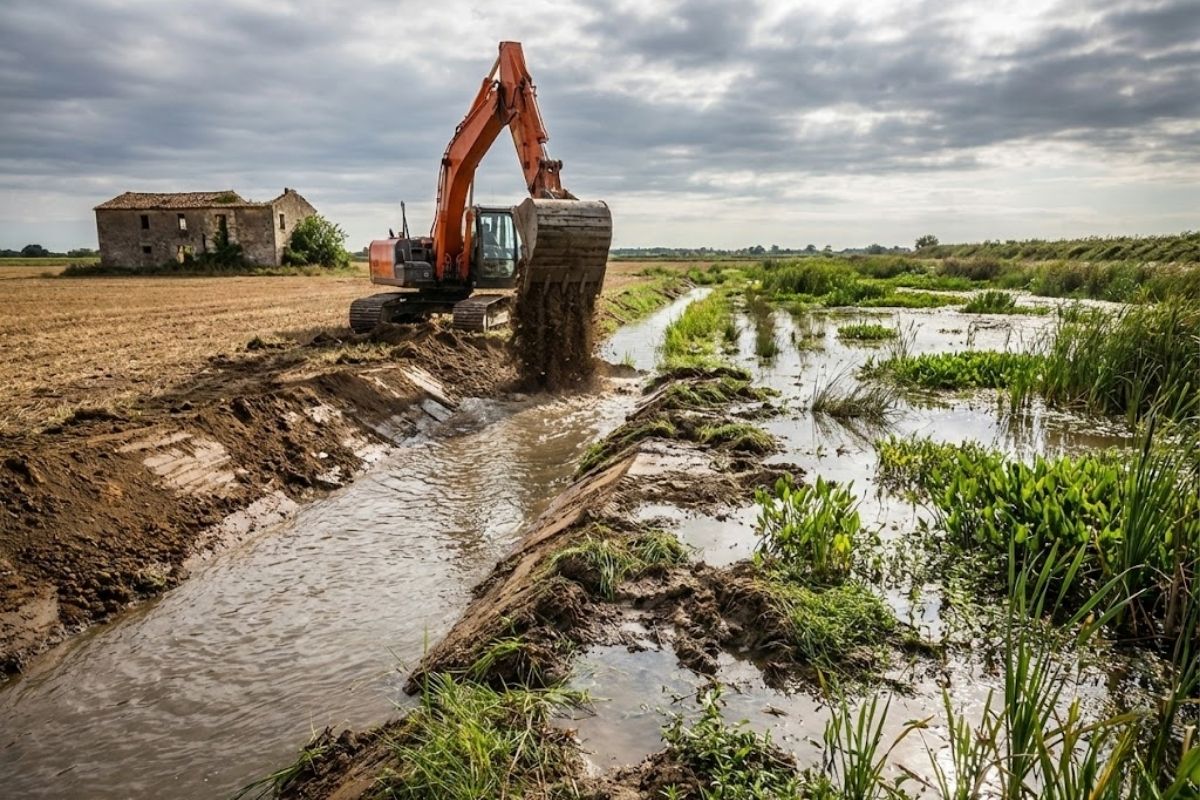


The Advancement In Europe Reverts Ancient Drainage: By Flooding Agricultural Fields And Removing Trees Outside The Habitat, Belgium Reactivates Peatlands, Reduces CO2 Emissions And Accelerates The Return Of Species. The Project Shows Why Wetlands Function As Climate Sponges, Filter Water And Store Carbon For Millennia.
Europe is changing what seemed untouched: instead of expanding drainage and keeping the land always “dry” for production, teams in Belgium are flooding agricultural fields and cutting down trees to resurrect ancestral swamps and interrupt a silent leak of carbon that has been occurring for decades.
In the Black Creek Valley, in Belgium, a common agricultural area is undergoing a planned transformation with shovels, sweat, and heavy machinery. The goal is simple to explain and hard to execute: close the drain opened by drainage ditches, return the water to the soil, and allow peatland, a rare and delicate ecosystem, to function again as a CO2 sink and nursery for biodiversity.
How Agricultural Fields Took The Place Of Wetlands In Europe

In many regions, European agricultural fields are cut by drainage ditches, those narrow lines of water that seem like a detail of the landscape but have changed the continent.
-
A forgotten cord on the floor of a basement in Vienna leads a plumber to a box containing 30 kilograms of gold with Mozart’s face, hidden before World War II. The treasure, worth 2.3 million euros, was just centimeters away from a worker who ignored the sign a day earlier.
-
A couple buys an old chalet, breaks the kitchen floor for renovation, and finds over a thousand coins of gold and silver hidden since the English Civil War over 4 centuries ago.

-
Rigid bags with their days numbered: new trend prioritizes comfort in 2026.

-
YouTuber creates an excavator equipped with a giant 4.5-meter sword to challenge his brother to a rematch, and the invention quickly goes viral on social media.

The function is to channel excess surface water to streams and rivers, turning previously flooded areas into “cultivated” lands.
The cumulative effect has been enormous. The estimate is that up to 20% of Europe was covered by wetlands just 100 years ago.
Today, the estimated loss has reached about 80% of those areas.
What appears to be just “green field” often hides a past of swamps, marshes, and peatlands that were drained to become agricultural production.
This drainage has not only altered land use.
It has affected water, biodiversity, and climate. Without wetlands, the landscape loses the natural sponge that retains water, filters, and stabilizes extremes.
Why Cutting Down Trees May Be The Key To Recovering Swamps

The image is counterintuitive, but it is part of the plan: cutting down trees. The reason is not “anti-forest”. It is ecology applied to the right place.
In these areas of Belgium, forests that have grown there do not belong to the original peatland ecosystem. The roots suck moisture from the soil and prevent the peat from recovering.
The restoration starts with a premise: ancestral swamp needs constant water and a high water table.
Trees in unsuitable locations can act as biological pumps, draining the moisture that should support the system. Cutting down trees here clears the way for a rarer ecosystem to exist again.
Furthermore, the removal of unwanted vegetation requires maintenance.
New seedlings need to be removed manually for years until the water level is high enough to naturally make the environment “hostile” to the advance of those plants that compete with the peat.
What Is Peat And Why Wetlands Store More Carbon Than Ill-Placed Forests

Peat looks like mud, but it is something else. Peatlands are a special type of wetland formed where water does not flow or drain. The soil remains constantly waterlogged.
When plants die and sink, oxygen cannot reach them.
Without oxygen, microbes that normally decompose organic matter do not function as they would in dry soil.
The result is a slow and continuous buildup: layer after layer of dead plants deposits in the wet soil and, over centuries, becomes peat.
And here’s the crucial climatic point: because the plants do not decompose, the carbon they captured while alive does not return to the atmosphere.
The scale of this stock explains why restoring peatlands has become a priority.
Although peatlands cover only 3% of the Earth’s surface, they store twice as much carbon as all the forests in the world combined.
It is, by far, the largest known terrestrial carbon sink in this context.

This also exposes the trap of “ill-placed forests”. Planting trees where the original ecosystem is a peatland can reduce water in the soil and hinder the restoration of the most efficient sink.
Not every planted tree is a climate gain if it is in the wrong habitat.
The Hidden Problem: Drainage, Oxygen And Silent CO2 Emissions

When peatlands are drained to become agricultural fields, the system changes state. Without water, the peat layers begin to dry out. Oxygen starts to penetrate again.
Then the decomposers, who have been “absent” in that anoxic environment for millennia, return and begin to work.
They start at the surface and release enormous amounts of CO2 as they decompose ancient plant material, layer by layer.
What was stored becomes emissions. The drainage of peatlands represents 5% of all CO2 emissions related to peatlands in the world, a significant number for a process that, from the outside, seems like just “fixing the water in the soil”.
The analogy used on site summarizes it well: it’s like a full bathtub and suddenly someone pulls the hose and sees everything disappear. What was once a reservoir and a carbon block becomes a source of CO2.
And there’s an aggravating factor: deep down, there is still intact ancient peat. In the Black Creek Valley, part of this deep peat is up to 14,000 years old.
If nothing is done and the area continues to dry out, this ancient layer could also decompose and release more carbon.
It’s a race against time to avoid additional emissions from a millennia-old “archive” of climate.
The Project In Belgium: From Drained Field To Reconstructed Swamp
The practical mission in Belgium follows four fronts, applied directly to the reality of drained agricultural fields:
First, cut down trees that suck moisture and do not belong to the original ecosystem.
Second, remove unwanted vegetation, with continuous manual labor to prevent seedlings from dominating the soil before the water stabilizes the system.
Third, repeatedly mow, because decades of farming have left the soil excessively fertilized, favoring fast-growing grass that, if neglected, dominates everything and hinders the return of the natural mosaic.
Fourth, the decisive step: “putting the lid back on the bathtub.” In practical terms, this means stopping the drainage.
Filling, blocking or reconfiguring ditches so that rain and groundwater remain in the valley, raising the water table and returning the constant flooding necessary for the peatland.
This effort is being carried out in the Black Creek Valley with community involvement and support from a specialized team.
The funded restoration on site covers 7.5 hectares of peatland.
The complete reconstruction is planned to take 5 years, led by Ecotree and the local partner Natuurpunt, which has been working for decades on restoring the area and concentrates accumulated local expertise.
The Impact On Carbon: Stopping Decomposition And Locking Emissions Before They Leave The Soil

When the water table rises slowly and water begins to remain in the valley, restoration halts the decomposition process of the deeper peat.
This means blocking the release of carbon that would otherwise be released into the atmosphere.
After this, a slower and longer-term process occurs: new layers of peat begin to form above, something that can take generations.
The climate gain has two natures. One is immediate by stopping emissions that were occurring.
The other is cumulative, by rebuilding the stock over time.
In practical terms, restoring wetlands is both preventing loss and rebuilding capturing capacity, and that’s why Europe has looked beyond trees and understood the role of ancestral swamps.
Biodiversity Responds Quickly: Species Return Before The Swamp Is “Finished” Being Born
The visible part of the return often comes quicker than carbon. As the water returns, the landscape changes and biodiversity begins to respond at surprising rates.
In the Black Creek Valley, reports are of returning rare plants and fauna associated with wetlands.
A notable milestone mentioned is that, for the first time in modern history, a pair of common cranes successfully returned to Belgium to breed and establish themselves precisely in the restored areas of the valley.
There are also records of animals reappearing after long periods of absence. After 200 years, wolves have been spotted again in the valley.
And beavers are returning, reinforcing the logic of the project because their dams help to keep water within the landscape, acting as natural engineering that sustains the flooded environment.
This sequence highlights a central point: recovering drained agricultural fields to wetlands is not just about carbon, it is about rebuilding ecological corridors and natural functions lost for centuries.
Why Europe Is Doing This Now And What Changes In The Climatic Logic
The restoration of ancestral swamps shows a change in strategy. For a long time, the drive was to drain, straighten, and channelize to make everything productive and predictable.
Now, Europe faces the climatic and ecological cost of that predictability.
Wetlands function as giant sponges: they retain water, protect against floods and droughts, filter water before it reaches rivers and oceans.
Moreover, 40% of plant and animal species depend on them in some way, and many species only exist in this type of environment.
When the climate debate focuses only on trees, there is a risk of missing the target.
In places where nature was swamp, insisting on forest may be inefficient or even counterproductive.
If Europe is willing to flood agricultural fields to bring swamps back, do you think other countries should do the same even if it reduces cultivated areas in some regions?







Fantástico Europa será un lodazal, desindustrializada, destruyendo sus nucleares, minas de carbón, bosques también su agricultura y ganadería, es lo que se merece por seguir fantasificando que las emisiones controlan la temperatura según la carbonomancia, la ciencia podrida y **** que más ha saqueado las arcas públicas con sus paranoias apocalípticas que la gente sigue tragando mientras las superpotencias siguen sus planes sin suicidarse abriendo nuevos yacimientos. Es lo que merece Occidente, desaparecer como estado nación, económica, cultural y demograficamente por su **** y seguidismo de unos líderes corruptos, drogadictos y arrastrados.
Exigirse lo a rusia, si tenéis bemoles
Interessante o artigo, mas principalmente a Europa para de cobrar dos paises subdesenvolvidos a preservao de florestas tropicsis, e ” corta da propria carne” e comeca a agir no seu proprio territorio, os os danos causados devem e podem ser recuperados , mesmo que parcialmente.