





 Portuguese
  English
  Spanish
  6 min of reading
  14 comments


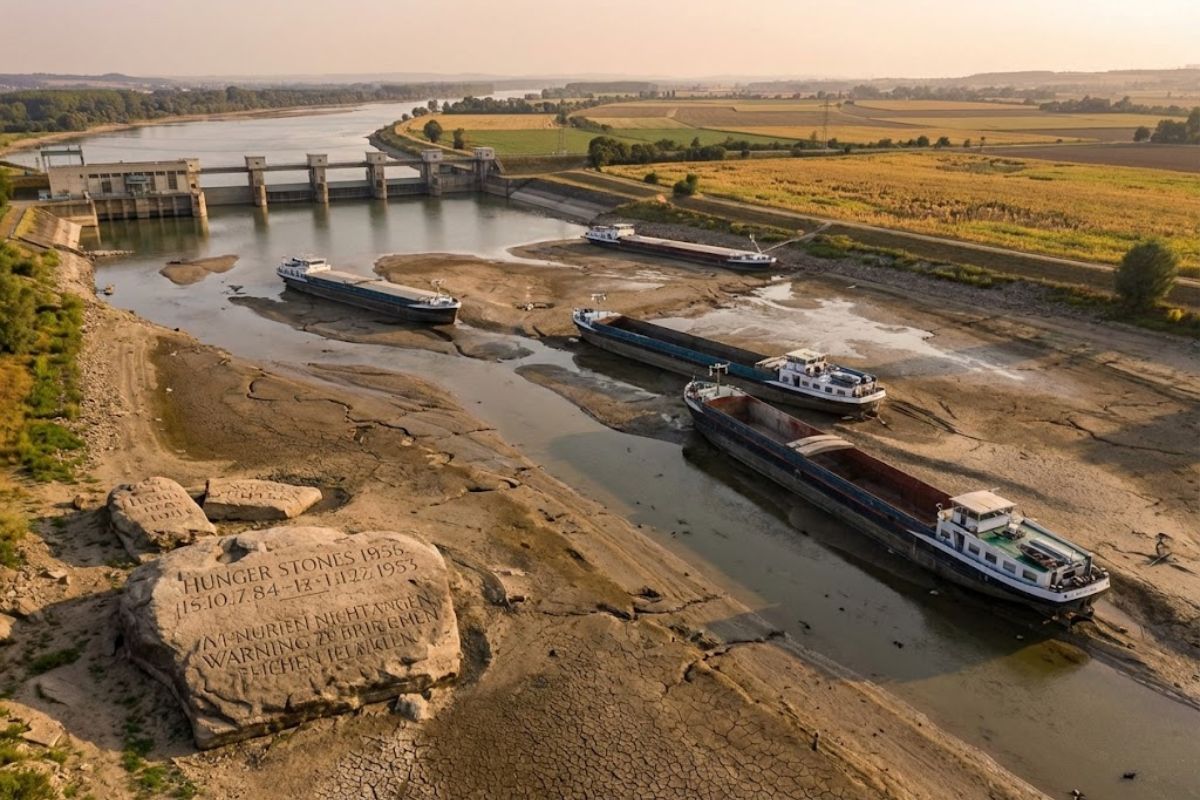


As Europe Sees Rivers Drying Up in Series and Hunger Stones Resurface in Historic Beds, Ships Run Aground, Power Plants Reduce Energy, Crops Shrink, Reserves Fall, Insurance Rates Soar, and Governments Admit Real Risk of Lacking Water, Food, and Security Sooner Than Expected for Millions of People Across the European Continent
Since 2015, episodes of extreme drought have been repeating more frequently in different regions of Europe, causing rivers to dry up in stretches previously considered safe for navigation, irrigation, and power generation. The persistent reduction in flow in basins such as the Rhine, Danube, Loire, Po, Elbe, and Thames reveals a structural change in the European water regime, linked to global warming and the increasing recurrence of severe heat waves.
At the same time, hunger stones inscribed between the 15th and 19th centuries, with warning messages about famine and misery after major droughts, are emerging from the riverbeds, indicating that the current cycle of drought is comparable to, or even more intense than, some of the worst historical records. The combination of drying rivers, cracked riverbeds, stranded vessels, pressured power plants, and threatened crops fuels the fear that water, food, and energy security will run short before the official projections.
Rivers Drying Up and the Message from Hunger Stones

In the Rhine, a strategic river corridor for Germany and neighboring countries, water levels below normal at various points force vessels to navigate with half their load or simply stop their routes.
-
A new Brazilian shopping center worth R$ 400 million will be built in an area equivalent to more than 4 football fields, featuring 90 stores, 5 cinemas, a supermarket, a college, and parking for 1,700 cars, potentially generating 3,000 jobs.

-
Larger than entire cities in Brazil: BYD is building a 4.6 km² complex in Bahia with a capacity for 600,000 vehicles per year, but the discovery of 163 workers in conditions analogous to slavery has shaken the entire project.

-
With an investment of R$ 612 million, a capacity to process 1.2 million liters of milk per day, Piracanjuba inaugurates a mega cheese factory that increases national production, reduces dependence on imports, and repositions Brazil on the global dairy map.

-
Brazilian city gains industrial hub for 85 companies that is equivalent to 55 football fields.


In some stretches, the banks widen to the point of allowing pedestrians to cross on foot during periods of severe drought, indicating that drying rivers are no longer an exceptional scenario and have become part of the routine for entire cities.
A similar situation is observed in stretches of the Danube in Central Europe, where sandbanks emerge and narrow navigable channels, and in the Loire, France, where areas previously flooded are occupied by exposed stones and sparse vegetation.
In this context, hunger stones resurface not only as historical memory but as a physical marker of a water level that, when reached, historically brings famine, transportation restrictions, and local economic crises.
The message is clear: if rivers dry up more frequently, the risk is not just symbolic but directly tied to the survival of communities.
Ships Run Aground and Supply Chains Stall

The main European rivers function as true liquid highways for the transport of fuels, minerals, grains, and chemicals.
When rivers dry up in critical stretches of the Rhine, for example, each barge that reduces its load requires dozens of additional trucks to transport the same volume of goods by road, increasing logistical costs, congesting roads, and raising emissions.
During periods of severe drought, ships get stuck or are prevented from completing full routes, affecting industrial and agricultural supply chains.
Products arrive late at refineries, steel mills, and distribution centers, and contracts need to be renegotiated due to unforeseen costs.
This logistical vulnerability, amplified by the fact that rivers are drying up sequentially in different basins, transforms a climatic phenomenon into a systemic economic risk for Europe.
Power Plants with Less Water to Operate

The water crisis also directly impacts the energy sector.
In France, nuclear power plants that rely on large rivers for cooling reactors need to reduce power or temporarily suspend operations when water is scarce or excessively warm.
Less volume and more heat mean less capacity to dissipate heat without exceeding environmental limits, particularly during periods of high electrical demand.
Hydroelectric plants in countries such as Norway, Spain, Italy, and alpine regions face reservoirs below historical averages, reducing generation capacity and putting pressure on the European electrical system.
When rivers dry up and reservoirs recede simultaneously in several countries, the result is a more vulnerable network, with more volatile energy prices, a need to import electricity, and greater dependence on fossil sources amidst a climate transition.
Crops Shrink and Food Prices Rise
In agriculture, the consequence of drying rivers is immediate: less water available for irrigation and drier soils in critical production areas.
In northern Italy, the Po River is vital for rice fields, corn crops, and pastures that feed the dairy chain.
When the level drops too much, irrigation channels receive less water, harvests shrink, and producers incur successive losses.
In parts of Spain, France, and Central Europe, the combination of prolonged droughts, heat waves, and less water in rivers compromises harvests of wheat, fruits, vegetables, and vineyards.
The lower supply, coupled with steady or increasing demand, puts pressure on prices, raising the cost of the basic food basket in the region and in importing countries.
The image of shrinking crops by drying rivers summarizes the link between climate crisis, food security, and food inflation.
Urban Supply and Water Security Under Pressure
In addition to rural areas, large and small cities depend on rivers and reservoirs connected to them for domestic, industrial, and service supply.
In some municipalities, the critical level of reservoirs leads authorities to impose consumption restrictions, limit water use for irrigation, street cleaning, and non-essential industrial activities.
Collection systems need to be adapted to source water from deeper points, which requires additional investments in engineering and energy.
In scenarios of rivers drying up repeatedly, supply networks designed for a more stable water regime operate near their limits more frequently, increasing the risk of failures, rationing, and conflicts between economic sectors over who should have priority in water use.
This transforms water security into a central theme of urban and national planning.
Climate Change and the New Frequency of Droughts
Climate studies indicate that Europe is warming faster than the global average, which accelerates evaporation, alters rainfall patterns, and reduces the volume of snow and ice that feed rivers throughout the year.
The problem lies not only in the intensity of each isolated drought but in the frequency with which they occur.
Instead of rare events over a century, severe drought waves have been repeating at intervals of just a few years.
This shortening of the interval between crises prevents full recovery of aquifers, glaciers, and reservoirs.
When natural systems don’t have time to recover and rivers drying up again make headlines before complete recharge, structural vulnerability increases, and governments’ margin for maneuver diminishes.
The consequence is a cycle of permanent emergency management, rather than preventive planning based on water stability.
How to React Before Rivers Dry Up Even More
The discussed responses combine adaptation and mitigation.
In the short term, authorities adjust navigation rules, prioritize human supply over other uses, flexibilize power plant operations, revise irrigation plans, and create emergency funds for affected producers.
The immediate goal is to reduce the economic and social impact each time rivers reach critical low levels.
In the long run, the agenda includes reducing greenhouse gas emissions, diversifying the energy matrix, implementing more efficient irrigation systems, reviewing agricultural crops in vulnerable regions, and restoring wetlands and riparian forests that act as natural water sponges.
Without these measures, the continent will have to deal with an overlap of water, food, and energy crises that could destabilize economies and democracies.
In the end, the resurgence of hunger stones and the vision of drying rivers in some of Europe’s most iconic postcards serve as a real-time alert.
It is not just about threatened landscapes but about infrastructure, jobs, and lives at risk in a continent that has always seen itself as a reference for stability.
In your opinion, what should be Europe’s absolute priority to face the prospect of seeing its rivers drying up more and more: reducing emissions, changing the agricultural model, reinventing the energy system, or combining all of this into a single plan?









Parar de investir em armas para fomentar guerras, e financiar a combinação de tudo isso em um plano único.
Combinar tudo em um plano único, inclusive fiscalizar e punir com mais rigor as empresas que poluem os rios.
Recuperar as matas ciliares protegendo as nascentes e as margens dos rios.