





 Portuguese
  English
  Spanish
  5 min of reading
  0 comments


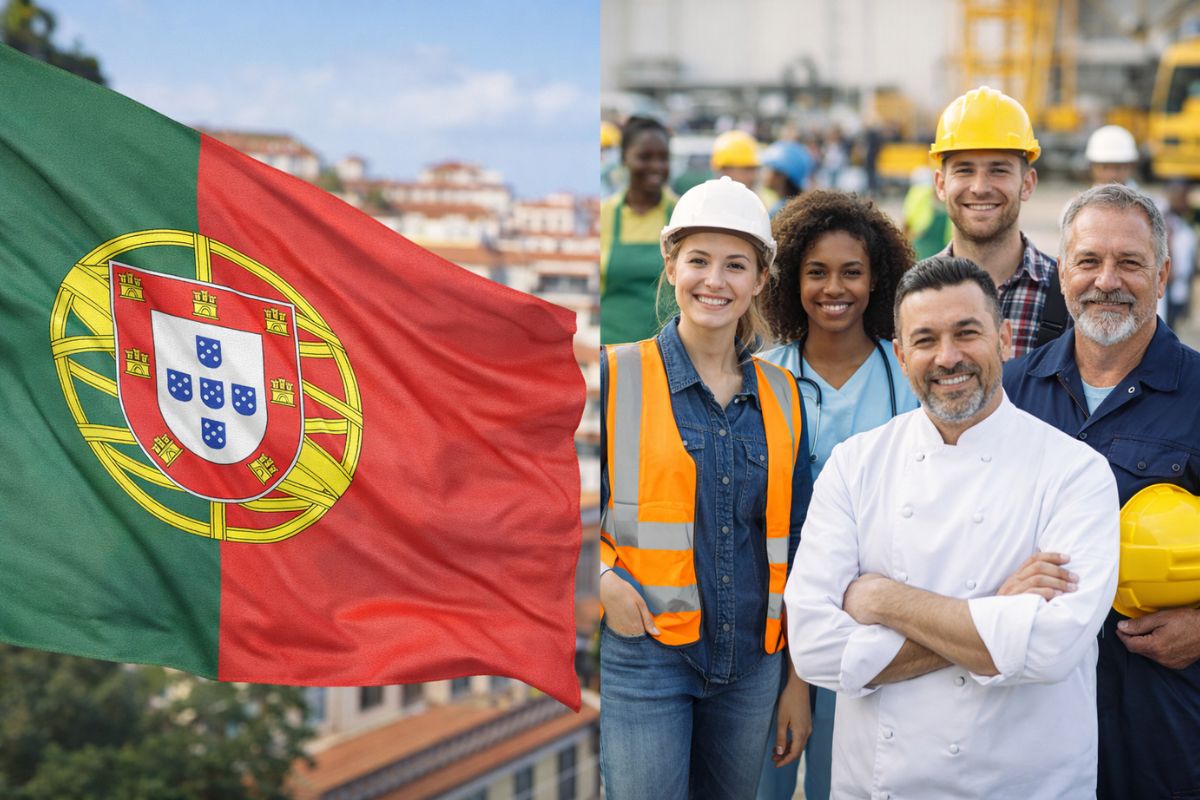
Portugal, the most sought-after European country by Brazilians, will need up to 1.3 million workers by 2030 according to projections based on INE and AIMA data, because the aging population has reduced the ratio to 1.7 workers per pensioner, well below the 2.5 considered ideal.
While thousands of Brazilians dream of moving to Portugal, the European country faces a problem that few imagine. Portugal will need up to 1.3 million new workers by 2030 to keep its social security and economy functioning, according to projections based on statistics from the National Institute of Statistics (INE), Social Security, and the Agency for Integration, Migration, and Asylum (AIMA). The accelerated aging of the population combined with declining birth rates has created a scenario where the European country simply does not have enough people of working age to sustain the system.
The numbers explain the urgency. Currently, the European country has only 1.7 workers for each pensioner, a figure considerably below the 2.5 considered ideal to maintain the social security system in balance. Without the entry of new workers, the math doesn’t add up: fewer contributors mean less revenue for social security, less domestic consumption, and less economic activity. Immigration has ceased to be an option for Portugal and has become the only viable long-term strategy to avoid collapse.
Why the most sought-after European country by Brazilians is so desperate for workers

Portugal is going through the same process affecting various countries in Europe: the population is aging rapidly while birth rates continue to decline.
-
The government allows the new ID to be requested on a mobile phone and delivered at home.

-
Millions of PET bottles are turning into clothing around the world, and tons of recycled polyester are revolutionizing the fashion industry, with brands like Adidas, Nike, Zara, and Shein already incorporating it into their collections.

-
Sitting on the sidewalk at the end of the afternoon: the simple habit that brought neighbors together, slowed down the routine, and reveals why social interaction was stronger before the digital age.
-
Daughter of a public servant, a young woman from MA turns her fight for the environment into a victory and secures a full scholarship at a university in the USA.

The result is an inversion of the age pyramid where the number of people over 65 years old grows each year while the economically active population decreases. Fewer people working means fewer people contributing to social security, fewer people paying taxes, and less economic activity.
The European country cannot solve this problem solely with policies to encourage childbirth, because even if Portuguese families started having more children tomorrow, it would take at least 18 to 20 years for these new citizens to enter the labor market.
The demographic math does not wait. The need for 1.3 million workers by 2030 is too urgent to be solved by births. Only immigration can fill this gap within the necessary timeframe.
The foreigners who already support the economy of the European country
Immigration is already a structural reality in Portugal. According to data from INE and AIMA, the number of foreigners registered in Portuguese Social Security has already surpassed one million workers.
These foreign professionals are essential to balance the public accounts of the European country, specifically the social security system, which relies on contributions from those who are active to pay the benefits of those who have already retired from the market.
Without this contribution from immigrants, the European country would already be in a critical social security situation. The ratio of 1.7 workers per pensioner, which is already low, would be even lower without the foreigners who work and contribute legally on Portuguese soil.
Brazilians represent one of the largest immigrant communities in Portugal and are present in sectors ranging from construction to tourism, from technology to healthcare. For the European country, every foreign worker contributing to Social Security is part of the solution, not the problem.
What the ratio of 1.7 workers per pensioner means in practice
To understand the gravity, it is necessary to know what this number represents. In a healthy social security system, the ideal ratio is at least 2.5 active workers for each pensioner, ensuring that contributions comfortably cover benefit payments.
With 1.7, the European country operates at a structural deficit: the contributions from workers are not sufficient to fully cover payments to pensioners, and the government needs to supplement with resources from the general budget.
If the ratio continues to fall, the European country may be forced to choose between reducing pension benefits or increasing taxes on active workers, both politically explosive options.
The third alternative is the one Portugal is pursuing: bringing in more workers from abroad to increase the base of contributors. With 1.3 million new workers by 2030, the expectation is that the ratio will approach the ideal level and that the system will function again without the need for constant government subsidies.
What this means for Brazilians thinking of emigrating to the European country
For Brazilians, the scenario creates a real window of opportunity. A European country that desperately needs labor tends to facilitate migration processes, expand work visas, and create integration programs that make moving more viable.
Portugal is already the most sought-after destination for Brazilians emigrating to Europe, for reasons ranging from the shared language to cultural proximity, and the need for workers only reinforces this trend.
But it is important to understand that the demand from the European country is not for just any type of worker. Sectors such as construction, healthcare, technology, tourism, and long-term care are the ones that need professionals the most.
Brazilians with qualifications in these areas find in the Portuguese scenario a rare combination: a country that needs them as much as they would like to be there. Immigration has ceased to be tolerated and has become encouraged as state policy.
Brazil may face the same problem as the European country in the future
The demographic issue is not exclusive to Portugal. Brazil is also undergoing an inversion of the age pyramid, and the 2022 Demographic Census showed that the number of people aged 65 or older grew by 57.4% in just 12 years.
The difference is that Brazil still has a proportionally larger young population than Portugal, giving the country a window of time to prepare. But this window is closing.
If Brazil does not adjust its social security system and labor market policies in the coming decades, it may face a scenario similar to that of the European country: lack of workers, unsustainable social security, and dependence on immigration to keep the economy functioning. The difference is that Portugal can attract immigrants from Europe, Africa, and Latin America.
Brazil would have to compete for foreign workers in an increasingly competitive global market. What is happening in Portugal today is a warning of what may happen here tomorrow.
Would you consider moving to Portugal knowing that the European country needs workers? Do you think Brazil should be more concerned about the aging population? Share in the comments. This debate about demographics and work affects the future of those starting their careers now and those preparing for retirement.










Seja o primeiro a reagir!