





 Portuguese
  English
  Spanish
  7 min of reading
  0 comments


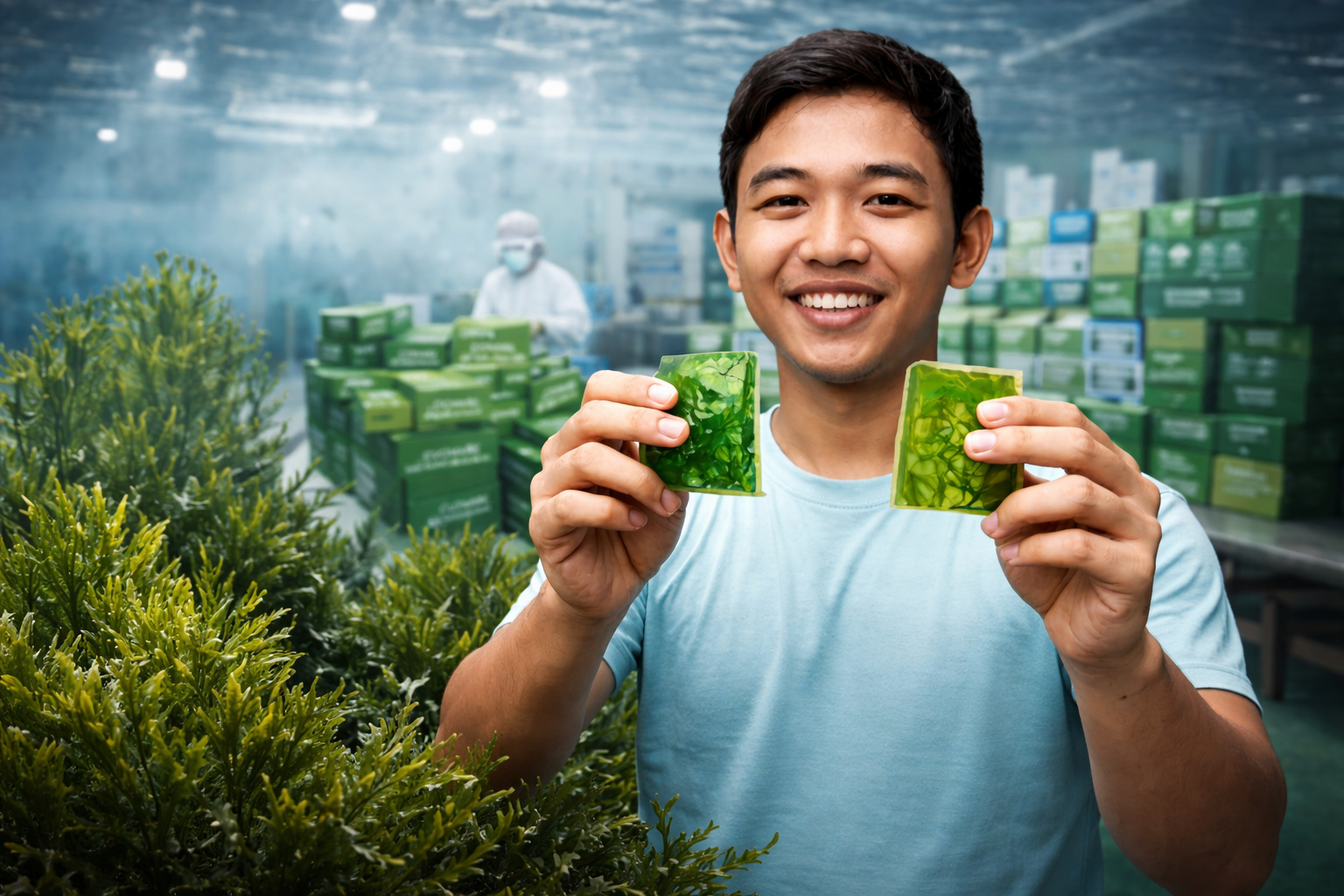
At 23 Years Old, An Entrepreneur from Indonesia Created A Direct Alternative to Disposable Plastic: Packaging Made from Seaweed That Dissolves in Hot Water at 100 °C or Can Simply Be Ingested with Food.
Indonesia is facing a devastating environmental crisis as the second-largest ocean plastic polluter on the planet, with 620,000 tons leaking annually into rivers and seas while paradise beaches disappear under mountains of waste. Single-use plastic sachets dominate this catastrophic scenario, representing 70% of marine plastic waste with no commercial value for recycling or adequate collection infrastructure.
As this environmental tragedy unfolded, David Christian returned to the country after four years of studying in Canada and was shocked by the volume of plastic bags spread across the streets of Jakarta. But instead of merely lamenting the problem, this 23-year-old identified an extraordinary opportunity: to transform the abundance of Indonesian seaweed into a viable commercial solution to replace disposable plastic.
Indonesia Produces 10 Million Tons of Seaweed Annually with Chronic Oversupply
Indonesia dominates the global seaweed production alongside China, cultivating more than 10 million tons annually with a goal to expand to 19 million tons by 2020. This massive production is concentrated in five of the six poorest provinces of the country, where farmers face exploitive distribution chains dominated by middlemen and loan sharks.
-
Motorola launched the Signature with a gold seal from DxOMark, tying with the iPhone 17 Pro in camera performance, Snapdragon 8 Gen 5 that surpassed 3 million in benchmarks, and a zoom that impresses even at night.

-
Satellites reveal beneath the Sahara a giant river buried for thousands of kilometers: study shows that the largest hot desert on the planet was once traversed by a river system comparable to the largest on Earth.

-
Scientists have captured something never seen in space: newly born stars are creating gigantic rings of light a thousand times larger than the distance between the Earth and the Sun, and this changes everything we knew about stellar birth.

-
Geologists find traces of a continent that disappeared 155 million years ago after separating from Australia and reveal that it did not sink, but broke into fragments scattered across Southeast Asia.


Seaweed cultivation does not require arable land, freshwater, chemical fertilizers, or sophisticated technology to thrive. Production occurs entirely offshore in simple floating structures, allowing up to 40 tons to be cultivated in an area equivalent to a baseball field. The full growth cycle takes only 45 days until harvest, multiplying rapidly without significant human intervention.
Paradoxically, this abundance creates economic suffering for producers who receive miserable payments due to long intermediated trade chains. Farmers indebted to loan sharks sell their harvests at prices that barely cover operational costs, resulting in child malnutrition and an inability to afford education. Unused productive surplus rots while families go hungry.
Certified Seaweed Packaging Is 100% Biodegradable and Completely Dissolves in Hot Water Without Leaving Residues
The manufacturing process of Evoware starts with red algae collected from cooperative farmers in Makassar who receive specific training on proper cleaning and maintaining high-quality standards. The material undergoes controlled fermentation without aggressive chemical processing, preserving natural properties while yeast waste is converted into animal feed, completely eliminating waste.
The end result is a flexible translucent film that can be printed with custom logos, sealed thermally like conventional plastic, and stored for two years without artificial preservatives before beginning degradation. Certification from the Kenyan Bureau of Standards confirms total biodegradability, and Halal certification ensures suitability for Indonesia’s majority Muslim population, removing cultural adoption barriers.
The most revolutionary feature is instant dissolution when submerged in hot water above 100°C, releasing the contents without the need to manually open the packaging. Seasoning sachets for instant noodles simply melt upon adding boiling water, automatically mixing the seasoning. This property transforms the consumer experience by eliminating the step of opening multiple small packets.
Edible Material Contains Fibers, Vitamins, Minerals, and Works as a Natural Fertilizer for Plants
Besides being biodegradable, Evoware’s packaging is completely edible and nutritious, providing a natural source of dietary fibers, essential vitamins, and minerals that seaweed concentrates during growth. The flavor is described as “almost tasteless and odorless” by the company, allowing consumption alongside packaged food without significantly altering the dining experience.
The ideal application is burger wraps that can be bitten along with the sandwich, eliminating the need to remove the paper before eating. Consumers who prefer not to ingest the packaging can dispose of it in home composting where it functions as natural fertilizer for plants, returning nutrients to the soil in a completely closed cycle without producing any waste.

Nutritional properties transform waste into resource, especially relevant in regions where malnutrition affects vulnerable populations. Discarded sachets in gardens or pots provide plant nutrition identical to commercial organic compounds, creating value even when the product is not directly consumed. This versatility of final use completely eliminates the concept of “waste.”
Manual Production of 60 Sachets Daily Expands to 2,000 Units with Machinery Automation
When Evoware began commercial operations in March 2018, artisanal production was limited to a mere 60 sachets daily made entirely by labor-intensive manual work. This microscopic scale made it impossible to meet the growing demand of approximately 100 weekly inquiries about packaging, with 87% of these inquiries coming from outside Indonesia, highlighting international appeal.
Investment in automated machinery allowed for an extraordinary productive leap to 2,000 sachets daily, a 3,233% increase in manufacturing capacity. This automation drastically reduced unit costs, which were five times higher than conventional plastic packaging to only 20% more expensive after economies of scale, making the product commercially competitive.
The production facility is located in Jakarta while raw material is supplied by a cooperative of 1,200 seaweed farmers in Makassar, South Sulawesi. The company plans to expand to Bali where consumer environmental awareness is higher, facilitating initial adoption before scaling to broader markets through distributors in other Asian countries.
Cooperative of 1,200 Farmers in Makassar Receives 178% Higher Payments Than Traditional Middlemen
Evoware’s business model transcends corporate profit by integrating direct social impact in seaweed-producing communities. The company pays cooperative farmers 178% above the price offered by traditional intermediaries, breaking the vicious cycle of exploitation that keeps families in generational poverty despite producing valuable commodities.
The stated goal is to increase farmers’ income by 62% starting with 60 initial families and expanding to 1,200 supplier families by 2023. This growth not only improves individual quality of life but also catalyzes regional economic and social development by injecting capital directly into communities historically marginalized by the formal economy.
Technical training provided by the company teaches farmers how to cultivate high-quality seaweed, properly wash the material, and maintain consistent standards that the premium market demands. This knowledge transfer empowers producers to access higher value-added markets independently, creating human capital that remains in the community even after the eventual commercial relationship with Evoware ends.
Ello Jello Line: Edible Flavored Cups of Mint, Orange, Lychee, and Green Tea
In addition to neutral food packaging, Evoware has developed the Ello Jello line of edible disposable cups with various flavors including mint, orange, lychee, and green tea. These cones can hold ice cream, desserts, or beverages, being completely consumed after use, eliminating waste entirely.
The initial price of these edible cups was five times higher than traditional crepe cones, creating a significant barrier to market adoption. Productive automation has substantially reduced this difference, making the product accessible to broader segments beyond premium consumers willing to pay a premium for sustainability.

Current applications of Evoware packaging include sandwiches, waffles, instant coffee, popsicles, seasonings, snacks, energy bars, and organic sugar. Non-food products also utilize sachets to package toothpicks, soaps, and sanitary pads, demonstrating versatility beyond the original food sector.
Research and Development of Water-Resistant Formula for Liquids such as Shampoo and Soap
The main limitation of the original packaging is its low moisture barrier which causes degradation when exposed to high humidity or direct contact with liquid water. The product was specifically designed for quick single-use as a fast-food wrapper or internal packaging for condiments in industrialized food products where prolonged exposure to moisture does not occur.
The technical team led by partner Noryawati, responsible for research and development with an extensive scientific background, is actively working on developing an improved water-resistant formulation. This enhanced version will not be edible but will remain 100% biodegradable, allowing for the storage of liquids such as shampoo and soap that the conventional market dominates with plastic bottles.
Tests have shown that the current packaging has superior resistance to atmospheric oxygen exposure compared to conventional metal sachets, preventing oxidative deterioration of packaged foods. This unexpected property adds functional value beyond environmental benefit, improving the shelf life of air-sensitive products.
Goal: Reduce 2,400 Tons of Plastic Waste and 14,400 Tons of CO₂ by 2023
Environmental objectives quantified by Evoware are based on internal studies projecting the elimination of 93 tons of plastic waste in 2018/2019 expanding to 2,400 tons by 2023. The reduction of carbon dioxide emissions follows a similar trajectory starting with 558 tons and reaching 14,400 tons in the same timeframe.
The preservation of clean coastlines aims to maintain 218 initial hectares and expand to 5,408 hectares by 2023, protecting the coast from environmental threats caused by plastic accumulation that suffocates marine ecosystems. This goal recognizes that Indonesia has an extremely extensive coastline requiring massive scale intervention for measurable impact.
Evoware’s work has received international recognition through two awards in 2017: Social Venture Challenge Asia in the Idea category and Circular Design Challenge in the New Plastics Economy category. Founder David Christian was subsequently named Young Champion of the Earth by the United Nations Environment Programme in 2020, validating the potential impact of the innovation.
Sachets Replace Multi-Layer Packaging with No Recycling Value in the Indonesian Market
Single-use sachets represent a particularly problematic item contributing to plastic leakage in Indonesia and other Southeast Asian countries due to their small size and zero commercial value in the recycling market. No collector or recycler has a financial incentive to collect these microscopic wastes that require extensive cleaning before reprocessing.
PT Seaweedtama Biopac Indonesia operates as a manufacturer while PT Evogaia Karya Indonesia functions as a distributor, a corporate structure that separates production from marketing allowing for a scale of impact through the Evoware brand. This strategic division facilitates future expansion by enabling different regional partners to assume local distribution tailored to specific markets.
Conventional multi-layer packaging combines different laminated plastics making mechanical separation for recycling impossible, directing 100% of this material to landfills or incineration. Substituting with a biodegradable single-layer seaweed sachet completely eliminates this category of waste, creating a viable path for responsible disposal in contexts where waste management infrastructure is non-existent.








Seja o primeiro a reagir!