





 Portuguese
  English
  Spanish
  5 min of reading
  0 comments



This Is a Milestone in the History of Military Aviation, with Surprising Details About the Trajectory of One of the Most Iconic Fighters of the Brazilian Air Force. Discover How the Aircraft Shaped Air Defense and Withstood the Test of Time.
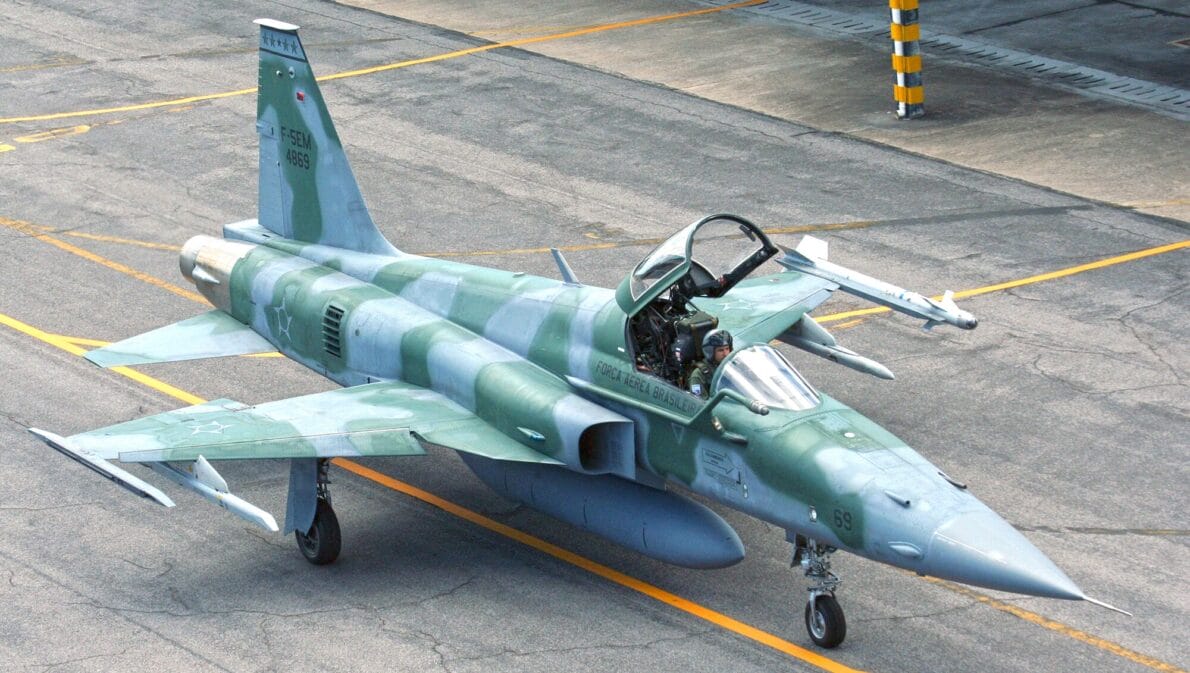
The F-5 completed 50 years of operation in the Brazilian Air Force (FAB) in 2025.
This historic fighter has a trajectory that intertwines with the evolution of FAB itself.
The aircraft was introduced in Brazil in 1975, but its story begins decades earlier.
-
Mercado Livre has just started selling medications with delivery in up to three hours to your door, and this move could completely change the way Brazilians buy medicines on a daily basis.

-
In Dubai, rising tensions from the war in the Middle East are causing super-rich individuals to leave the Gulf and direct their fortunes to a new financial refuge in Asia.

-
“No one will make us change the Pix,” says Lula after the US report.

-
Lula responds directly to Trump and says that Pix is from Brazil and will not change under pressure from anyone, after a report from the United States pointed out the Brazilian payment system as an American trade barrier.


In the 1950s, the United States Air Force was looking for a lightweight, economical, and efficient fighter.
This context led Northrop to develop an innovative project, led by engineer Edgar Schmood, who was also responsible for the development of the P-51 Mustang, a legendary World War II aircraft.
The goal of Northrop was to create a high-performance fighter, affordable for other allied nations, and capable of operating in adverse conditions.
The Beginning of the F-5
In 1953, NATO issued a requirement for a lightweight tactical fighter, capable of operating from improvised runways and carrying conventional as well as nuclear armaments.
Recognizing this need, Northrop developed the N156 model.
This project aimed to reverse the trend of increasingly larger and more expensive fighters of the time.
The heart of the new fighter would be the General Electric J85 turbojet engines, capable of generating up to 5,000 pounds of thrust with afterburner.
With this, the F-5 would have a thrust-to-weight ratio far superior to other aircraft of that era.
This configuration would ensure excellent performance even today.
Today, the F-5 continues to impress with its capability and efficiency, boasting an impressive combination of power and versatility.
The Evolution of the Design
The development of the F-5 underwent various adjustments, leading Northrop to focus on a lightweight version for export as well as an advanced training aircraft.
This later resulted in the T-38 Talon.
With these design changes, the final configuration of the F-5 was defined in 1956.
The United States Air Force selected the training version N156 Tango to replace the T-33, creating the T-38, which first flew in 1959.
Subsequently, the model N156 Fox was officially designated F-5 Alpha Freedom Fighter and entered large-scale production.
Characteristics of the F-5
The F-5 has a length of 14.45 meters and a wingspan of just 8.13 meters.
This gives the aircraft a long and narrow fuselage, with a distinct configuration.
The height of the plane, considering the tip of the vertical stabilizer, is about 4 meters.
With an empty weight of 4,349 kg and a maximum takeoff weight of 11,193 kg, the F-5 is capable of reaching a maximum speed of Mach 1.6 (approximately 1,730 km/h).
Its range is 1,814 km with the use of an external tank.
Its combat radius is about 300 miles, which is impressive for a light fighter of its generation.
The F-5’s armament capacity is also noteworthy, with seven hardpoints, allowing it to carry up to 3,200 kg of bombs, missiles, and external tanks.
Additionally, it can be armed with the AIM-9B Sidewinder missile and a 20 mm M39 cannon, with 280 rounds.
The Success of the F-5 in Brazil
The F-5 has proven to be a reliable aircraft with low operational costs, being widely used by various air forces around the world, including the United States.
In 1975, the F-5 was introduced into the Brazilian Air Force.
The FAB acquired 30 units of the F-5E model and 6 units of the F-5B, in a contract worth 72 million dollars.
The first aircraft arrived in Brazil in March 1975, with the final delivery occurring at Galeão Air Force Base in Rio de Janeiro.
In 1988, FAB expanded its fleet, acquiring 22 more units of the F-5E and 4 units of the F-5B.
During the 1990s, the remaining F-5B units were retired and sent to museums.
Modernization of the F-5
With the advancement of technology, FAB initiated a modernization program in the early 2000s to update its aircraft.
This process involved Embraer and Israeli systems companies, resulting in the upgrade of 46 units to F-5E/M and F-5F/M versions.
As a result, the F-5 fighters transitioned from third-generation aircraft to fourth-generation aircraft, with modern avionics, new radars, and electronic warfare systems.
These improvements allowed the F-5 to remain relevant in combat even today.
The avionics were updated to include LCD displays, a head-up display (HUD), and helmet-mounted displays for the pilot.
The defense system was enhanced, with encrypted communication implemented with other FAB aircraft.
The Participation of the F-5 in Movies and Training Exercises
The F-5 also gained notoriety outside the military world.
In the 1986 film “Top Gun,” the F-5 was used as the fictional MiG-28, the enemy plane that battles the F-14 Tomcat.
The United States Air Force uses the F-5 to simulate enemy aircraft during air combat training exercises.
This use of the F-5 in air combat training has been essential for improving air defense tactics.


The F-5 Until Today
Even with the introduction of new fighters, such as the Gripen E/F, the F-5 continues to operate in FAB until 2025.
In 2008, FAB acquired 11 units of the F-5, which were modernized in Jordan.
These fighters underwent a similar upgrade process to that performed on the Brazilian units, ensuring their effectiveness in combat missions.
F-5: A Legacy That Endures
In 2025, the Brazilian Air Force celebrates 50 years of operation of the F-5, an aircraft that played a fundamental role in Brazil’s defense and continues to be a reference for combat aviation.
With its ability to adapt and evolve, the F-5 is an example of how a successful project can endure through constant innovations.
Today, the F-5 is one of the most valuable aircraft in the FAB fleet, maintaining the security and sovereignty of Brazilian airspace.
Soon, the introduction of the Gripen E/F, which will replace the F-5, will mark the end of an era. However, the legacy of the aircraft that marked the history of the Brazilian Air Force will continue to be remembered for decades.
And you, have you imagined what the future of Brazilian military aviation will be like after the retirement of the F-5? Share your opinion in the comments!








Seja o primeiro a reagir!