





 Portuguese
  English
  Spanish
  5 min of reading
  0 comments


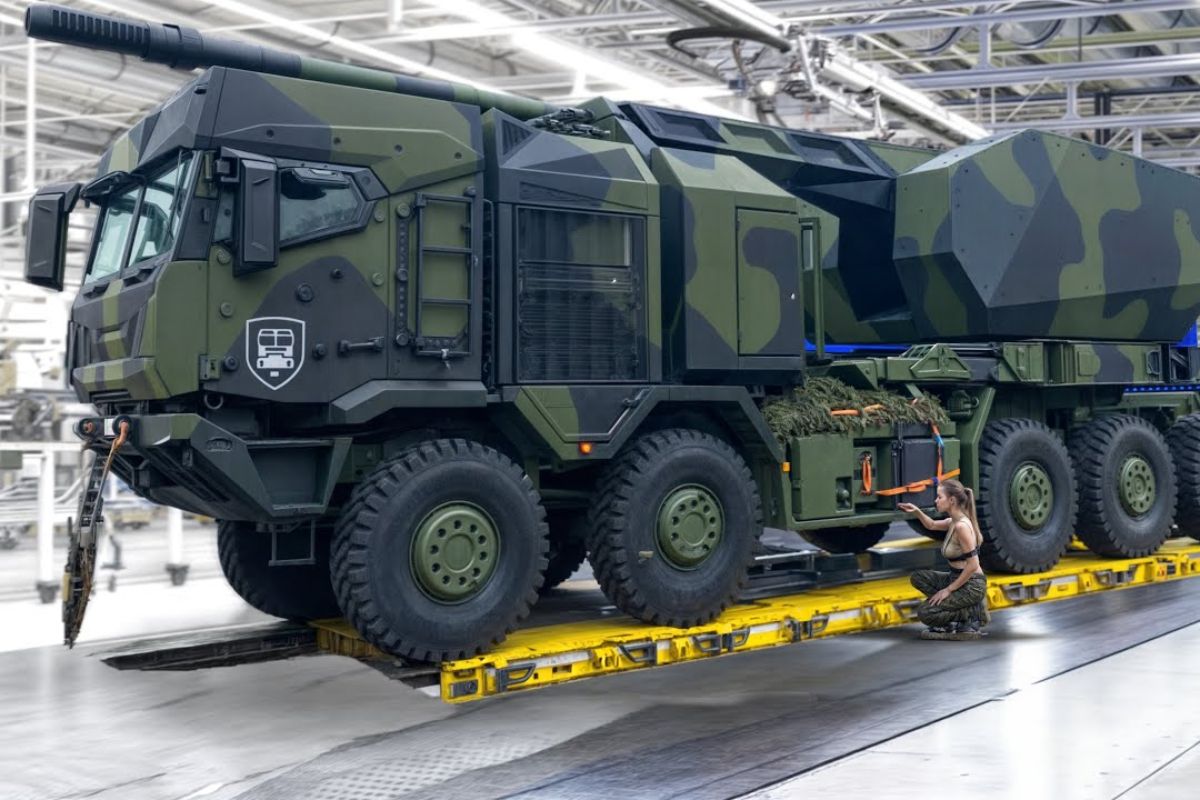
Secret German Factory Reveals in Detail How Giant Military Trucks Are Handcrafted, Receive Extreme Armor, Support Up to 130 Tons, and Reveal Europe’s Silent Rush to Expand Its Heavy War Industrial Capacity.
The manufacturing of giant military trucks takes place within a highly restricted industrial complex located in Central Europe, strategically near Germany, Austria, and the Czech Republic. The facility operates under strict security protocols, access control, and confidentiality, producing vehicles intended exclusively for national armed forces and European military alliances.
Since 2007, over 20,000 giant military trucks from the HX family have been produced in this industrial system. However, the most extreme model in the line, the HX81 known internally as the “Elephant,” has only 137 units manufactured, due to its complexity, cost, and highly specialized function. Each vehicle is designed to transport modern battle tanks, operate in active combat zones, and withstand environmental conditions that would destroy civilian vehicles in minutes.
The Structural Birth of Giant Military Trucks

The production of the giant military trucks begins with the welding of the chassis, which is performed almost entirely manually.
-
Larger than entire cities in Brazil: BYD is building a 4.6 km² complex in Bahia with a capacity for 600,000 vehicles per year, but the discovery of 163 workers in conditions analogous to slavery has shaken the entire project.

-
With an investment of R$ 612 million, a capacity to process 1.2 million liters of milk per day, Piracanjuba inaugurates a mega cheese factory that increases national production, reduces dependence on imports, and repositions Brazil on the global dairy map.

-
Brazilian city gains industrial hub for 85 companies that is equivalent to 55 football fields.

-
Peugeot and Citroën factory in Argentina cuts production by half and opens a layoff program for more than 2,000 employees after Brazil drastically reduced purchases of Argentine vehicles.


Unlike traditional automotive industry, there are no high-speed robotic lines. The reason is simple: each chassis is unique, made to military specifications and prepared for extreme loads.
The chassis uses ultra-high-strength steel, designed to endure minimal deformation even under a combined weight of up to 130 tons.
The front and rear axles are mounted separately, with extremely tight tolerances, and then integrated into the main structure.
Each axle is developed to operate in deep mud, snow, sand, rocky terrain, and inclines over 60%, a scenario common in real military operations.
Anti-Corrosion Treatment and Manual Military Painting

After structural welding, the chassis of the giant military trucks is transported to a secluded area of the factory, where it undergoes a complete anti-corrosion treatment.
This coating is essential for ensuring decades of operation in extreme environments, including saline air, constant humidity, ice, intense heat, and chemical exposure.
The painting is done manually.
The predominant color is standard European military green, followed by versions in desert camouflage.
Each layer is applied slowly, with constant visual inspection to ensure that there are no defects on large metal surfaces.
The workers use complete protective gear due to the toxicity and durability of the compounds used.
Wheels, Tires, and the Base for Extreme Loads
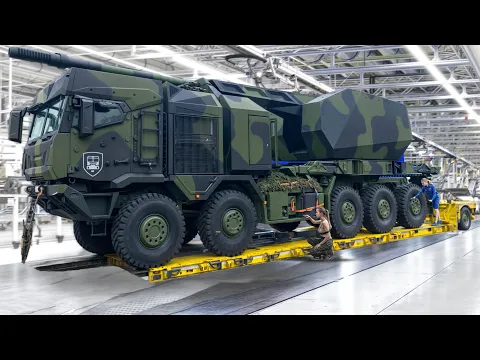

The giant military trucks are equipped with eight large wheels, installed with the help of hydraulic manipulator arms.
Each wheel is secured with ten bolts, double the civil standard, ensuring structural stability even under maximum load.
This set of wheels, tires, and axles allows the HX81 to transport trailers weighing up to 73 tons, in addition to the vehicle’s own weight.
The system is designed to maintain continuous traction on terrains where conventional trucks would simply get stuck or suffer structural failures.
Modular Cabins and Ballistic Protection
The cabin of the giant military trucks is constructed separately from the chassis. There are unarmored versions and versions with integrated armor, depending on the mission.
The armor can resist shrapnel, ballistic impacts, and nearby explosions.
The reinforced roof supports the weight of two armed soldiers and the recoil of a heavy machine gun of 12.7 mm mounted on a circular support.
The interior prioritizes functionality and durability: steel surfaces, washable vinyl coverings, and the absence of fragile components common in civilian vehicles.
Kilometers of Wiring and Extreme Manual Assembly
Each giant military truck contains kilometers of electrical wiring.
The wiring harnesses are produced in a separate pavilion and delivered to the assembly line at strictly controlled times.
The installation is entirely manual, requiring absolute precision.
Seats, panels, communication systems, and controls are installed with the help of internal cranes.
Each step is supervised by teams responsible solely for quality, ensuring that no component falls out of specification.
The “Marriage” Between Chassis and Cabin
The most critical moment in the assembly of the giant military trucks is known as the “marriage.”
In this phase, the cabin is lowered onto the chassis using internal overhead cranes.
After fitting, structural bolting occurs, window installation, sealing, and complete integration of electrical and hydraulic systems.
The windows receive special sealing, ensuring total insulation.
Each vehicle is then identified with a serial number, military markings, and official symbols of the recipient armed forces.
Engine, Power, and Extreme Mobility
The giant military trucks use turbocharged V8 diesel engines, with an approximate power of 500 kW.
The 8×8 traction system guarantees total off-road mobility, with a maximum speed of 89 km/h and a range of up to 800 kilometers.
The lowered chassis, combined with reinforced suspension, large shock absorbers, and sturdy stabilizers, allows continuous operation on extremely uneven terrain, maintaining minimal comfort and crew safety.
Sealing, Submergence, and Performance Tests
Before final release, the giant military trucks undergo rigorous testing.
The cabin is subjected to intense jets of water to verify total sealing.
No infiltration is accepted, as the vehicle must withstand flooded crossings and partial submergence.
In dynamometers, the engine is tested under maximum load.
On internal tracks, each truck runs technical circuits for almost one hour, evaluating brakes, steering, suspension, electrical systems, and overall performance.
Limited Production and European Industrial Acceleration
Even with gigantic facilities, annual production is limited to a few hundred units.
This occurs because each giant military truck is practically handcrafted, requiring thousands of hours of specialized labor.
In recent years, the number of employees and the production pace have increased consistently.
The reason is clear: Europe is silently accelerating its war industry, expanding military contracts, growing factories, and heavily investing in heavy logistics, especially in light of rising geopolitical tensions on the continent.
A Strategic Pillar of Modern Warfare
The giant military trucks are not just transport vehicles.
They represent the logistical backbone of modern armies, enabling the movement of tanks, artillery systems, mobile bridges, and heavy equipment in any operational scenario.
Each unit that leaves this secret factory carries tons of steel, extreme engineering, and a clear message: Europe’s military industrial capacity is being strengthened to face prolonged conflicts, high-intensity operations, and unpredictable scenarios.
Do you believe that this quiet expansion of giant military truck production indicates defensive preparation or a new cycle of arms race on the European continent?






-

-

-

-

-

-

61 pessoas reagiram a isso.