





 Portuguese
  English
  Spanish
  7 min of reading
  0 comments


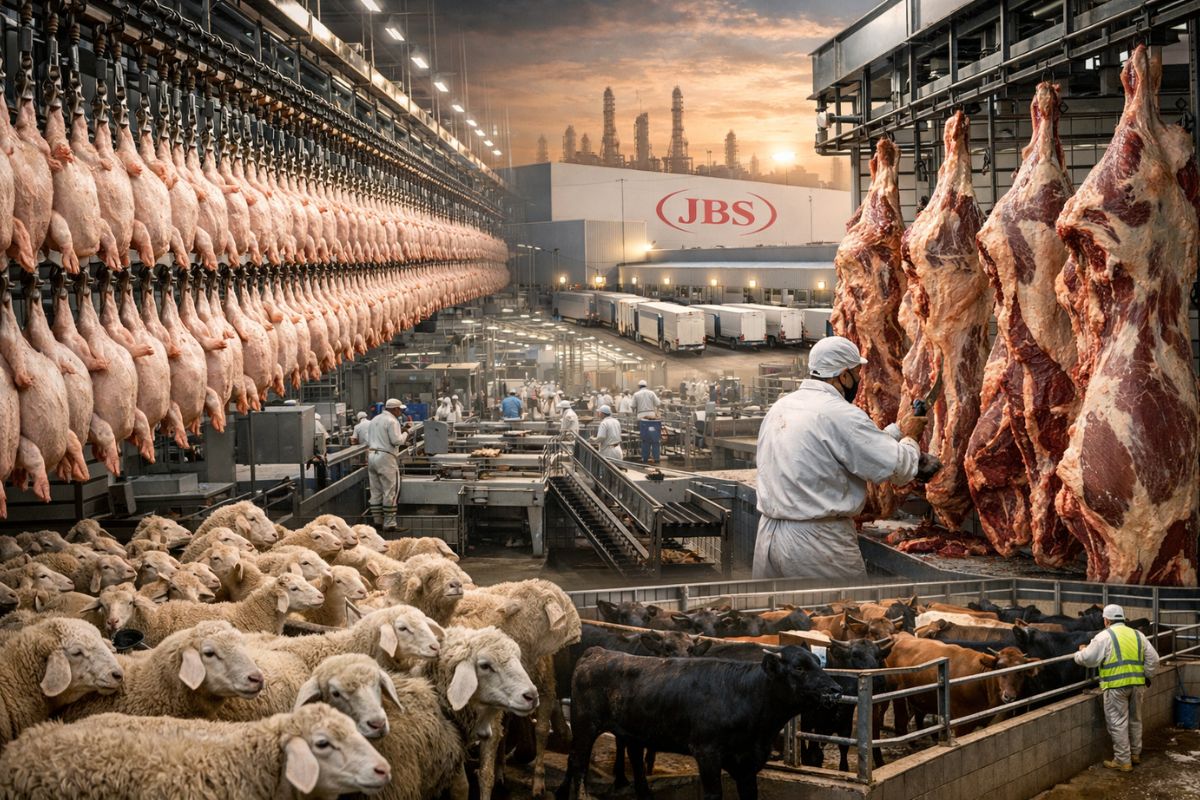
With JBS Holding a Majority Stake in a Joint Venture with Oman Food Capital, the Project Brings Together Two Productive Structures, Bets on the Halal Market, Anticipates More Than 300 Thousand Tons Per Year, and Places Oman at the Center of an Industrial Expansion Focused on Local Production and Export of Diversified Proteins.
JBS announced an investment of approximately R$ 750 million to establish a new industrial platform for protein production in Oman, in the Middle East, in a move that combines scale, geographical positioning, and focus on a consumer market with enormous international relevance. The proposal involves poultry, cattle, and lamb, in addition to creating more than 3,000 direct jobs over the coming years.
The project is not limited to opening a new isolated unit. It is designed to integrate structures already in development in the country, strengthen local food production, and transform Oman into a strategic base for the export of halal products. In practice, the operation expands the company’s international reach and reinforces a more structured presence in a region viewed as decisive for the protein sector.
JBS Bets on Oman to Open a New Growth Front
The operation will be structured through a joint venture, a model in which two organizations share participation, investment, and management. In this arrangement, JBS will hold 80% of the newly created holding, while the remaining 20% will remain with OFC, the abbreviation for Oman Food Capital, the investment arm in food and agribusiness of the Oman Investment Authority, the sovereign fund of the country.
-
A new Brazilian shopping center worth R$ 400 million will be built in an area equivalent to more than 4 football fields, featuring 90 stores, 5 cinemas, a supermarket, a college, and parking for 1,700 cars, potentially generating 3,000 jobs.

-
Larger than entire cities in Brazil: BYD is building a 4.6 km² complex in Bahia with a capacity for 600,000 vehicles per year, but the discovery of 163 workers in conditions analogous to slavery has shaken the entire project.

-
With an investment of R$ 612 million, a capacity to process 1.2 million liters of milk per day, Piracanjuba inaugurates a mega cheese factory that increases national production, reduces dependence on imports, and repositions Brazil on the global dairy map.

-
Brazilian city gains industrial hub for 85 companies that is equivalent to 55 football fields.


This format shows that the project does not emerge merely as a common industrial expansion. It arises from an association between JBS’s global experience in the protein sector and Oman’s interest in expanding its internal productive capacity. It is a combination of capital, logistical strategy, and long-term objective, which helps explain why the investment gained such relevance.
The choice of the country also has a direct connection with the role Oman seeks to occupy in the regional economy. The partnership aligns with Vision 2040, a national strategic plan focused on economic diversification and strengthening food security. This means that JBS’s arrival simultaneously meets two interests: the company’s international expansion and the consolidation of a more robust productive base in Omani territory.
Industrial Capacity Places the Project Among the Most Ambitious in the Region
The new complex brings together two productive structures already under development and is expected to achieve an annual capacity exceeding 300 thousand tons. Within this industrial framework, the operation anticipates the daily processing of about 1,000 cattle, approximately 5,000 lambs, and up to 600,000 birds per day. These numbers place the initiative at a scale that attracts attention even in a sector accustomed to large volumes.
The operational forecast also reveals a phased implementation. According to the provided schedule, the beef and sheep operation is expected to begin within six months, while poultry production is projected to start in about 12 months.
This difference in timing suggests that the structure was planned to gain traction progressively, reducing implementation bottlenecks and allowing for an organized entry into different productive fronts.
Another important point is that the project does not rely on a single protein. By including poultry, cattle, and lamb, JBS expands its commercial flexibility and reduces dependence on a single segment. This diversification increases the operational adaptability in response to specific market demands, in addition to strengthening the company’s presence in categories with distinct consumption profiles.
The Location of the Plants Helps Explain the Strategic Weight of the Investment
A significant portion of the funds will be directed towards completing the integrated poultry plant of A’Namaa, located in the Ibri region, in northern Oman. The city is approximately 380 kilometers west of Muscat, the capital of the country, and 280 kilometers south of Dubai, in the United Arab Emirates. This geographical position reinforces the logistical importance of the unit, especially for connection to major commercial circulation centers in the Gulf.
The investments also include the beef and lamb processing unit of Al Bashayer, located in Thumrait, in southern Oman. Thus, the project is distributed across two productive fronts within the country, allowing for a broader operational base more suitable for different stages of the chain. It is not just about building capacity, but organizing that capacity in locations that facilitate outflow, integration, and regional expansion.
This territorial distribution has strategic weight because it brings production closer to important consumer markets and, at the same time, favors the construction of Oman as a platform for export. For JBS, this means operating closer to relevant destinations for halal protein. For the country, it represents the chance to attract industrial investment, generate jobs, and expand its participation in a highly contested global segment.
The Halal Market Gives Economic and Commercial Meaning to JBS’s Advancement
The new structure was designed to cater to the halal market, focused on producing food that follows Islamic religious standards. This segment comprises around 2 billion consumers worldwide, which helps explain why major companies in the sector have increasingly directed attention to the region.
JBS’s entry with an operation of this scale indicates that the halal market has ceased to be merely a complementary opportunity and has come to occupy a central position in the growth strategy.
In this context, Oman appears as a balancing point between local production and access to external markets. The company is not just expanding its physical presence in another country; it is establishing a base that can support the distribution of proteins with specific requirements, in an environment where certification, supply regularity, and scale are decisive factors.
There is also an important element in the project design: the investment strengthens local food production while opening up space for export. This gives the operation a dual character.
On one hand, it meets a national development and supply agenda. On the other, it consolidates a platform capable of connecting JBS to an expanding global market. It is precisely this dual function that transforms the investment into something larger than the simple opening of an industrial plant.
More Than 3,000 Jobs and International Advancement Reinforce the Reach of the Operation
The expectation is to create more than 3,000 direct jobs over five years. These positions will arise at different stages of the production chain, including agro-industrial production, food processing, logistics, distribution, and training of the local workforce. The impact, therefore, goes beyond the factory floor and reaches essential areas for the operation and sustainability of the complex.
This data helps gauge the economic importance of the project within Oman. When an operation of this scale combines production, transport, processing, and worker training, the effect tends to spread across various levels of economic activity. The expected result is not only increased industrial capacity but also a greater productive density around the enterprise.
For JBS, the move also represents concrete advancement in its international presence. With the new investment, the company will operate in 26 countries across five continents. Additionally, the project marks the company’s first upstream investment in the Middle East, a stage in the chain involving the production and initial processing of food. This enhances the company’s level of control over the operation in the region and deepens its engagement in a front that goes beyond simple product distribution.
In recent years, the company has been strengthening its operations in the Middle East with the inauguration and expansion of a plant in Jeddah, Saudi Arabia, Seara brand operations in Dammam, and an industrial unit in Ras Al Khaimah, in the United Arab Emirates. Currently, JBS has around 1,600 employees in the region.
The investment in Oman, therefore, does not emerge as an isolated step but as part of a broader and carefully constructed expansion.
What the Project Signals Going Forward
The new industrial platform of JBS in Oman combines scale, diversification of proteins, strategic location, and focus on a market with enormous demographic and commercial weight.
By investing R$ 750 million in a structure capable of processing up to 600,000 birds per day, in addition to cattle and lamb, the company reinforces its global presence and demonstrates that the Middle East has ceased to be merely a complementary front to become an effective piece in the company’s growth map.
At the same time, the project indicates how major food sector groups are reorganizing their operations to get closer to strategic markets, meet specific demands, and build productive bases with greater regional reach. When investment, logistics, employment, and international demand converge in the same project, the impact tends to be much greater than the size of the project itself.
In your view, does JBS’s advancement in Oman strengthen the company’s competitiveness in the halal market or increase the global competition for productive bases in strategic regions? And does this type of billion-dollar investment tend to generate more local opportunities or further concentrate power among industry giants?








-

Uma pessoa reagiu a isso.