





 Portuguese
  English
  Spanish
  4 min of reading
  2 comments


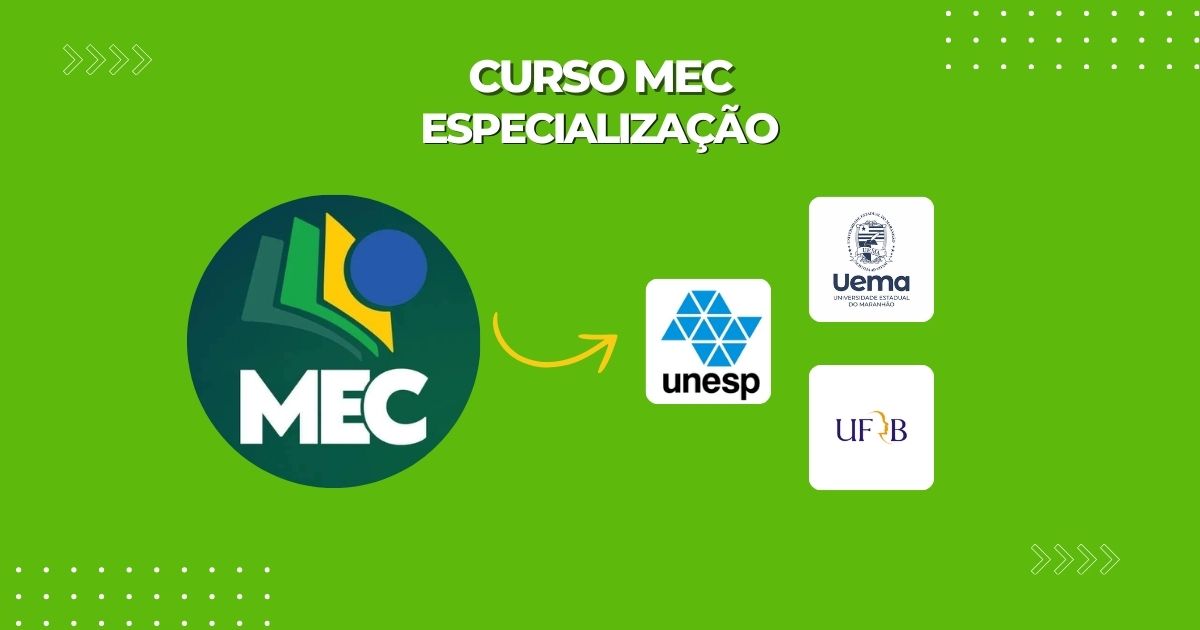

MEC And Universities Open 15,000 Slots in Free Online Special Education. Applications Open!
In a move that promises to revolutionize educator training in Brazil, three renowned universities have joined forces to offer 15,000 slots in free specialization courses in Special Education, all taught entirely online.
With a growing demand for professionals prepared to handle diversity in classrooms, the course stands out as a valuable tool for those who want to qualify and participate in building a truly inclusive education.
And the best part: at no cost for public school teachers.
-
Federal Institute opens over 700 vacancies in free technical courses in Civil Engineering, Mechanics, Electrotechnics, Computer Science, and Nursing; see how to enroll and study at IFPB.
-
Become a professional in logistics, mechanics, computer science, chemistry, or gastronomy at the Federal Institute: Ifes opens more than 1,000 spots in free technical courses with selection without an exam.

-
Take a 100% online and free course at Itaú: Foundation releases 156 options with certificates, registrations open for all of Brazil, unlimited access, areas such as technology, education, and management, and a flexible schedule without tutoring.
-
Senai will pay up to R$ 700 per month for those who take free technical courses: there are 12,000 open positions across Brazil and training with access to the technology market.
What the Specialization in Special Education Is Like and Who Can Participate
The Federal University of Recôncavo da Bahia (UFRB), the State University of Maranhão (UEMA), and the São Paulo State University (Unesp) coordinate the initiative in partnership with the Ministry of Education (MEC).
The institutions offer entirely distance courses, providing robust training for public basic education teachers who wish to enhance their performance with students who have specific needs.
UFRB: Special Education Course with a Focus on Inclusion
At UFRB, the extension course in Special Education from the Perspective of Inclusive Education is aimed at public basic education teachers, especially those living in Bahia and in municipalities determined by the notice.
The training includes comprehensive modules and activities totaling 120 hours. Here are the main details:
Objective: To empower teachers to develop inclusive pedagogical practices, aligned with Special Education policies and respecting students’ specificities.
Slots: 5,000 slots, aimed at serving various regions of the state of Bahia.
Registration: Until November 15, 2024, through the UFRB website. Registration is free and spots will be filled on a first-come, first-served basis with document review.
This is a unique opportunity for educators interested in transforming their practices and enhancing their skills, promoting a more inclusive education adapted to diversity.
UEMA: Online Training with a Focus on Rights and Inclusive Practices
UEMA offers 5,000 free slots in the Special Education course, also with a focus on inclusive education.
The program, offered at a distance, integrates synchronous and asynchronous activities, allowing greater flexibility for participants. The modules include:
Human Rights: Approach to the rights and guarantees of students with disabilities.
Diversity: Discussion on the appreciation of diversity in education.
Curriculum: Adaptation of the curriculum to meet students’ needs.
Inclusive Pedagogical Practices: Tools to build inclusion strategies in classrooms.
Applications are open until November 4, 2024.
Teachers in public basic education must register through the Superintendent of Educational Technologies (STED/UFMA) system, with slots filled in order of registration.
Unesp: Training with Interactive Modules and a Focus on Diversity
Unesp also participates in the initiative and offers an extension course in Special Education, with 120 hours of online training.
Aimed at teachers and professionals in basic education in São Paulo, the course promotes training in pedagogical practices for inclusion. Key aspects include:
Content: The course includes theoretical and practical modules, distributed in synchronous classes, video tutorials, reading of didactic material, and interactive activities.
Slots: 5,000, with 1,250 for affirmative actions aimed at black, brown, indigenous, people with disabilities, transgender, and transgender individuals.
Selection Criteria: Candidates will be selected based on the order of registration, respecting the availability of spots and giving preference to affirmative action groups.
Applications must be made through the Selection Process System of CDeP3-Unesp, with the final deadline on November 15, 2024.
Importance of Training for Inclusive Education
Training teachers in special education is a fundamental pillar to promote inclusion and adequately meet the needs of all students.
As highlighted by the MEC, these courses aim to provide educators with the essential tools for a more sensitive and adaptive pedagogical practice to diversity.
In addition to broadening teachers’ repertory, this training also encourages the creation of a more welcoming environment for students with special needs, contributing to a fairer and more accessible education.
Benefits and Transformations for Teachers and Students
This MEC training in partnership with universities represents not only an advance for educators but also a direct reflection on the quality of education provided in Brazilian schools.
The specialization in special education prepares teachers to promote effective inclusion, allowing students with different needs to learn on equal terms.
For teachers, it is an unprecedented opportunity for professional development and enhancement.
How to Register?
Applications must be made on the official websites of the responsible universities, each with its respective online registration system and specific criteria for candidates.
All courses are free, and spots are limited. It is essential that interested parties respect the established deadlines to ensure their participation.
Registration Links
Considering that training in special education helps build a more inclusive school environment, do you believe that this training should be mandatory for all public school teachers?








Gostaria de fazer um curso de EAD, nesta área, muito bom as informações!
Deus