





 Portuguese
  English
  Spanish
  6 min of reading
  117 comments


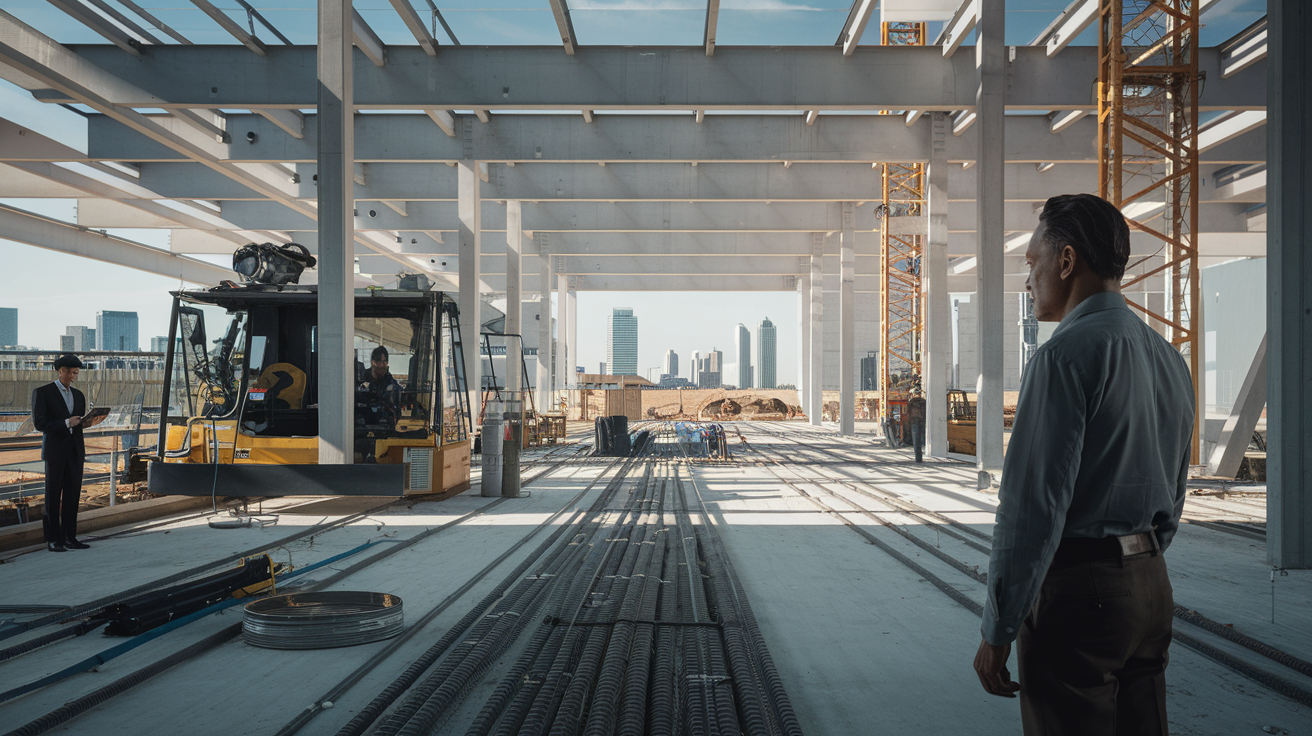


The Brazilian Construction Industry Faces A Significant Shortage Of Skilled Labor, Resulting From Educational And Generational Changes. To Overcome This Challenge, Companies Are Investing In Industrialization Of Processes, Internalization Of Services, And Technological Training Of Workers, Aiming To Maintain The Efficiency And Sustainability Of The Sector In Light Of Market Transformations.
The Brazilian construction industry faces an alarming scenario. While the country is experiencing an economic recovery, a major challenge is beginning to emerge on construction sites: the lack of skilled labor.
The shortage of professionals is threatening the pace of various construction projects, raising costs and creating a real bind for industry entrepreneurs.
It’s not a simple situation. With the evolution of the market, the profile of the workforce is changing and thus, the construction sector finds itself facing the urgent need to reinvent itself.
-
A new Brazilian shopping center worth R$ 400 million will be built in an area equivalent to more than 4 football fields, featuring 90 stores, 5 cinemas, a supermarket, a college, and parking for 1,700 cars, potentially generating 3,000 jobs.

-
Larger than entire cities in Brazil: BYD is building a 4.6 km² complex in Bahia with a capacity for 600,000 vehicles per year, but the discovery of 163 workers in conditions analogous to slavery has shaken the entire project.

-
With an investment of R$ 612 million, a capacity to process 1.2 million liters of milk per day, Piracanjuba inaugurates a mega cheese factory that increases national production, reduces dependence on imports, and repositions Brazil on the global dairy map.

-
Brazilian city gains industrial hub for 85 companies that is equivalent to 55 football fields.


What is being done to overcome this challenge? What does the future hold for labor in the sector? These questions are at the center of the debate.
On one hand, statistics show a significant increase in the number of Brazilians with higher education; on the other hand, this reality reflects a change in the profile of workers seeking qualification.
In a country where most people were used to working in the construction industry in operational roles, the scenario is now different: children of foremen are becoming engineers and many of these new professionals do not have the same appetite for working on construction sites.
But what is motivating this change? How are companies reacting to keep their operations running?
The Educational Transformation And Its Reflection On The Labor Market
With the growth of higher education in Brazil, the country has encountered an interesting phenomenon. According to IBGE data, in 2023, 23.2 million Brazilians held a higher education diploma, which represents about 23% of the workforce in the country – a record number.
This change reflects not only the increase in the population’s educational level but also a change in mindset regarding operational professions.
Today, the “son of the foreman” prefers to pursue a career in an office, with a degree in engineering, instead of entering the construction site, where their father often spent a lifetime of hard work.
This was stated by Ubirajara Freitas, CEO of Tegra Incorporadora, at a UBS BB event on Wednesday (29), as reported by Jornal de Brasília. “Today, the son of the foreman is an engineer and he doesn’t want to go to the construction site, so we are industrializing the process,” said Ubirajara Freitas, CEO of Tegra Incorporadora, at a UBS BB event on Wednesday (29).
This shift in values and professional aspirations is a reflection of a country that is gradually becoming more educated and less dependent on manual labor.
However, this transition creates a clear problem for the construction sector, which until now depends on a large amount of skilled labor, especially in operational roles such as masons, carpenters, and helpers.
With young people distancing themselves from these jobs, the scarcity of qualified professionals has intensified, and construction companies are looking for alternatives to fill this gap.
Measures Taken By Construction Companies To Tackle The Shortage Of Professionals
The strategies adopted by construction companies are diversifying, seeking solutions for both the short and long term.
According to Ubirajara Freitas, CEO of Tegra Incorporadora, one of the main responses to this issue lies in the industrialization of construction processes.
According to him, with advancements in technology and the implementation of prefabrication systems, the need for labor at the construction site has been significantly reduced.
In other words, construction companies are resorting to factories for ready-made components, which arrive at the construction site already prepared for assembly.
This allows manual work, which is typically more time-consuming and dependent on a large number of workers, to be replaced by more automated processes.
Additionally, another strategy adopted by some construction companies is to internalize service providers.
Traditionally, many of these companies relied on outsourcing to hire temporary labor, but with the shortage of professionals, this practice has proven ineffective.
Thus, many companies have started to directly hire their employees, providing more stability and loyalty, in addition to allowing greater control over the quality of labor.
Tegra Incorporadora, for example, has been actively working to integrate its workers by providing technologies such as smartphones and tablets, easing communication and streamlining processes on construction sites.
The Impact Of Inflation And Interest Rates On The Construction Market
With the shortage of skilled labor, construction companies are not only facing an increase in labor-related costs but also the consequences of inflation on industry products.
Despite the pressure on material prices, both Ubirajara Freitas and Ricardo Valadares Gontijo, CEO of Direcional (a construction company focused on Minha Casa Minha Vida), assure that inflation is being controlled and does not pose an immediate threat.
On the other hand, what really concerns both CEOs is the slowing economy and rising interest rates.
According to Freitas, an ideal scenario would be an interest rate of 7% or 8%, something that is not currently being achieved.
The Brazilian economy, with an inflation rate of around 6%, is far from ideal, but industry entrepreneurs say they are prepared to deal with this reality and seek solutions that ensure continued growth.
The Future Of The Construction Industry: How Construction Companies Are Adapting
In times of resource scarcity, one of the alternatives to ensure the success of projects is to invest in professional training.
Both Freitas and Gontijo emphasize the importance of continuous training for workers, as it is impossible to rely solely on a labor market that is constantly short on skilled labor.
Therefore, training initiatives have been a priority.
In the case of Direcional, for example, many of its workers are part of the target audience for the Minha Casa Minha Vida program, which reinforces the importance of investing in professional qualification.
Construction companies are also attentive to changes in worker behavior and the need for technologies that can facilitate work on construction sites.
From the use of management apps to remote monitoring of works, innovation is becoming an indispensable tool for the sector.
The integration of new generations with technology may be the determining factor to cope with the lack of professionals, especially in the digital age we live, with the increase of automation and artificial intelligence.
The Construction Industry Is Still An Engine Of The Economy
Although the lack of qualified professionals is a growing challenge, the construction sector in Brazil continues to be one of the main engines of the economy.
Construction companies are adapting, reinventing themselves, and investing in innovative solutions to ensure that the sector continues to grow.
However, the road ahead will not be easy and will require joint efforts between companies, workers, and the government to ensure that constructions are not halted and that Brazil continues to grow economically. What is at stake is not only the labor market but also the future of Brazilian cities.
Do you think the future of the construction industry in Brazil is at risk due to the lack of skilled labor? Leave your opinion in the comments!









O problema é que, desde o ajudante de obras até o profissional mais qualificado são mal remunerado pelos empresários da construção…Muitas das vezes os profissionais fazem cursos, se qualificam e as empresas oferecem um salário e meio, ou em muitos casos uns 1,800 reais. Desse jeito é impossível não faltar mão de obra nos canteiros de construção!
A falta de mão de obra na construção civil é um processo natural que ocorrerá no Brasil, devido aumento da escolaridade população.
O EUA é um exemplo, as vagas operacionais, principalmente na construção civil, são as que mais absorvem os imigrantes, pois os americanos preferem não atuar nesses serviços.
Incrível como a desinformação ou interpretação tendenciosa está acabando com o senso crítico das pessoas.
Lendo os comentários, percebo que muitos leitores nao conseguiram responder corretamente uma questão de interpretação de texto.