





 Portuguese
  English
  Spanish
  6 min of reading
  2 comments


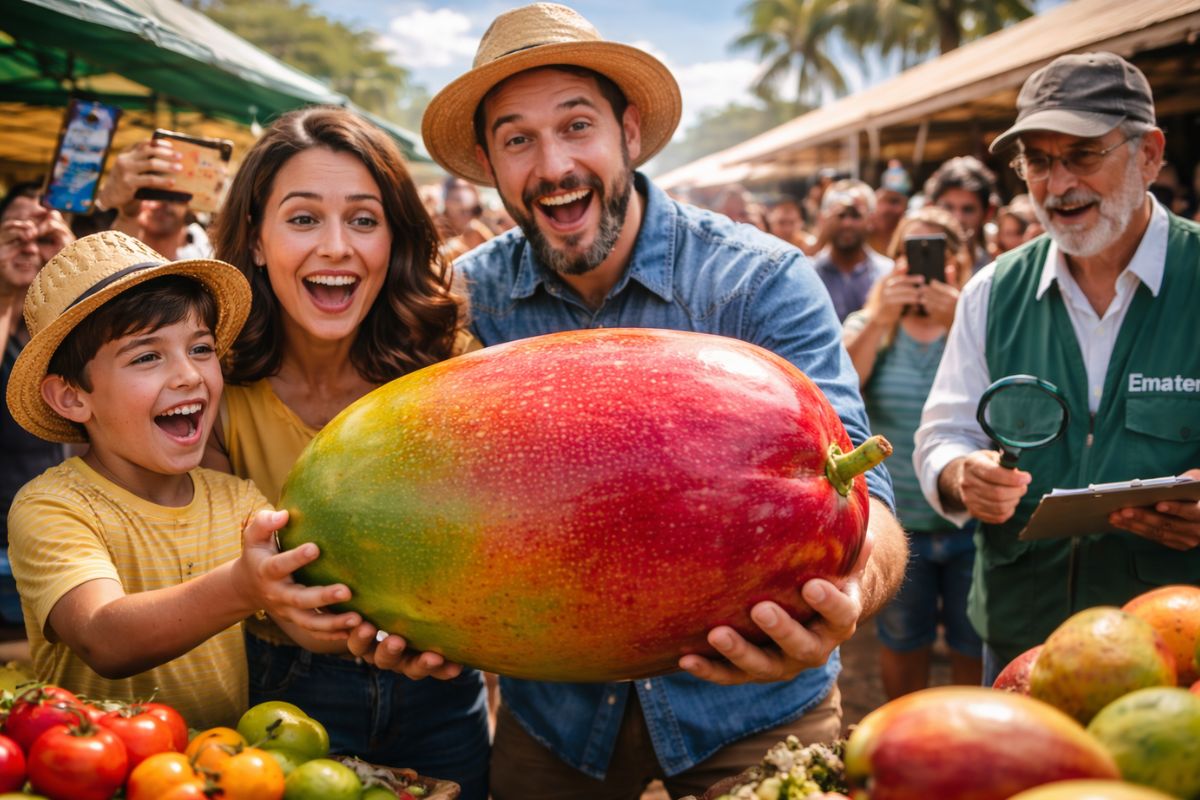


Fruit That Looked Like a Coconut Became an Attraction at a Fair, Drew the Attention of an Agronomist from Emater, Mobilized a University in Uberlândia, and Was Identified as a Rare Giant Haden Mango Resulting from a Genetic Mutation
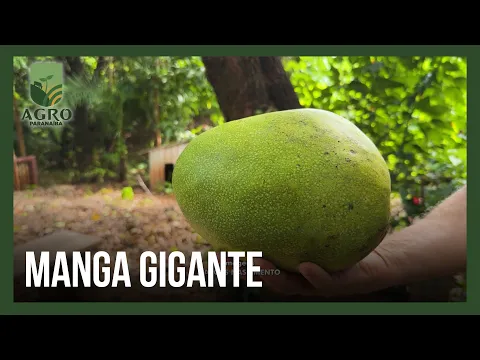
The story of this giant mango that weighs almost 3 kg begins in the simple backyard of a family in Uberlândia, where a mango tree grown from randomly discarded seeds became the star of a scene that is hard to believe. The fruit is so large that, from afar, it confuses even those accustomed to farms and markets, looking like a beef heart or even a coconut, until someone gets closer to confirm: it is indeed a mango.
From the moment the family realized that this was not an ordinary mango, curiosity turned into investigation. The giant mango left the backyard, went to the market, caught the attention of experienced producers, mobilized an agronomist from Emater, and reached the Federal University of Uberlândia, where a biology and agronomy professor confirmed that it is a super mango Haden created by a genetic anomaly, a true “new genetic material” within the same species.
From Common Mango to Giant Mango in the Family’s Backyard

It all starts when the brother of the house owner brings some mangoes from a farm. There were so many fruits that some ended up lost and were thrown into the backyard.
-
Friends have been building a small “town” for 30 years to grow old together, with compact houses, a common area, nature surrounding it, and a collective life project designed for friendship, coexistence, and simplicity.

-
This small town in Germany created its own currency 24 years ago, today it circulates millions per year, is accepted in over 300 stores, and the German government allowed all of this to happen under one condition.

-
Curitiba is shrinking and is expected to lose 97,000 residents by 2050, while inland cities in Paraná such as Sarandi, Araucária, and Toledo are experiencing accelerated growth that is changing the entire state’s map.

-
Tourists were poisoned on Everest in a million-dollar fraud scheme involving helicopters that diverted over $19 million and shocked international authorities.


From there, the mango tree was born, which would later surprise the family. Among jabuticaba and acerola trees, the mango tree grew sovereign, with branches full of large fruits, one of which assumed gigantic proportions.
The owner, Ademir, got used to seeing the tree loaded with fruit, but even so, he did not recall having seen a giant mango of that size.
The shape drew attention, resembling a heart and occupying almost the entire hand of anyone trying to hold it.
When the team arrives to document the scene, no one dares to guess the exact weight. It is said to weigh two kilos, maybe three, but everyone agrees on one thing: it is an unusual mango.
Weight, Shape, and the Curiosity That Became a Market Attraction
The scene to pick the fruit already shows that this is not an ordinary mango. Ademir needs a pole, a hook, and several attempts to finally knock the giant mango from the tree, in a kind of “competition” narrated as if it were a sports broadcast. When it finally falls, there is a feeling of relief mixed with astonishment.
In the measurement done by the team, two impressive specimens are revealed. One mango weighs over 2.8 kg, and the other exceeds 2 kg, with a circumference of around 60 centimeters.
For comparison, a large mango usually weighs between 450 and 650 grams. There, each fruit was equivalent to several common mangoes, both in weight and volume.
Before reaching the university, the giant mango becomes an attraction at a market, where it is placed in the hands of vendors and consumers accustomed to dealing with fruits every day. Many say they have never seen anything like it, even with decades of experience in farms and stalls.
Some compare it to exhibition mangoes they have seen at Ceasa but admit that it is very rare for something like this to appear for sale.
When the Giant Mango Becomes a Case for Agronomist and University
To go beyond curiosity, the family receives a visit from Osvaldo, an agronomist from Emater. He observes the tree, analyzes the fruit, looks at the images, and summarizes the astonishment in numbers.
According to the agronomist, a mango considered large usually weighs between 450 and 650 grams, while the giant mango of the family weighs over 2 kg and approaches 3 kg.
Osvaldo recalls that, in record-keeping, there is news of a mango weighing just over 4 kg found in Colombia, considered the largest to date. Even without breaking that record, Ademir’s fruit “is on the right track,” as he himself acknowledges.
The agronomist explains that identifying the variety by appearance alone is difficult because many plants have similar visual characteristics, and in this case, the skin is still green, which complicates further.
Given the difficulty in determining “what kind of mango this is,” the need arose to take the case to the university.
The giant mango ceases to be merely a curiosity from the backyard and becomes a subject of study, prompting a visit to the Federal University of Uberlândia in search of a botanist or professor specializing in plants and fruits.
Genetic Anomaly Transforms Haden Mango into Super Fruit

In the university corridors, after knocking on different doors and sharing the story, the team finds Professor José Geraldo Mageste, who combines knowledge in biology and agronomy.
He explains that a mango tree can produce about 1,150 flowers so that, in the end, only one fruit survives, which increases the chance of different crossings and genetic combinations in the environment.
After analyzing the fruit and its characteristics, the professor concludes that it is not a new species but a Haden mango that underwent a genetic anomaly, resulting in a sort of “super mango” within the same variety.
The species remains Mangifera indica Haden, but with a fruit that deviates from the norm in size and structure.
The professor speaks of “new genetic material” that deserves to be evaluated with care. The plan is to open the mango, check the size of the seed, and test its germination capacity, always with a scientific perspective.
The giant Haden mango ceases to be merely a nature exaggeration and becomes a didactic example of how mutations and genetic anomalies can create unique individuals even within a known species.
Names, Stories, and the Imagination Surrounding the Giant Mango
While science seeks technical explanations, popular imagination does its part. At the market and in the backyard, the fruit acquired various nicknames: horse mango, wide mango, family mango, big coconut mango.
Each person who handled the fruit ventured a theory or name, showing how the giant mango activated memories, comparisons, and jokes among those who approached it.
Some said they do not like “big mangoes”, others saw it as a great exhibition piece, some compared it to a coconut, and some insisted that it was “mango from a giant”.
In the end, the plant’s owner decided to name it family mango, in a loving attempt to register the importance of that fruit, which became a topic of conversation at home, at the market, and in university corridors.
What the Giant Mango Reveals About Nature, Science, and Curiosity
The story of this giant mango discovered in Uberlândia shows how a different fruit can connect worlds that often seem distant. On one side, the daily life of a family, the backyard, the market, the jokes, and the astonishment.
On the other side, the technical work of an agronomist from Emater and the academic routine of the Federal University of Uberlândia, where the fruit becomes a subject of study.
More than a possible record candidate, the giant Haden mango highlights how nature produces exceptions and how science needs these exceptions to better understand the limits and possibilities of each species.
It also reminds us that stories from the farm and backyard can indeed lead to serious research, with laboratories, microscopes, and discussions about genetics.
In the end, there is a question that mixes curiosity, affection, and science: if you found a giant mango like this in your backyard, would you save it for research, sell it at the market, or call the whole family to enjoy this super Haden mango together?









Sou de Uberlândia MG, no meu quintal tem um pé de manga que na sua primeira safra 2025, produziu uma fruta com a característica desta manga da reportagem, porém com 928 gramas e está documentada. Vamos aguardar as próximas safras.
Sou de Uberlândia MG, no meu quintal tem um pé de manga que as frutas tem esta característica, na primeira carga 2025, produziu uma manga com 928 gramas e está documentada. Vamos aguardar as próximas safras.