





 Portuguese
  English
  Spanish
  6 min of reading
  2 comments


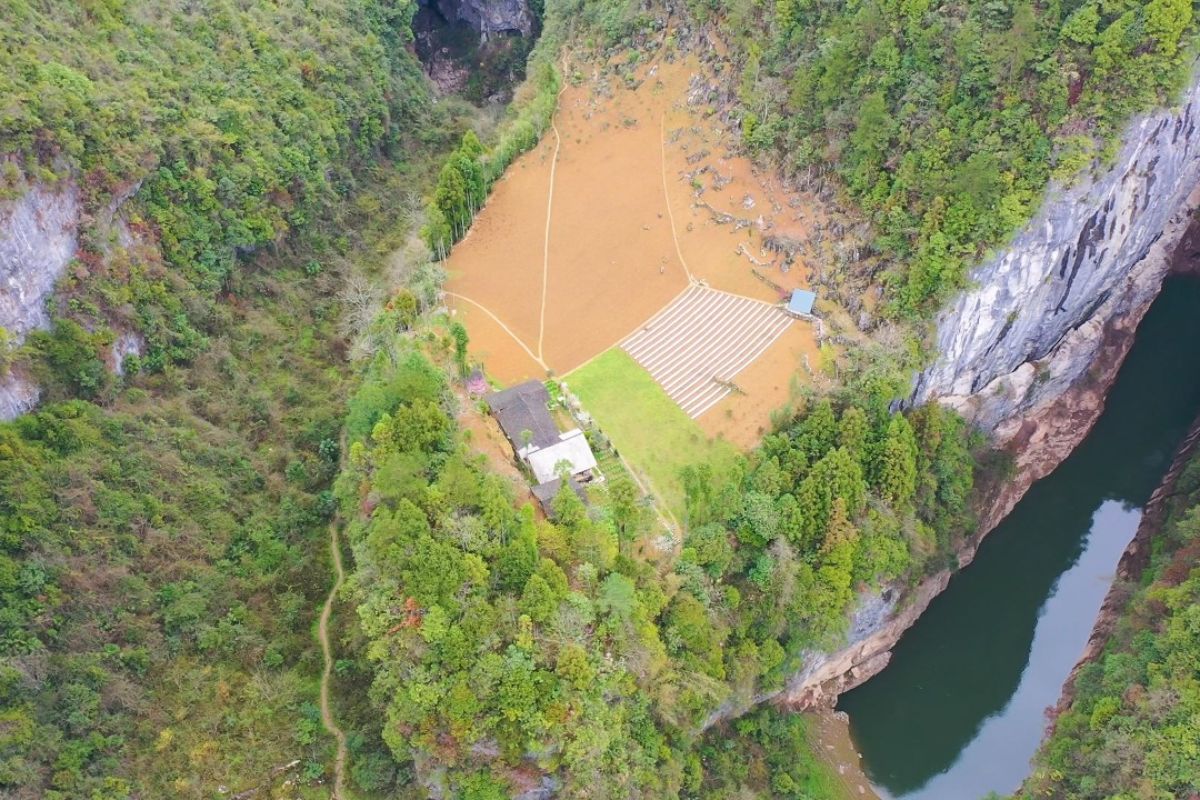


Surrounded by steep cliffs and accessible only by caves and carved trails, the family lives in isolation in a mountain valley in Hubei and turns the place into a true self-sufficient paradise away from the noise of cities.
In the ancient riverbed of the Qingjiang River, in the city of Lichuan, in Enshi, Hubei province, the scene resembles a classic tale: wooden houses, corn hanging to dry, bees, orchards, and a landscape that seems to have stopped in time. There, a family lives in isolation in a mountain valley, surrounded by cliffs on three sides, with a single access through a small gate carved into the rock, as if the mountain itself had decided to hide this refuge from the eyes of the world.
To reach the heart of this valley, one must traverse narrow trails and cross caves carved by water over thousands of years. With each step, the scenery changes: from the dark interior of the caves to the sudden light of a wide, flat plateau, where the terrain opens up to homes, crops, and a daily life that defies the contemporary urban standard. The contrast between the difficult path and the serene space of the valley reinforces the feeling that it is a hidden paradise, guarded by geography and time.
A Hidden Valley Among Cliffs in Hubei

In the mountainous interior of Hubei, the aerial image of the place shows a natural amphitheater: a narrow valley, nestled between cliffs and steep ravines, with only a small strip of flat land occupied by the main house, vegetable gardens, and fruit trees.
-
Italian researchers have detected what appears to be a second Sphinx buried under the sands of Egypt, and satellite scans reveal a gigantic underground megastructure hidden beneath the Giza Plateau for over 3,000 years.

-
There are 4,223 drums and 1,343 metal boxes concreted with 50-centimeter walls that store the radioactive waste from Cesium-137 in the worst radiological accident in Brazil, just 23 kilometers from Goiânia, with environmental monitoring every three months.
-
Giant Roman treasure found at the bottom of Lake Neuchâtel in Switzerland reveals an advanced trade system, circulation of goods, and armed escort in the Roman Empire about two thousand years ago.

-
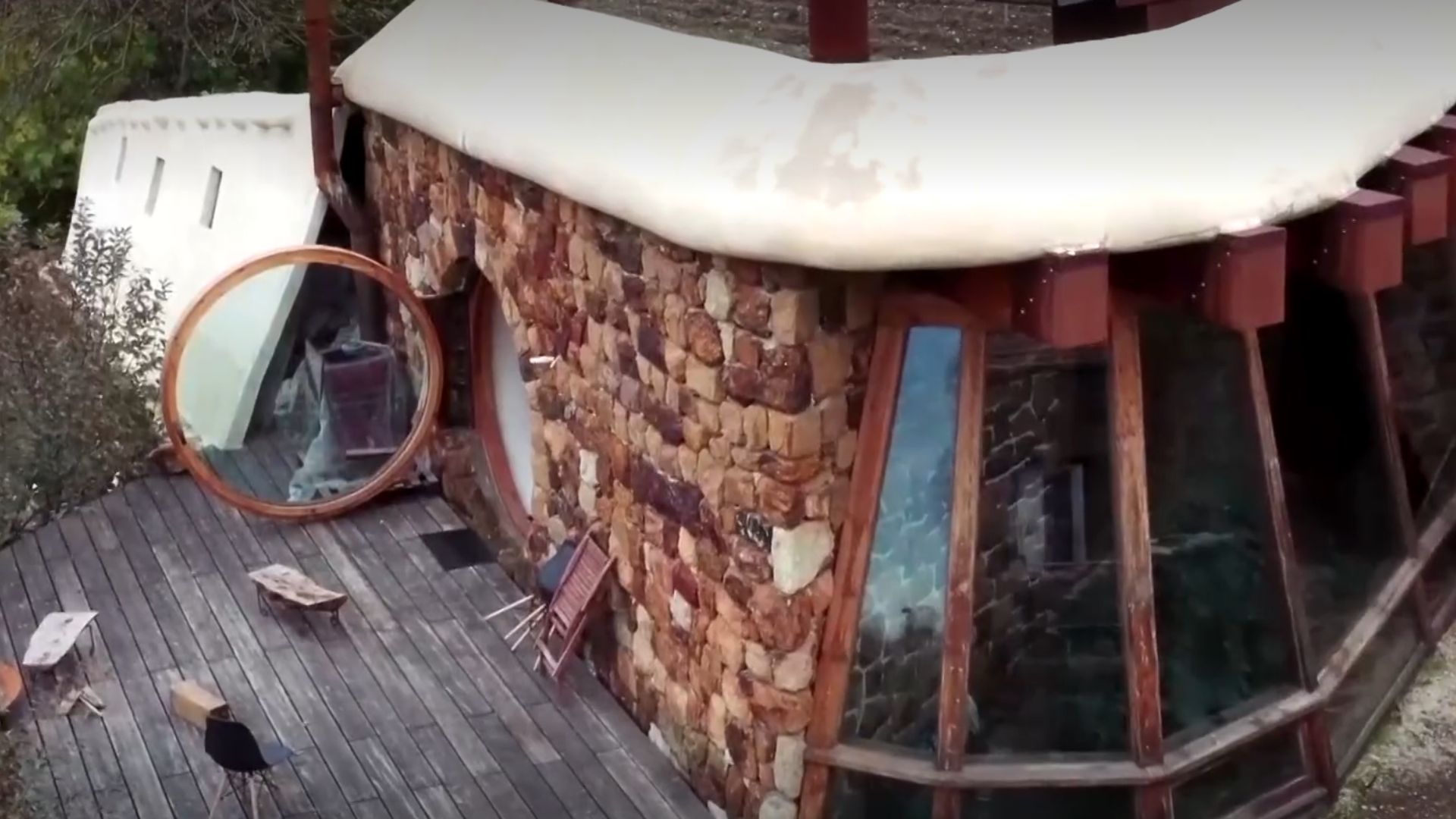
He buried 1,200 old tires in the walls to build his own self-sufficient house in the mountains with glass bottles, rainwater, and an integrated greenhouse.

The family lives in isolation in a mountain valley that functions as a kind of natural fortress, with the mountain serving as protection on three sides and a single controllable access point.
The terrain is the result of an ancient riverbed that dried up, leaving behind caves, galleries, and rock walls that now form this microterritory.
Down below, the atmosphere is silent, the air is clean, and the presence of humans is limited to the house, yard, crops, and small infrastructure built over decades.
The scenery immediately evokes the idea of a “refuge”: a place where the outside world seems distant, yet everything essential is within reach.
Accessible Only by Caves and Carved Trails

Reaching this valley requires following a series of passages that seem scripted to create a gradual discovery experience.
First, the visitor walks along a narrow trail, opened in the ancient riverbed, until the entrance of the first cave, locally known as one of the “dragon gates.”
From there, there are three caves of different sizes, connected by stretches of stairs carved into the rock and damp, flat, dark paths.
Inside the caves, the floor is surprisingly regular, a reflection of the ancient action of water. In some sections, natural lighting is minimal, requiring lanterns.
In others, natural windows allow light to enter, revealing large halls that resemble the size of a football field.
After the third “gate,” a small passage appears in the mountain and, further ahead, a stone wall with a simple gate, which serves as the only formal entrance to the small village.
Crossing this gate, the change of environment is sudden: cliffs, houses, trees, and gardens appear all at once, like a “secret village” revealed dramatically.
The Exclusive Village Where Only One Family Remains
The place is known as an “exclusive village” because, today, only one family resides there.
In the past, more than a dozen families occupied the same valley, living in wooden houses that were later demolished or abandoned as residents migrated to nearby cities, like Wulong or larger urban areas in Chongqing and other regions.
The current generation of the resident who remains, from the Qin family, reports that the family has lived in isolation in a mountain valley for over fifty years, since an old house in another part of the region was destroyed by fire in the early 1970s.
After that episode, the family decided to rebuild their life on that protected plateau, accepting the challenge of living in a difficult-to-access location, but with available land and relative safety.
Since then, the valley has become not just a home, but a life project.
Self-Sufficient Routine with Spring Water and Own Production
The daily life in this mountain valley is marked by self-sufficiency. In front of the main house, the land is carefully utilized for growing vegetables, legumes, and fruits.
Collard greens, peppers, corn, cabbage, legumes, and trees like peach, plum, and other fruit-bearing trees compose the landscape.
The goal is clear: to minimize dependence on external supplies.
The water comes from a spring on the mountain slope, channeled by simple piping, partly with modern pipes and partly using traditional resources, such as bamboo in specific sections.
This solution ensures a continuous supply of clean water, essential for consumption, irrigation, and domestic activities.
Having a constant spring water supply in a context where the family lives in isolation in a mountain valley is one of the pillars to keep the place habitable, especially in dry periods.
In addition, there is beekeeping for honey production, firewood stacked for use in stoves, and basic lighting systems, including panels or solar lamps in strategic locations.
The combination of these elements creates a simple yet functional infrastructure capable of sustaining daily life without heavy reliance on urban networks.
Wooden House, Corn Hanging, and Memory of Several Generations
The main residence follows traditional rural architecture, with a wooden structure, an internal courtyard, and outbuildings used as a kitchen, storage, and drying area.
The corn hanging from the eaves is a striking visual element, indicating past harvests and the organization of production throughout the seasons.
According to the resident’s account, the current house is more than five decades old and was built shortly after the fire that destroyed the family’s previous home.
Before that, other families had passed through the valley but left as new opportunities arose outside.
Today, the family that lives in isolation in a mountain valley keeps alive the memory of those who passed through while adapting the structure to contemporary needs, with basic electricity, occasional internet access, and some level of integration with the outside world via road and trail.
Connection with the Outside World Without Giving Up Isolation
Although the valley seems completely isolated, access to the top of the mountain can be made in just a few minutes on foot from the main trail.
From there, it is possible to reach roads that connect to other villages and towns, allowing for occasional supplies, health trips, education, and other necessities.
This feature makes the case even more unique: the family lives in isolation in a mountain valley by choice, and not by total impossibility of leaving.
There is a delicate balance between isolation and connection, in which the refuge is preserved as the main residence, but without total rupture with society.
This decision allows them to enjoy the best of both worlds: the food and environmental security of living in the valley and the ability to access urban resources when strictly necessary.
A Living Laboratory of Simple Life, Resilience, and Extreme Landscape
From a social and cultural perspective, the daily life of this family in Hubei functions as a living laboratory of simple life and resilience in an extreme environment.
The rugged terrain, the need to cross caves to enter and exit, the self-sufficiency based on their own soil and mountain water, and the permanence of a single family over decades illustrate a form of territory occupation that is increasingly rare.
While many rural communities migrate en masse to urban centers, this family lives in isolation in a mountain valley without breaking from agricultural tradition and direct ties to the landscape.
The result is a way of life that blends the past and present: ancient cultivation and construction techniques coexist with occasional modern technology solutions, such as electric lighting and minimal digital communication.
In the end, the mountain valley of Hubei is not just an exotic setting, but a concrete example of how individual choices can shape an entire territory.
Instead of abandoning the place, the family transformed it into a functional, productive paradise that is simultaneously protected by geography.
Would you have the courage to trade urban life for a refuge like this, accessible only by trails and caves, or do you prefer to keep paradise solely as a travel destination in your plans?










Lindo ,mas deixaria por destino de viagem com ida e volta,nosso corpo precisa de tudo um pouco ninguém está imunes, e para viver precisamos de hospitais etc …
É meu sonho. Adoraria. Imagino o silêncio, a paz e a magia que deve existir no lugar.