





 Portuguese
  English
  Spanish
  6 min of reading
  0 comments


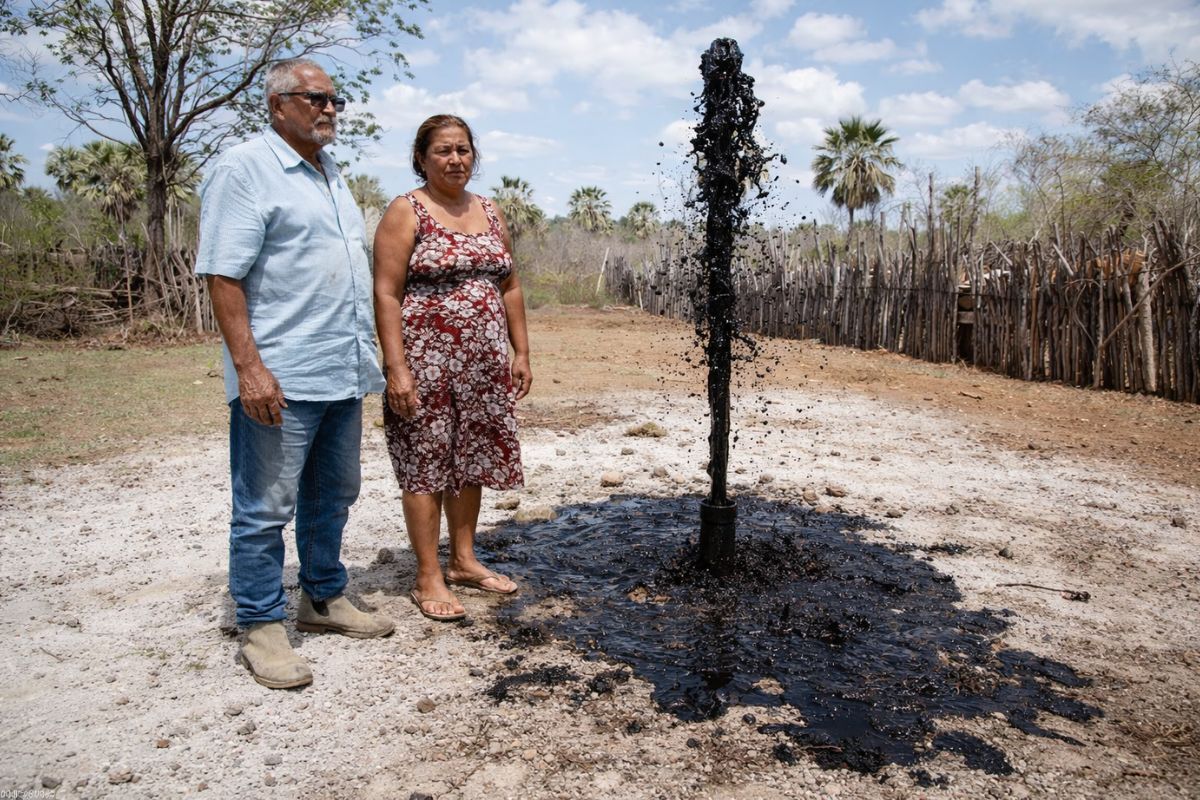
Farmer Sidrônio Moreira drilled a well in Tabuleiro do Norte, Ceará, in search of water for his family, but found a black liquid with a fuel smell that could be oil, and now he awaits a report from the ANP while the loan debt compromises the household finances.
Farmer Sidrônio Moreira, 63, a resident of Sítio Santo Estevão, 35 kilometers from the center of Tabuleiro do Norte, in Ceará, took out a loan of R$ 15,000 to drill a well in his backyard to solve a problem that has plagued the family for years: the complete absence of piped water. What he found, however, was not water. From the hole opened in the ground emerged a dense, black liquid with a strong fuel smell, which could be oil. Since then, Sidrônio has been prohibited from drilling new wells, cannot use or sell the material found, and continues without water and with the debt hanging over him.
According to updates from G1 this Saturday (21), the case began in November 2024, when the family hired a team to drill the well. A video recorded at the time shows the moment the dark liquid emerges from the ground, and Sidrônio even celebrates, thinking it is water. Weeks later, he realized that it was not water. The family approached the National Agency of Petroleum (ANP) in July 2025, but the agency only responded in February 2026, after a request for information made by g1. Now, Sidrônio awaits a definitive report while the family’s finances become increasingly more compromised.
Why Sidrônio’s family decided to drill a well with borrowed money
The decision to take out the loan was not made lightly. Sidrônio and his wife, Maria Luciene, 58, live with their two children in a rural area without access to piped water.
-
At 100 years old, an elderly man who dreamed of “making it to the newspaper” finally shares his story, reaching his centenary with children, grandchildren, great-grandchildren, and great-great-grandchildren, moving his family with a life of hard work, farming, honesty, and without vices.

-
Germany proposes silent propellers to solve a centuries-old problem: the damage caused in the ocean by ship noise.
-
What the Public House of Julius Caesar was like inside in the Roman Forum: layout, atrium with compluvium and impluvium, tablinium and peristyle, and the scandal of the Bona Dea, revealed in an AI recreation.

-
While digging a trench next to a pool in Germany, workers found more than 1,500 silver coins from 1320 in the rubble, revealing a treasure buried for over 700 years.

The family relies on a regional pipeline and water trucks to have water at home, a reality shared by hundreds of families in the rural area of Tabuleiro do Norte. The couple’s income comes from two pensions and the sale of animals, beans, and corn, making any extra expense a significant burden on the budget.
The idea of drilling the well was, in Sidrônio’s own words, to find peace of mind. The loan of R$ 15,000 would be enough to open two wells on the property and ensure a water supply for the family and the animals.
The plan was simple: solve the water problem and continue life in the countryside. No one in the family imagined that, instead of water, the soil of that backyard would hide something that would completely change everyone’s routine.
What exactly was found in the well and what the technicians say
In the first well drilled, the team hired by Sidrônio found a dark, dense liquid with a strong fuel odor. The material had no characteristics of water.
The family was confused and decided to drill a second well, which also presented the same type of substance. Technicians from the Federal Institute of Education of Ceará (IFCE) visited the site and collected samples of the material for preliminary analysis, but the definitive report depends on the ANP.
The location of Sidrônio’s site helps explain why the suspicion of oil is plausible. Tabuleiro do Norte borders Rio Grande do Norte and is part of the Jaguaribe Valley region, which is covered by the Potiguar Basin, an area already known for oil exploration activities between Ceará and the neighboring state.
The existence of an oil basin in the region makes it possible that the material found in the well is indeed oil, although the ANP still needs to confirm this hypothesis and assess whether the volume justifies any type of commercial exploitation.
The R$ 15,000 debt and the family’s financial situation while awaiting the ANP
While waiting for the ANP’s report, Sidrônio deals with the debt from the R$ 15,000 loan that financed the two wells. The farmer can no longer drill new wells on the property, must isolate the areas of the drillings, and avoid any contact with the liquid found.
The result is that the family is left without water, without the R$ 15,000, and with the obligation to keep the wells sealed, a situation that Sidrônio himself summarizes with a phrase that went viral on social media: neither water nor the R$ 15,000.
The delay of the ANP exacerbates the problem. The family approached the agency in July 2025, but the agency only responded in February 2026, after being questioned by the press. There were more than seven months of silence while the family continued to pay the loan and depended on water trucks.
A positive piece of news is that the deputy mayor of Tabuleiro do Norte, Antério Fernandes, confirmed that a new pipeline is being built in the rural area of the city and should serve more than 700 families, including Sidrônio’s. The completion deadline is the end of March 2026.
If it is oil, the farmer could profit from the discovery on his land
The answer is complex. According to ANP technicians, the Federal Constitution states that the subsoil and its riches, including oil and gas, are the property and monopoly of the Union.
This means that Sidrônio does not own the oil found on the land, cannot extract it on his own, and cannot sell it.
The farmer has no rights over the mineral resource itself, regardless of having been the one who drilled the soil and financed the operation with his own money.
However, there is a compensation provided by law. If the area undergoes a process of exploration and commercial production in the future, the landowner has the right to receive a percentage of the profit that can reach up to 1%, depending on various factors that will be evaluated by the ANP.
Before that, however, the agency needs to analyze whether it is worth exploring the basin, as other similar finds in the region have been dismissed for being too small to justify commercial extraction. The family, for its part, remains grounded.
What the family hopes for and why this case exposes larger problems than oil
Sidnei Moreira, Sidrônio’s son, made it clear to g1 that the family is not making plans based on the possibility of the liquid being oil. The priority remains water. It was never our intention to find oil, it was always to find water, summarized Sidnei.
The family intends to continue life in the countryside, taking care of the animals and the crops, while awaiting both the ANP’s report and the completion of the pipeline that should finally bring piped water to the region.
The case of Sidrônio’s well exposes a reality that goes beyond curiosity about oil. Entire families in the interior of Ceará live without access to piped water in 2026, relying on water trucks and precarious pipelines to survive.
A 63-year-old farmer had to go into debt to try to solve a problem that should be the responsibility of the public authorities.
He found something that could be worth billions, but that does not belong to him, and continues without water, in debt, waiting for a response from a federal agency that took seven months just to visit the site.
What do you think of this story? Should Sidrônio receive any immediate compensation for what he found, or is the law right to reserve the subsoil for the Union? And what does it say about the reality of those who still live without piped water in Brazil? Leave your comment.





Seja o primeiro a reagir!