





 Portuguese
  English
  Spanish
  4 min of reading
  0 comments


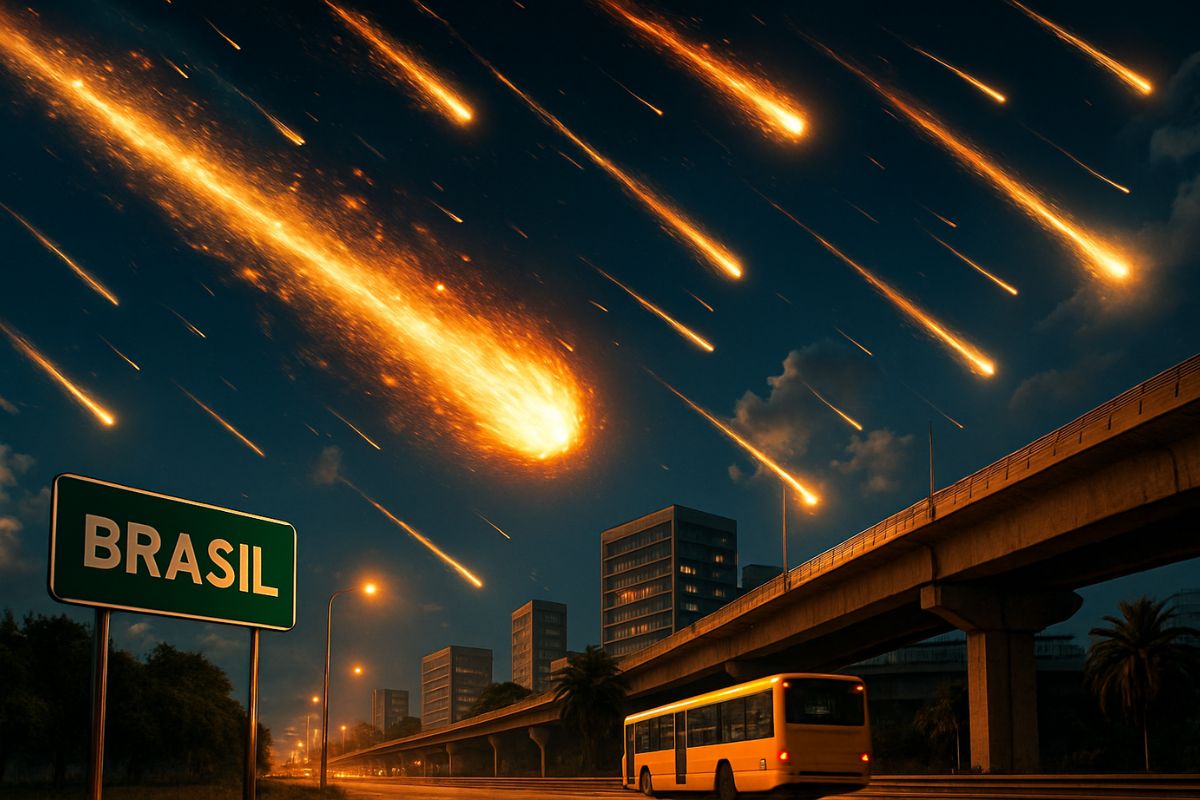
Annual Phenomenon Linked to Halley’s Comet Will Be Visible to the Naked Eye Across Brazil This Morning, With Up to 20 Meteors Per Hour Crossing the Sky in Areas of Low Light Pollution
The Halley’s Comet is once again starring in one of the most anticipated astronomical events of the year: the Orionid Meteor Shower, which can be observed from different regions of Brazil this morning. The phenomenon peaks between the night of Tuesday (21) and the early hours of Wednesday (22), with the potential to display up to 20 meteors per hour under good atmospheric conditions.
The shower is formed by particles left behind by Halley’s Comet in its journey through the Solar System. When these fragments penetrate the Earth’s atmosphere, they ignite and produce bright streaks visible to the naked eye. Even without the comet being close to Earth, its cosmic legacy continues to light up the skies every year, in a phenomenon of rare beauty and scientific value.
Best Times and Locations for Observation in Brazil
According to recent astronomical data, the best time to observe the phenomenon is between midnight and 2 a.m., when the radiant of the Orion constellation, the point from which the meteors seem to originate, is highest in the sky.
-
More than one million North Americans were ordered to close their windows and stay indoors because the air in the southern United States became so toxic that pollution levels reached 18 times above the World Health Organization’s safety limit.

-
China has accumulated up to 1.4 billion barrels of oil in strategic reserves, invested 25 years in renewable energy, and purchased 80% of cheap Iranian oil: how Beijing has prepared for decades for the crisis that is now shaking the world.

-
A single lake holds 20% of the planet’s non-frozen freshwater and is also the deepest and oldest on Earth.

-
How 5,000 Indian dabbawalas manage to deliver around 200,000 lunchboxes a day in Mumbai for over 130 years using bicycles, crowded trains, and a manual system that continues to operate with impressive accuracy.


In areas away from urban centers, observers may see up to 20 meteors per hour, a number that can drop to between 5 and 10 in cities with heavy light pollution.
Experts recommend seeking dark locations with a clear horizon and wide visibility of the east, preferably in rural or beach areas.
Observation should be done with the naked eye, without the need for telescopes or binoculars.
The recommendation is to arrive about 20 minutes before the expected start, to allow your eyes to adapt to the darkness and increase sensitivity to the light of the meteors.
Why the Phenomenon Occurs Every Year
The Orionid meteor shower occurs when Earth crosses the trail of debris left by Halley’s Comet, which completes an orbit around the Sun every 76 years.
Even when absent from Earth’s field of view, the comet leaves behind small particles of dust and rock that remain floating on its path.
As it passes through this region of space, the Earth’s atmosphere comes into contact with the remnants of Halley’s Comet.
The impact speed is extremely high, about 66 kilometers per second, and the friction with the air causes the particles to incinerate instantly, generating the bright and colorful trails we call meteors.
One of the Most Remarkable Phenomena in the Astronomical Calendar
The Orionids are considered one of the most beautiful and consistent meteor showers in the annual astronomical calendar.
Even with a moderate rate of meteors per hour, the intensity and length of the luminous trails make the event especially attractive to astronomers and curious observers.
In ideal conditions, far from the interference of urban lights, the experience can reveal traces of up to 20 times the average brightness observed in large cities.
For many, it is an opportunity to reconnect with the cosmos and appreciate a phenomenon that has been occurring for millennia, keeping alive the memory of the most famous comet in history.
The Legacy of Halley’s Comet
The Halley’s Comet was first recorded in 240 B.C. and reappears approximately every seven decades.
Its last passage occurred in 1986, and the next return is expected in 2061.
Until then, the fragments left by it will continue to provide the annual displays of the Orionids and the Eta Aquariids, which occur in May.
For researchers, each observation also represents a window of study on the composition of comets and the dynamics of the Solar System.
The incandescent particles allow for a better understanding of how smaller celestial bodies interact with Earth and influence the spatial environment around the planet.
Even without the need for equipment, the phenomenon of the Orionids requires patience and attention.
With each bright streak, one can witness fragments that traveled for centuries before disintegrating before our eyes.
And you, have you ever observed the meteor shower linked to Halley’s Comet? Do you intend to find a dark place to watch the spectacle this morning? Share in the comments what your experience with the night sky is like and whether the phenomenon has sparked your astronomical curiosity.







-

-

2 pessoas reagiram a isso.