





 Portuguese
  English
  Spanish
 4 min of reading
  1 comment


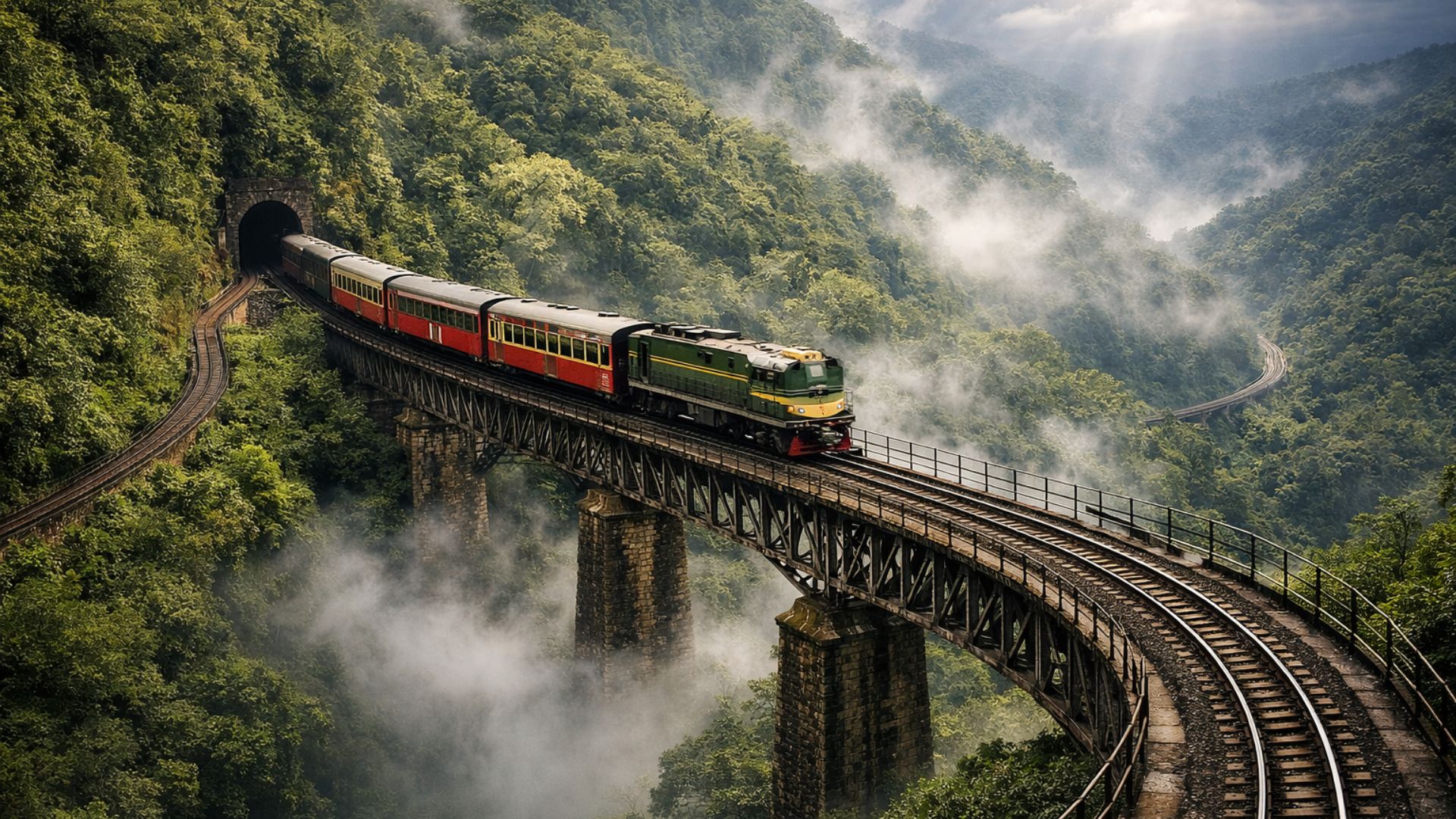


Recognized Abroad, Train Crossing Through Serra do Mar Combines Atlantic Forest, Tunnels, and Historic Bridges on a Route Between Curitiba and Morretes.
The tourist train that connects Curitiba to Morretes, in Paraná, travels one of the most well-known sections of the historic Paranaguá–Curitiba Railway, a late 19th-century project that crosses Serra do Mar with tight curves, tunnels, and bridges amid the Atlantic Forest.
The route, currently operated by Serra Verde Express, usually lasts about four and a half hours and combines scenery, heritage, and engineering in one journey.
International recognition came, among other acknowledgments, from a list by the British newspaper The Guardian that featured the route as one of the 10 Notable Train Journeys in a selection published in April 2015, describing the crossing through the forest and the passage through tunnels and bridges over the mountain.
-
Friends have been building a small “town” for 30 years to grow old together, with compact houses, a common area, nature surrounding it, and a collective life project designed for friendship, coexistence, and simplicity.

-
This small town in Germany created its own currency 24 years ago, today it circulates millions per year, is accepted in over 300 stores, and the German government allowed all of this to happen under one condition.

-
Curitiba is shrinking and is expected to lose 97,000 residents by 2050, while inland cities in Paraná such as Sarandi, Araucária, and Toledo are experiencing accelerated growth that is changing the entire state’s map.

-
Tourists were poisoned on Everest in a million-dollar fraud scheme involving helicopters that diverted over $19 million and shocked international authorities.


Train Curitiba–Morretes and the History of the Paranaguá–Curitiba Railway
Although the tourist ride is often associated with the Curitiba–Morretes axis, the complete railway connects Curitiba to the coast, up to Paranaguá, and spans a little over 100 kilometers, according to various technical and historical records.
In practice, the best-selling route ends in Morretes, a city that has become the gateway for those wishing to descend the mountain by train and return by road.
The construction, which began in 1880 and was completed in early 1885, employed thousands of workers under conditions considered difficult for the time, in a layout that had to adapt to the terrain and humidity of the mountain.
A survey published by Tribuna do Paraná mentions the employment of nine thousand people among Brazilians and foreigners during the work.
Even today, part of the allure of the route comes from the fact that it is a adhesion railway, without a rack system, which requires careful operation on slopes and curves.
Technical reports about the circulation in the area even mention the use of sand on the tracks to aid adhesion at specific moments during operation.
Altitude, Speed, and Travel Time on the Descent of Serra do Mar
The change in altitude helps explain why the train needs to proceed at a moderate speed.
A report from Gazeta do Povo describes the departure at 934.6 meters above sea level, in Curitiba, and the arrival in Morretes at about 10.5 meters in altitude.
Since the layout is winding and the mountain imposes natural limitations, the travel time tends to be longer than the mileage might suggest.
The operator of the tour itself states an approximate duration of 4h30, with potential variation due to operational and safety issues.
In this type of historic railway, the slower cadence is not just a tourist detail.
It is part of the safety requirements needed to cross bridges, enter and exit tunnels, and navigate cliffs, often with the valley open right beside the tracks.
Tunnels and Bridges Along the Route and the Carvalho Viaduct
The tourist section has become known for crossing 13 tunnels and dozens of suspended structures.
In the Serra Verde Express material, the route is described with 13 tunnels and 41 bridges along the way from Curitiba to Morretes.
Historical sources about the railway as a whole record that the line was designed with 14 tunnels, but currently, only 13 remain, along with about 30 bridges and viaducts over its entire length.
The difference generally occurs because some counts consider only the main works of art, while others include smaller structures along the route.
Among the most remembered points is the Carvalho Viaduct, also mentioned in international texts about the ride, where the train curves around pillars and gives the impression, to those observing from inside the carriage, that the train “hovers” over the void before snugly fitting back into the slope’s design.
The largest tunnel is usually identified as being 457 meters, a number reiterated in historical records of the railway and associated with the group of tunnels opened in the mountain during the 19th-century construction.
Shared Operation with Freight Trains and Impact on Schedule
The railway does not operate as an isolated theme park.
It integrates the network connecting the Port of Paranaguá to the interior of Paraná and other export routes, with freight trains in daily operation.
At the same time, it maintains the tourist train as a regular service aimed at visitors.
This sharing helps explain stops and adjustments along the way.
Depending on the day’s schedule, the train may wait for crossings and track clearances, which can alter the arrival time without necessarily posing a problem for the ride.
Ticket Prices, Categories, and Return by Road
Prices vary by date and service category, as there are options ranging from basic tickets to premium experiences.
On the official sales page, the ticket for the train on the Curitiba–Morretes or Morretes–Curitiba route is listed “from R$ 199.00”, while combined packages with road transfers are advertised “from R$ 445.00”.
In terms of logistics for the return, it is common for visitors to descend by train and return by road in vans or buses, which is also included in packages offered by the operator.
In addition to shortening the overall time of the day, this solution reduces reliance on a second railway trip, which may be subject to operational windows and freight circulation.









Matéria legal, bom testo,elogios más não tem uma única foto real !? Lástima.