





 Portuguese
  English
  Spanish
  7 min of reading
  0 comments


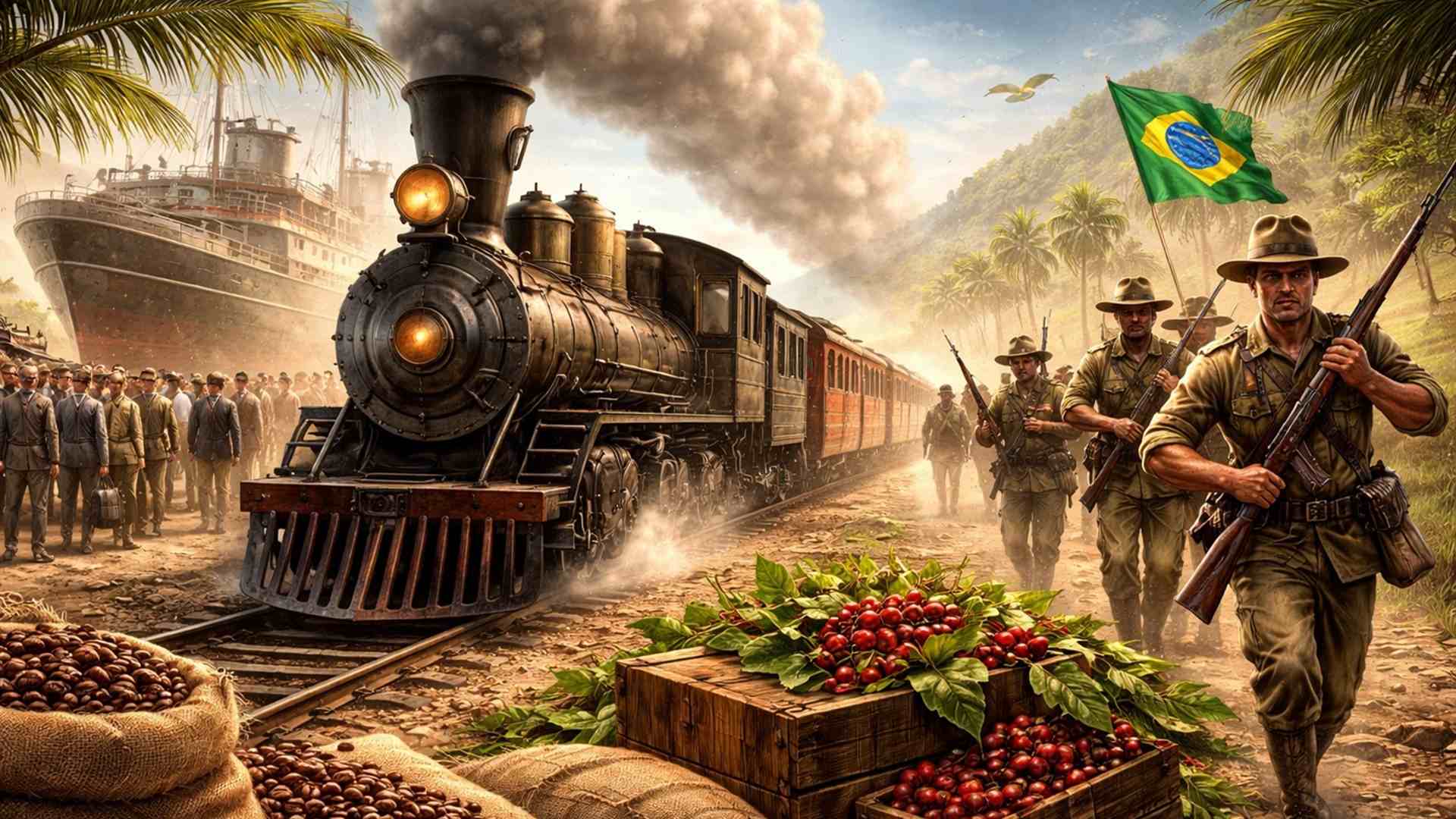
Between 1888 and 1930, Brazil experienced a cycle of accelerated growth, with population explosion, railroad expansion, absolute coffee dominance, mass immigration, and concentration of political power, followed by coups, military revolts, election frauds, and an economic crisis that ended the monopoly of coffee elites
Brazil advanced under Pedro II, with a population increase from 4 to 14 million, public revenues 14 times greater, exports multiplied by 10, and over 5,000 miles of railroads, but social and political tensions culminated in the coup of November 15, 1889, with the proclamation of the republic and profound transformations.
The country had made considerable progress under Pedro II’s leadership. The population grew from around 4,000,000 to 14,000,000. Public revenues increased 14 times, the value of exports rose 10 times, and new railroads exceeded 5,000 miles, equivalent to about 8,000 kilometers.
Immigration also intensified. In 1889, over 100,000 immigrants entered Brazil. Despite these indicators, a widespread feeling of discontent prevailed. Influential groups began to question the Empire and the figure of the emperor, even in the face of the recorded economic advances.
-
In Dubai, rising tensions from the war in the Middle East are causing super-rich individuals to leave the Gulf and direct their fortunes to a new financial refuge in Asia.

-
“No one will make us change the Pix,” says Lula after the US report.

-
Lula responds directly to Trump and says that Pix is from Brazil and will not change under pressure from anyone, after a report from the United States pointed out the Brazilian payment system as an American trade barrier.

-
Amazon has just announced a new fee on all deliveries, and your online purchases will become more expensive starting April 17, including for those buying from the United States here in Brazil.


Historians attributed the fall of the monarchy to the combination of an uneasy Army, an apprehensive landholding aristocracy, and a resentful clergy. These three groups progressively became critical of the emperor, amplifying the political isolation of the monarchic regime by the end of the 19th century.
In addition to these pressures, the most relevant factor was the stress imposed on the traditional social structure. The distance between the neo-feudal rural elites and the more progressive urban sectors widened. Urbanites, military personnel, and coffee growers began to see the monarchy as an obstacle to the future.
These groups assessed that the imperial regime represented the past and maintained close ties to the traditional agrarian elite. They argued that the republic would better meet the needs of an emerging capitalist system, increasingly based on coffee and industrial production.
A civil-military conspiracy then formed. On November 15, 1889, Army officers executed a coup. Pedro II abdicated and went into exile in Europe, ending nearly seven decades of monarchy in Brazil.
The abolition of slavery in 1888 and the overthrow of the monarchy in 1889 eliminated two central institutions of Brazilian history. These ruptures paved the way for a period of social, economic, and political changes that accelerated the country’s modernization process.
For this reason, the interval between 1888 and 1922 came to be described as the emergence of a “new Brazil.” The institutional reorganization and the redefinition of economic foundations marked this stage of transition and controlled instability.
The Transition to the Republic and the Initial Military Dominance
Manuel Deodoro da Fonseca, leader of the coup, assumed the role of provisional president of a government dominated by the military. He had the support of the emerging middle class and prosperous coffee growers, the social pillars of the new regime.
Fonseca proclaimed the republic, separated church and state, and enacted a new Constitution on February 24, 1891. The text combined presidential, federal, democratic, and republican elements, expanding the autonomy of the new states in relation to the former imperial provinces.
Congress elected Fonseca president still in 1891. However, he demonstrated difficulties in governing under the newly established constitutional rules. When he attempted to dissolve an opposing Congress and govern by decree, he faced strong public backlash.
The pressure was enough to force his resignation. Vice President Floriano Peixoto took over on November 23. Also a military figure, Peixoto suppressed royalist and military revolts, restoring a certain degree of order and institutional tranquility in the country.
The Rise of Civil Presidents and Coffee Politics
In 1894, in a relatively peaceful environment, Floriano Peixoto transferred power to the first civil president of the republic, Prudente de Morais. He had been the first republican governor of the state of São Paulo, the main coffee region.
The succeeding presidents, known as “coffee presidents,” were predominantly from São Paulo and Minas Gerais. They ensured political stability, reformed financial institutions, and boosted coffee exports.
Despite this, the regime offered little effective democracy. Only a minority of landowners had the right to vote. Election fraud was common, and regional political bosses acted with wide impunity, as long as they supported the sitting president.
During the 18th and 19th centuries, the economic and political axis shifted from the old sugar regions of the Northeast to the coffee-producing areas of the Southeast. Coffee came to dominate the national economy, accounting for more than half of export revenues in the early 20th century.
Excessive production soon generated problems. The oversupply drove international coffee prices down, threatening national prosperity. In 1906, São Paulo, Minas Gerais, and Rio de Janeiro coordinated a federal scheme to stabilize prices.
The government began purchasing the coffee surplus and removing it from the international market. The measure aimed to sustain product values but deepened the country’s economic dependence on a single commodity.
Urbanization, Immigration, and Transformation of Cities
Brazil received increasing flows of immigrants, and urbanization accelerated. The rubber boom in the basin of the Amazon River transformed Manaus into a cosmopolitan city, with electricity, trams, cinemas, and a grand opera house.
In Rio de Janeiro, Mayor Francisco Pereira Passos led urban reforms that reshaped the city. Meanwhile, doctor and scientist Oswaldo Cruz promoted public health campaigns that virtually eradicated yellow fever.
São Paulo consolidated itself as the country’s main commercial center. Its population surged from 35,000 inhabitants in 1883 to 350,000 in 1907. The port of Santos became one of the most bustling in the world, exporting large volumes of coffee.
These urban transformations reflected the strength of the coffee economy and Brazil’s increasing integration into European and North American markets. However, the accelerated growth expanded social and regional contrasts.
Intellectual Production and Reflection on the Country
The period was also marked by a literary renaissance. Intellectuals analyzed traditions, conflicts, and changes in Brazilian society. The works of this moment examined historical tensions and the impacts of ongoing modernization.
A central example was Os Sertões, published in 1902. The book described the bloody confrontation between government forces and messianic separatists in the interior of Bahia, reflecting on the deep divisions within Brazilian society.
The narrative highlighted the conflict between rural and urban Brazil, often described as the opposition between “two Brazils.” This understanding helped consolidate critical interpretations of the country’s structural limitations.
Territorial Expansion and Foreign Policy
The policy of territorial expansion reached its peak under the leadership of Baron of Rio Branco, José Maria da Silva Paranhos. Serving as Minister of Foreign Relations from 1902 to 1912, he conducted decisive negotiations.
Under his guidance, the Army closed thousands of miles of interior borders and took control of disputed territories. Other South American countries ceded Brazil about 342,000 square miles, an area larger than France.
Except for the territorial incorporation, Rio Branco avoided international conflicts. He prioritized diplomatic relations with the United States over the United Kingdom, partly due to consideration of Roosevelt’s Corollary to the Monroe Doctrine.
During World War I, Brazil sympathized with the Allies and declared war on Germany on October 26, 1917. Subsequently, it temporarily occupied a seat on the League of Nations Council.
Challenge to the Coffee Elite and Political Crisis
The growing urban middle class began to contest government support for coffee growers. Some of the younger military officers shared this discontent, forming a critical alliance against the existing political structure.
In the presidential elections of 1922, this coalition challenged the coffee elite. The government declared victory amid accusations of fraud. In response, dissatisfied officers organized an attempted coup in Rio de Janeiro.
The uprising failed, but it initiated a period of eight years of instability. Groups of young officers, known as “tenentes,” led broader rebellions in the mid-1920s.
After a revolt in 1924, survivors marched thousands of miles through the interior of the country attempting to stimulate insurrection. Rural landowners maintained control over workers and effectively resisted the movement.
Meanwhile, urban centers began to express growing demands for social and political reforms. Public events, like the Modern Art Week of 1922 in São Paulo, reinforced nationalist sentiments.
The nationalists criticized coffee governments for monopolizing power regionally, manipulating elections, and resisting economic diversification. These criticisms gained traction as social tensions deepened.
The Ideas of the Tenentes and the End of Political Monopoly
In 1926, the tenentes adopted a vaguely defined nationalist ideology focused on political and economic development. They believed the Army could modernize the country and alter archaic habits.
Their priority was not immediate democracy but structural reforms. They advocated for the removal of entrenched politicians, expansion of the government base, and economic modernization with strong centralization of power.
The program included recognition of unions and cooperatives, agrarian reform, nationalization of natural resources, and the creation of a minimum wage, maximum working hours, laws against child labor, and educational expansion.
After implementing these changes, the tenentes claimed they would return the country to constitutional order. Many proposals coincided with the interests of the urban middle class, but coordination among groups was lacking.
The military rebellions did not gain effective urban support. Two factors ended the political dominance of the coffee growers. The first was the sharp drop in coffee prices during the international financial crisis of 1929–30.
The second was the elites’ attempt to install another president aligned with their interests. These events undermined the economic and political base of the regime, paving the way for a new phase in Brazilian history, marked by rupture and institutional redefinition, even with some visible instability in the process.
Source: Brittanica








Seja o primeiro a reagir!