





 Portuguese
  English
  Spanish
  6 min of reading
  0 comments


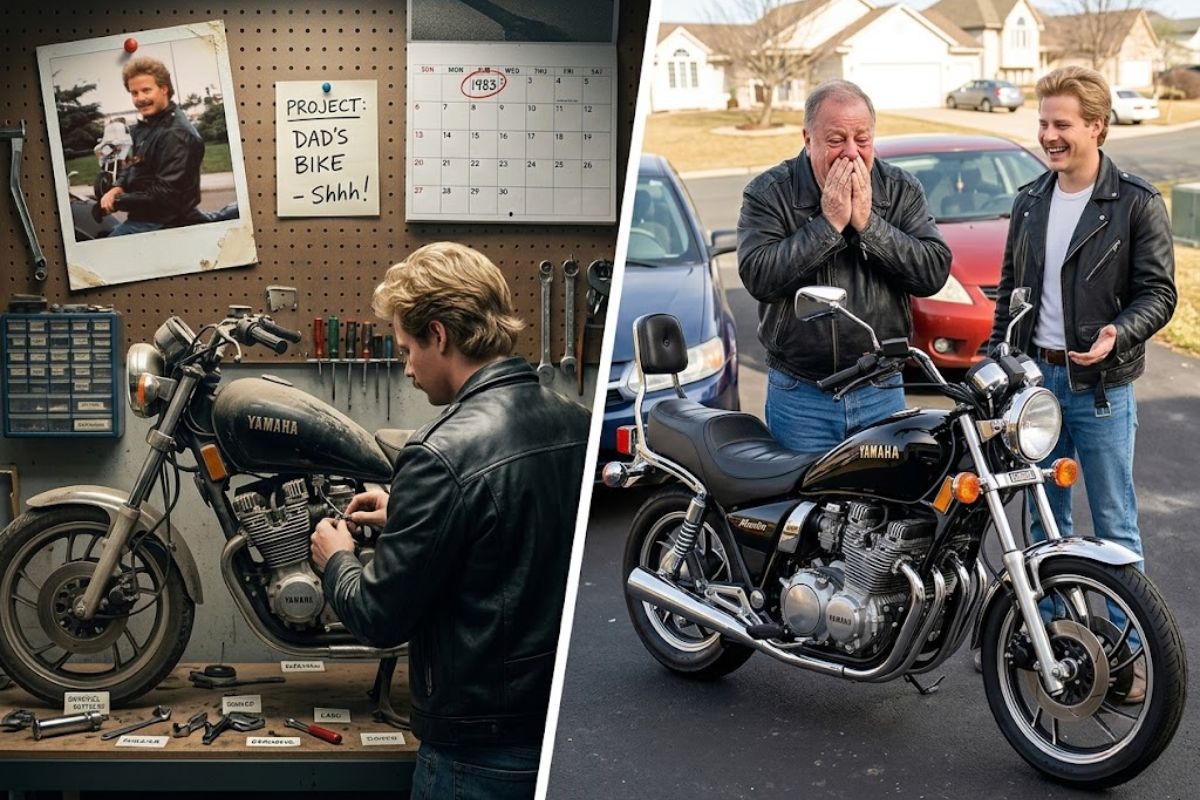
The Father’s Motorcycle, A 1983 Yamaha Maxim Forgotten for Nearly 20 Years, Disappears on Purpose While He Is Away; In Its Place, Boxes Under a Sheet. Son Jimmy, His Mother, and Friends Mobilize Donations on GoFundMe and Take It to Empire Cycle in Loretto, Minnesota, for a Complete Revision and Restoration.
What starts as a strange “absence” in the garage quietly becomes a very common portrait of adult life: emotional projects postponed until someone decides to pull the thread. In the case of Jimmy Tarpey, his father’s motorcycle, a 1983 Yamaha Maxim, was not just a parked vehicle; it was a physical reminder of a time when the family still had the road, freedom, and weekend plans.
And it was precisely for this reason that the decision to “make the father’s motorcycle disappear” did not stem from impulse but from a clear goal: to give back to his father something he had not been able to return to himself, the pleasure of seeing the old companion alive once again. The gift was not the machine itself; it was the return of a story.
When the Father’s Motorcycle “Disappears,” the Intention Is Not Theft, It’s a Family Plot

The first layer of this story seems simple: the father’s motorcycle disappears. But the detail changes everything: the disappearance was planned. While the father was away, the Yamaha left its spot, and a pile of cardboard boxes took its place, under the same sheet that had become part of the garage scene. The staging was key to keeping the secret without raising immediate suspicion.
-
Italian researchers have detected what appears to be a second Sphinx buried under the sands of Egypt, and satellite scans reveal a gigantic underground megastructure hidden beneath the Giza Plateau for over 3,000 years.

-
There are 4,223 drums and 1,343 metal boxes concreted with 50-centimeter walls that store the radioactive waste from Cesium-137 in the worst radiological accident in Brazil, just 23 kilometers from Goiânia, with environmental monitoring every three months.

-
Giant Roman treasure found at the bottom of Lake Neuchâtel in Switzerland reveals an advanced trade system, circulation of goods, and armed escort in the Roman Empire about two thousand years ago.
-
He buried 1,200 old tires in the walls to build his own self-sufficient house in the mountains with glass bottles, rainwater, and an integrated greenhouse.

This type of domestic “heist” works because it exploits a real habit: when something sits still for years, it becomes part of the landscape. The father’s motorcycle had been there for so long that the sheet became almost a symbol of postponement. Covering it, leaning it, promising “one day I will fix it” is a way of storing it without deciding. By swapping the motorcycle for boxes, the family also changed the meaning of the space: from storage to stage.
Operation Maxim: Who Joins, How It’s Organized, and Why the Mother Becomes the Central Piece
The project got a name, “Operation Maxim,” and this says a lot about the spirit of the plan: it was not a casual renovation; it was a mission with stages, secrecy, and cooperation.
Jimmy articulated the idea with his mother, who helped sustain the narrative of “everything is normal” and even reinforced the disguise by covering what looked like the motorcycle ahead of time. Her participation was not supplementary; it was the gear of the secret.
Beyond the immediate family, the operation grew beyond the house. With the support of a friend and dozens of people who contributed to a GoFundMe campaign created by Jimmy, the father’s motorcycle was put on a trailer and taken to Empire Cycle in Loretto, Minnesota.
Here lies an important response without needing to force any question: there was a cost, but the exact value is not what defines the action, but rather the fact that many people mobilized to make it happen. It was not “a son alone”; it was a network helping to restore a memory.
What a Motorcycle Left Idle for Almost 20 Years Typically Requires and Why It’s Not Just Aesthetic

When a motorcycle sits unused for years, the problem is rarely just “give it a wash and start it.” Time acts silently: fuel ages, rubber dries out, seals lose elasticity, and internal components can generate deposits.
In the case of the father’s motorcycle, the list of services mentioned includes carburetor repairs, new tires, and replacement of fuel hoses, in addition to the expected care for a motorcycle that has been idle for almost two decades. This is mechanical survival maintenance, not a whim.
The carburetor is a good example of how technique meets experience. It is responsible for dosing and mixing air and fuel appropriately for combustion.
During long periods of inactivity, it is common for residues and varnishes to form in the fuel system, making it difficult for fuel to flow and altering adjustments.
Tires, on the other hand, do not “age” just from wear while in use; they also suffer from sitting idle, potentially losing integrity and safety. And fuel hoses deal with heat, drying, and contact with substances that degrade the material over the years. Replacing what has aged is restoring reliability, not just shine.
Why Taking the Father’s Motorcycle to a Specialized Workshop Changes the Final Outcome

There is a huge difference between “making it work” and “restoring it to return to routine.” By taking the father’s motorcycle to Empire Cycle instead of trying to sort everything out in a makeshift way, the project takes on a commitment to safety, thorough checking, and consistency. Restoring is not just revving the engine; it is regaining trust in it.
This type of choice also shows emotional maturity: when the goal is to give a gift with sentimental value, the risk of a disappointing return is high if the work is incomplete.
A motorcycle that starts today and fails tomorrow can turn surprise into concern. A thorough inspection, on the contrary, helps restore the experience the father once had: not just looking at the machine but imagining riding it again. The technique protects the symbolism.
The “Midnight Maxim” Comes Home: The Moment When Surprise Becomes New Memory
After the restoration was completed, Jimmy brought the 1983 Yamaha Maxim back to his father’s house. The description is strong because it does not rely on exaggeration: the father’s motorcycle returned functional, shining like new, ready to be started and used.
The impact was not just visual. The father’s reaction was immediate: a hug, emotion, and the gesture that sums it all up, starting the motorcycle again as if confirming that it was real. The engine was not just sound; it was proof.
And there is a detail that adds a human dimension to the episode: upon hearing the rumble, the father jokes with his wife, saying that he has known that motorcycle longer than he has known her.
The phrase carries humor but also reveals belonging, history, and intimacy. The father’s motorcycle is not a neutral object; it is an old family element, prior to phases, changes, and routines. The humor there does not diminish the feeling; it makes it more genuine.
The Emotional Value of the Father’s Motorcycle and What This Story Says About Gifts That Cannot Be Measured by Price
There is a reason why this type of story captivates so many people: it touches on a collective feeling of time slipping away.
Almost everyone has something “saved for later,” whether it’s a project, a hobby, a trip, a repair, or a memory that deserved more attention.
The father’s motorcycle represents just that, the interval between what a person loved and what life allowed them to continue loving. Restoring, here, is giving space for an old and good version of someone to reappear.
There is also an interesting contrast: the plan involves logistics, a trailer, a workshop, parts, and donations, but the final point is not material.
The real gift is the chance to recall the past and, more importantly, to create new memories. A father who turns on his father’s motorcycle again is not just “testing the engine”; he is rehearsing a return to what made him smile.
And the son, by organizing everything, is saying without words: I saw what this means to you. It’s acknowledgment, not ostentation.
What makes Operation Maxim so remarkable is that it does not try to be grandiose; it is precise. A son perceives an old desire, structures a family operation, gathers support, performs the revision the right way, and returns the father’s motorcycle with surprise and respect for the story it carries.
It is a gift that does not compete with everyday life; it reorganizes it.
Now I want to draw you into this idea in a very personal way: if you could “resurrect” an important object from your family, what would it be, and why?
Would it be a father’s motorcycle, a grandfather’s tool, an instrument, an old car, a sewing machine, a photo that deserved to become an album? Tell what memory you would try to restore and how it would change your relationship.










-

-

-

-

-

-

27 pessoas reagiram a isso.