





 Portuguese
  English
  Spanish
  6 min of reading
  2 comments


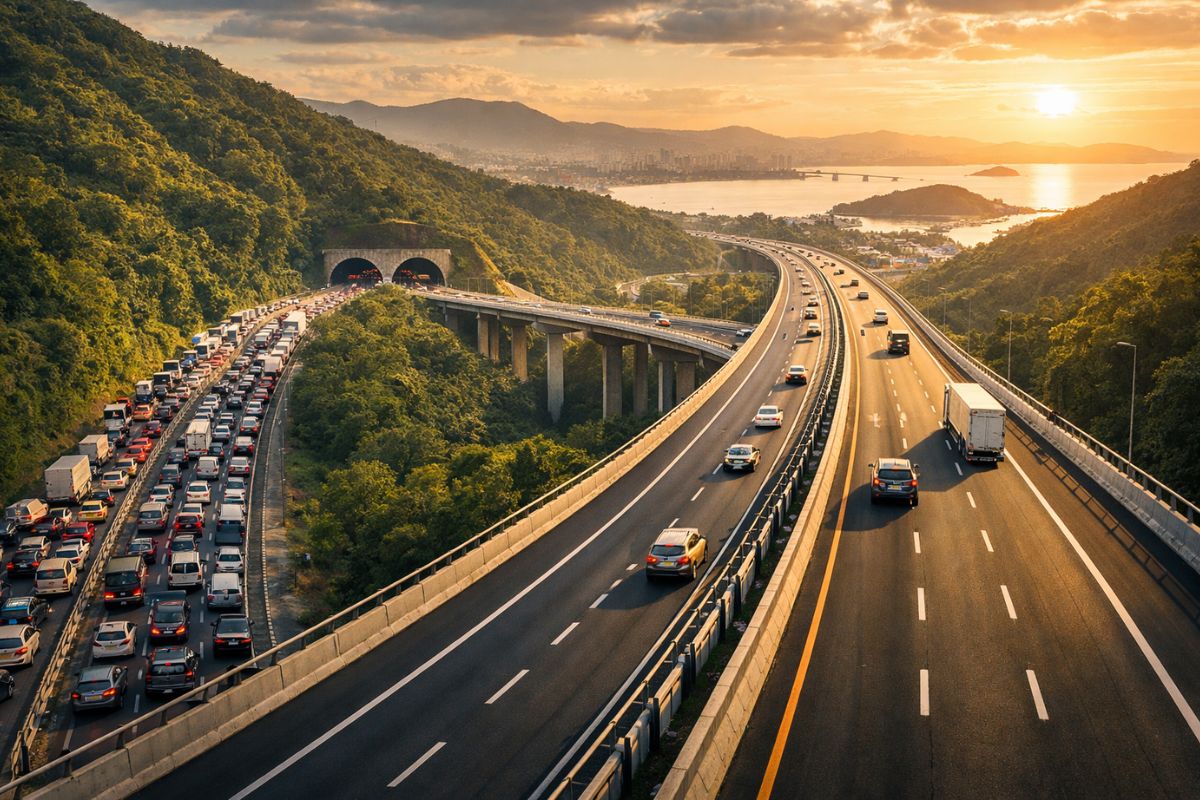


End of Suffering on BR-101 or Just Another Promise: Santa Catarina Designs a Mega Road Called Via Mar, 145 Km at 120 Km/h, to Shorten Joinville–Florianópolis from More than 3 Hours to 1h12 and Relieve Holidays and Critical Ordinary Days
Santa Catarina is aiming for a new route to unlock the coast: with BR-101 saturated, the state presents the megaproject Via Mar as a direct alternative between Joinville and Florianópolis. The proposal combines 145 km, a speed limit of 120 km/h, and a route change designed to “escape” the bottleneck that hinders travel.
The promise is simple to understand and hard to ignore: cutting travel time from over three hours during peak times to about 1h12, reducing the time on that stretch by around 60%. Behind this calculation lies an estimated investment of R$ 7.5 billion, phased execution, and a financing plan that mixes initial public works with a PPP featuring tolls.
The Megaroad Via Mar and the Logic of Creating a Parallel Route to the Nightmare of BR-101
When BR-101 is “drowned” in heavy traffic, the problem becomes more than just congestion: it turns into unpredictability. This is where the Via Mar megaproject emerges as a mobility bet in the Santa Catarina coast, with a route planned to connect Joinville to Florianópolis through a new path, without depending on the most congested stretch of the federal highway.
-
A new Brazilian shopping center worth R$ 400 million will be built in an area equivalent to more than 4 football fields, featuring 90 stores, 5 cinemas, a supermarket, a college, and parking for 1,700 cars, potentially generating 3,000 jobs.

-
Larger than entire cities in Brazil: BYD is building a 4.6 km² complex in Bahia with a capacity for 600,000 vehicles per year, but the discovery of 163 workers in conditions analogous to slavery has shaken the entire project.

-
With an investment of R$ 612 million, a capacity to process 1.2 million liters of milk per day, Piracanjuba inaugurates a mega cheese factory that increases national production, reduces dependence on imports, and repositions Brazil on the global dairy map.

-
Brazilian city gains industrial hub for 85 companies that is equivalent to 55 football fields.


The announced project establishes clear numbers and goals: 145 km in length and a speed limit of 120 km/h.
In practice, the logic aims to create a direct alternative to the corridor that currently concentrates a significant portion of traffic between coastal cities and Greater Florianópolis, especially when traffic surges on ordinary days and becomes a nightmare during holidays.
How Much It Costs, Who Pays First, and Why the Model Mixes Government and PPP
The estimated total cost for Via Mar is approximately R$ 7.5 billion. To make the beginning feasible, the strategy starts with the basics: initiating with an initial phase funded by the state itself.
This initial phase has a projected cost of R$ 1 billion and, according to the disclosed planning, will be funded by the government of Santa Catarina.
At the same time, the remaining sections will not be left “in limbo” without financial planning: the proposal is to open a tender for a PPP (Public-Private Partnership) to carry out the other segments.
The proposed rule is that the winner of the PPP will reimburse the state the money invested in the first phase after the bidding, and, to obtain the necessary funds, the concessionaire will install toll plazas along the megaproject.
This format attempts to balance the speed of initiation with the capacity for private investment and also brings the inevitable discussion about costs to users.
Where the Via Mar Passes and How the Project Was Divided to Get Off the Ground
The division into parts is the chosen path to make the project “executable” in blocks: there will be four lots, plus one remaining stretch, connecting the start in Joinville to strategic points until reaching the Highway Ring Road of Greater Florianópolis.
This segmentation also helps explain the “where” of the megaproject, as it ties the route to existing junctions and highways.
In the disclosed distribution, the lots and the remaining stretch are as follows, with lengths, sections, and special works planned:
- Lot 1 (26.85 km): between the junction of BR-101, in Joinville, and BR-280, in Guaramirim; four bridges and two overpasses. This lot, according to the proposal, will be executed by the state government.
- Lot 2 (21.09 km): from the junction of BR-280, in Guaramirim, to SC-415, between Massaranduba and São João do Itaperiú; two bridges and one overpass.
- Lot 3 (16.77 km): between SC-415 and SC-414, in Luis Alves and Navegantes; two bridges and eight retaining walls.
- Lot 4 (25.78 km): between SC-414 in Luis Alves and Navegantes, and the junction of SC-486, in Itajaí; four overpasses, four bridges, and three retaining walls.
- Remaining Segment (54.72 km): from the junction of SC-486, in Itajaí, to the Highway Ring Road of Greater Florianópolis; four overpasses, four bridges, and three retaining walls.
What Changes in Practice: Travel Time, Predictability, and the “Invisible Cost” of Congestion
The central argument of the Via Mar megaproject is the gain in time and, mainly, in predictability. Currently, the Joinville–Florianópolis trip can take over three hours even during times considered normal.
The projected calculation with the new route points to an arrival of around 1h12, a reduction of nearly 60%. It’s not just “going faster”; it’s reducing the risk of being hostage to the bottleneck.
This type of change tends to impact everyday decisions: departure times, work logistics, intercity travel, and even the planning of those who avoid the coast out of fear of constant delays.
By offering an alternative route, the idea is to ease the pressure on BR-101 — and, at the same time, create a corridor with more controlled characteristics, such as a limit of 120 km/h and a set of special works (bridges, overpasses, and retaining walls) spread along the lots.
Timeline, Promised Start, and the Points That Deserve Attention Before the “End of Suffering”
The declared expectation by Governor Jorginho Mello is to start construction in the first half of 2026, beginning with the initial phase under the responsibility of the state government.
This start date is crucial, as it is when the project leaves the realm of promises and enters the realm of execution—an etapa in which schedules, bids, and contracts begin to define the real pace.
At the same time, the very design of the PPP and the installation of tolls raise important questions without needing any bias: how will the cost of using the route look for those who frequently depend on the displacement?
At what points will the toll plazas be positioned along the megaproject? And how will the transition between the section completed by the state and the sections under the responsibility of the concessionaire be handled, given that the proposal includes reimbursements for the first phase after the bid?
It’s precisely in these details that a billion-dollar project becomes, or not, a solution perceived in daily life.
The Via Mar is born as a promise of a “shortcut” for one of the most stressful journeys in the Santa Catarina coast: trading the unpredictability of BR-101 for a megaroad with 145 km, a speed limit of 120 km/h, executed in lots with a projected cost of R$ 7.5 billion, expected to start in the first half of 2026.
Between the potential relief in travel time and the presence of tolls as part of the financing model, the debate is likely to be as intense as the traffic it seeks to avoid.
If this megaroad exists as designed, would you consider paying tolls to gain predictability and reduce travel time, or do you think the “cost” (both monetary and in the model) could become a new type of suffering?
And in which sections of BR-101 do you feel the bottleneck most destroys any planning?






Kkkkkkkkkk só papo ****. Não dão conta de fazer um trechinho minúsculo de estrada e querem fazer estrada mar??????? E 3h?!?!?! Aquele trecho toma por baixo de 6 a 8 horas.
Espero que seja algo real, assim evitaria perda de tempo e de vidas…todo dia tem acidentes com vitimas!