





 English
  Francês
  Alemão
  Italiano
  Japonês
  Norueguês
  Portuguese
  Spanish
  4 min of reading
  6 comments


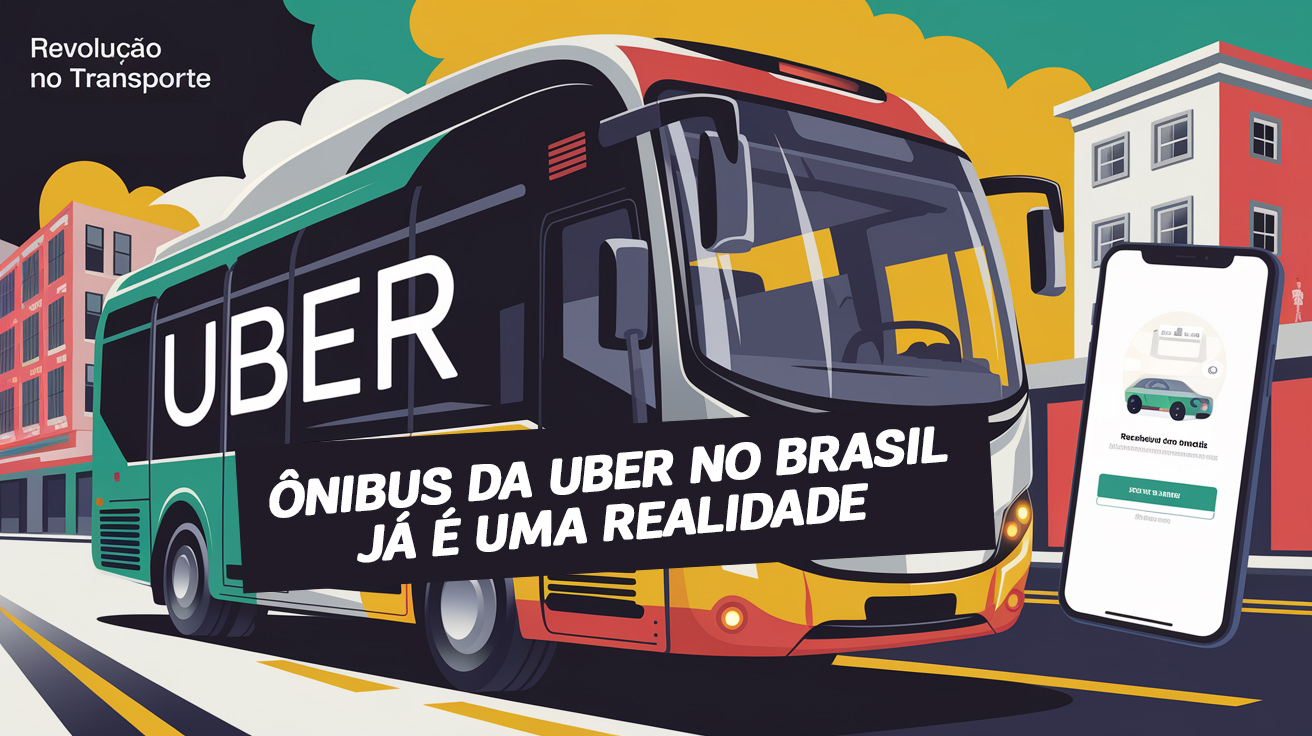


With the Promise of Transforming the Road Transportation Market, Uber Launched the Shuttle in Brazil. The Service Offers Cheaper Intercity Transport but is Already Facing Investigations for Alleged Illegality. Will This Service Revolutionize Mobility or is it Doomed to Failure? Discover All the Details and the Impact on the Transportation Sector!
Can you imagine a revolution in public transportation, where the agility and convenience of apps invade the road sector?
Well, Uber Shuttle has arrived to compete in the billion-dollar intercity charter market in Brazil, promising to offer cheaper and more practical rides but already facing resistance and investigations from authorities.
The service, which promises to change the transportation dynamics between major cities, has generated controversies and questions about its legality.
-
Expansion of Federal Institutes: 38 new campuses and R$ 200 million for public education; see the cities included.

-
Seen from space, a colossal ‘Y’ cuts through the largest desert in China, blending a jade-filled river, red and white mountains, and revealing the absurd scale of the transformation of the Taklamakan surrounded by a green wall with billions of trees.

-
The Pacific Ocean reveals what the cliffs of Big Sur have hidden for millennia: Pfeiffer Beach, in California, features swirling purple sand formed by garnet crystals and displays a stone arch that is illuminated by the sun in winter for just a few days each year.

-
Lula’s government changes rule in important benefit and thousands of Brazilians will no longer receive it; see what has changed.


Uber Shuttle, a service launched by Uber, aims to connect passengers between Guarulhos and São Paulo.
Announced on January 8, 2025, the service is inspired by an initiative created in Egypt in 2019 and is now present in over 30 countries.
The idea is clear: to compete in a market estimated at R$ 30 billion and to compete with companies such as Brazilian Buser, German FlixBus, and French BlaBlaCar.
In Brazil, Shuttle offers five fixed routes between neighborhoods in Guarulhos and regions in São Paulo, with prices ranging from R$ 30 to R$ 40 per trip.
How the Uber Shuttle Works
Passengers interested in the service must purchase packages with a minimum of two rides within a 30-day period.
The purchase is made directly in the Uber app, where it is also possible to track the route in real time.
The boarding validation occurs via QR code or PIN.
Uber has partnered with licensed companies, such as Viação Mimo, to operate the service, using vehicles with a capacity of up to 49 passengers.
Among the currently available routes, the following stand out:
- Bonsucesso > Itaim Bibi > Jurubatuba
- Jardim Adriana > Itaim Bibi > Jurubatuba
- Vila Rio de Janeiro > Itaim Bibi > Jurubatuba
- Taboão > Itaim Bibi > Jurubatuba
- São João > Itaim Bibi > Jurubatuba
It is worth noting that, so far, none of the routes offered by Shuttle pass through Guarulhos International Airport.
Controversy and Oversight
Despite Uber’s optimistic discourse, the service is already under scrutiny by Artesp (Transport Regulatory Agency in the State of São Paulo) and the Metropolitan Urban Transport Company (EMTU).
According to these agencies, the Shuttle’s operating model is not in compliance with current legislation.
According to Artesp, Viação Mimo is registered for charter services, but charging individually for seats characterizes a regular collective transport service, which is not allowed under charter regulations.
EMTU highlighted that the service offered does not fit into the categories provided by State Decrees No. 19,835/1982 and No. 29,912/1989, which regulate continuous and occasional chartering.
During an operation carried out on January 10, 2025, ten buses were inspected, two of which were seized and taken to a yard.
According to EMTU, further inspections will be conducted, which could result in fines or even vehicle seizures if the service continues to operate without authorization.
Defense of Uber and Mimo
In response to the criticisms, both Uber and Mimo defended the legality of the service, claiming that it adheres to the regulations for charter services.
Uber stated that reservations are not individual but made through packages, which meets legal requirements.
In a statement, the company emphasized that the model is similar to that practiced by other companies in the sector, but with a technological differential that allows seat reservations through the app.
For its part, Mimo stated that its “executive charter” model complies with the regulations of Artesp and EMTU.
The company emphasized that trips are charged in packages or monthly payments, not by individual tickets.
Should irregularities be confirmed, Mimo committed to immediately halt operations.
Mimo also clarified that its target audience consists of passengers who currently use private cars or individual transport services for daily commutes, such as trips to work or universities. According to the company, there is no direct competition with regular intercity routes.
The Future of App-Based Transportation
With the launch of Uber Shuttle, Uber aims to expand its presence in Brazil, entering a segment that generates billions annually.
However, the clash with regulatory agencies could pose a significant obstacle for the service.
While legal issues are unresolved, the company remains on controversial ground, splitting opinions between passengers and authorities.
It remains to be seen whether the model proposed by Uber will be able to survive regulatory demands or if it will be yet another chapter of tension between technological innovation and traditional legislation.
Do you believe that Uber Shuttle has the potential to transform public transportation in Brazil? Share your opinion in the comments!







No Brasil os poderoso não seita nada que é para melhoa para povo porque os políticos está por trás dos lucros nos transportes vê em viajes estadual é interestadual sempre mesma panela!
Quem fiscaliza o aplicativo quando não presta o serviço adequado?
No reclame aqui o que mais vemos são reclamações desses serviços por aplicativos
Não tem nem endereço onde possa fazer uma reclamação, tudo é por app controlado por inteligência artificial…
A gente liga e fala com um robô…
A própria BUSER diz que não é responsável pela viagem, diz que é só intermediário
E o passageiro fica sem saber a quem recorrer
Vai acabar com tudo no Brasil esse lixo se aplicativo que só explora os motoristas e acaba com o setor