





 Portuguese
  English
  Spanish
  5 min of reading
  0 comments



Innovative System Promises to Transform Fatal Accidents into Survival Landings by Combining Artificial Intelligence, Flight Sensors, and External Airbags to Protect Passengers in Critical Fall Situations.
A air safety concept promises to transform inevitable falls into survivable landings.
Named Project Rebirth, the system combines artificial intelligence, sensors, and external airbags to reduce damage in high-energy impacts.
-
Motorola launched the Signature with a gold seal from DxOMark, tying with the iPhone 17 Pro in camera performance, Snapdragon 8 Gen 5 that surpassed 3 million in benchmarks, and a zoom that impresses even at night.

-
Satellites reveal beneath the Sahara a giant river buried for thousands of kilometers: study shows that the largest hot desert on the planet was once traversed by a river system comparable to the largest on Earth.

-
Scientists have captured something never seen in space: newly born stars are creating gigantic rings of light a thousand times larger than the distance between the Earth and the Sun, and this changes everything we knew about stellar birth.

-
Geologists find traces of a continent that disappeared 155 million years ago after separating from Australia and reveal that it did not sink, but broke into fragments scattered across Southeast Asia.

The proposal was born after the crash of Air India’s flight AI171 on June 12, 2025, shortly after takeoff from Ahmedabad en route to London, a tragedy that left 241 dead on board and 19 on the ground, with only one survivor.
A preliminary report indicated a sudden loss of power in both engines after the fuel cutoff controls were activated.
The project has been submitted to the James Dyson Award 2025.
Tragedy in Ahmedabad Inspired the Idea
AI171 crashed 32 seconds after leaving the runway, hitting buildings near the airport.
The initial investigation by the Indian AAIB indicated that the fuel levers may have switched from “run” to “cutoff” moments after rotation, leading to engine shutdown and loss of lift.
The case is still under investigation, and there is no conclusion yet on the reason for the movement of the levers.
While families and authorities await definitive answers, the impact of the accident has mobilized young engineers.
Two students from Birla Institute of Technology and Science (BITS Pilani), Dubai campus, Eshel Wasim and Dharsan Srinivasan, decided to tackle a rarely addressed point by current safety systems: what to do when redundancies fail and a crash becomes imminent.
They presented the proposal at the James Dyson Award with the goal of developing functional prototypes.
How the System with AI Would Work
Rebirth is based on the premise that, in extreme scenarios, the priority is to preserve lives in the final phase of an accident.
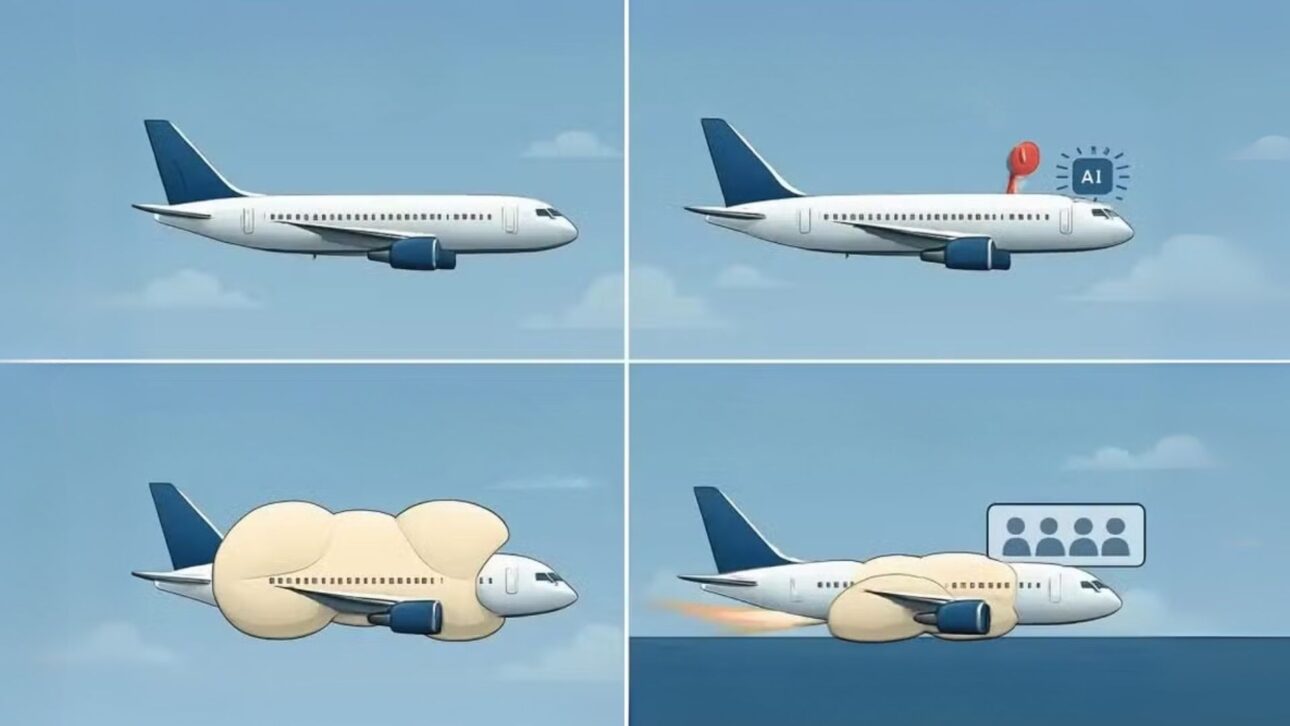
To achieve this, the proposed architecture continuously monitors flight parameters and, in the event of an inevitable collision, triggers an automated sequence.
According to the public project description and recent reports, AI tracks flight data and activates the protocol below 3,000 feet, a range in which there is little time left for human response.
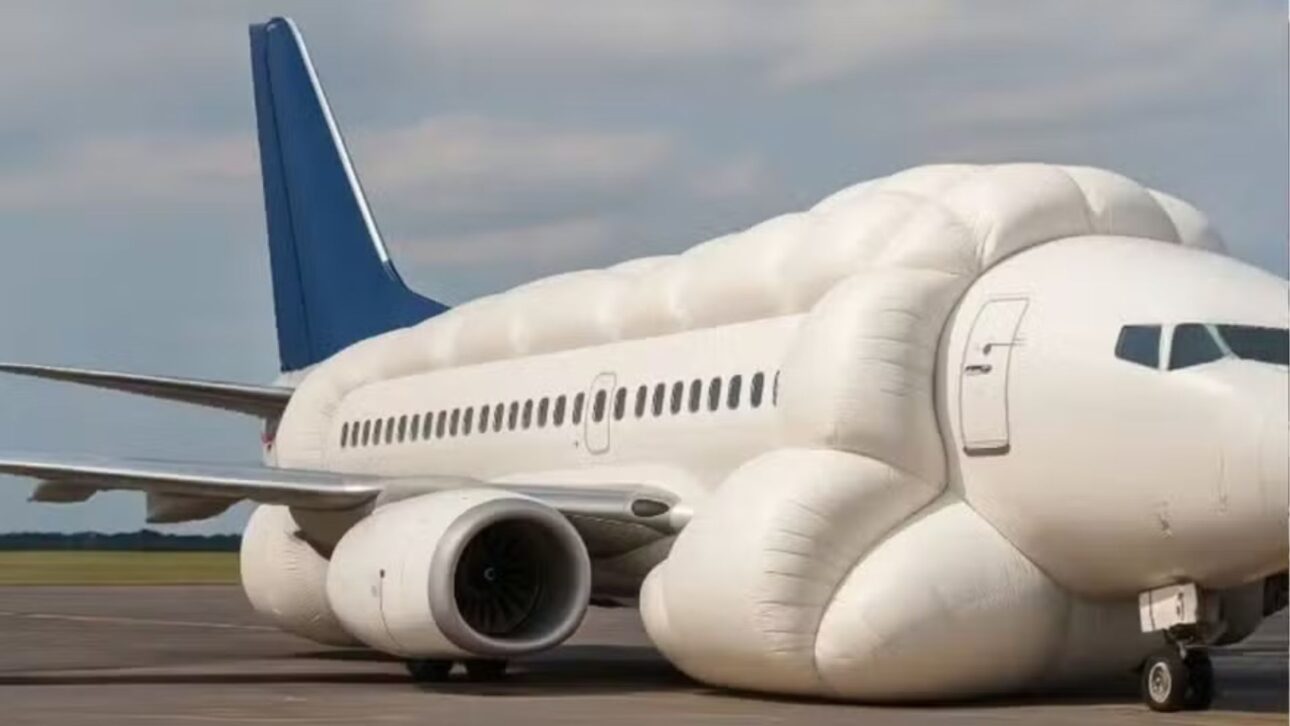
At that moment, external airbags would inflate within seconds to create a “cocoon” around the fuselage, absorbing part of the impact.
Automatic Activation and Protection Envelope
The proposal describes airbag modules installed at the nose, ventral region, and tail of the aircraft.
When inflated, these modules would form a damping barrier aimed at reducing structural loads and slowing down the passenger cabin.
In addition, the solution envisions the use of smart fluids that become stiffer under pressure, enhancing energy absorption at the moment of impact.
The goal is to create an envelope that limits internal accelerations to potentially survivable levels, even if the aircraft suffers severe damage.
Materials and Deceleration
In addition to the airbags and high-response fluids, Rebirth mentions a deceleration mechanism to reduce vertical speed in the final phase.
The public documentation cites reverse thrust or dedicated “boosters” to decrease the descent rate.
In theory, the combination of technologies would seek to transform a fatal impact into a forced landing with chances for rescue, with external signaling and beacons to facilitate the aircraft’s location.
From Concept to Test: Regulatory Path is Long
The creators acknowledge that the idea is in the conceptual stage and requires an extensive trail before any real usage.
In civil aviation, the certification of systems that interfere with aerodynamics and structure requires rigorous validation, from material and inflator tests to simulations and scaled trials.
The very interaction between external airbags and control surfaces, landing gears, and air intakes requires in-depth studies.
The application to the James Dyson Award 2025 provides visibility and potential financial support but does not replace aviation certification milestones.
Still, the proposal has gained international traction in recent days, especially due to the direct connection with the disaster in India.
In presentation texts and interviews, the authors report the emotional upheaval caused by the Ahmedabad crash.
One published excerpt summarizes the motivation: “my mother could not sleep” after the accident, referencing the suffering of relatives imagining the fear experienced by passengers and crew.
The pain, they say, turned into hours of research and design of a technological response.
What is Already Known About the Cause of the Accident
Three months later, the case of AI171 is still under investigation.
The preliminary report from AAIB brought the most concrete data so far: the recorders indicated the transition of fuel controls to cutoff right after takeoff, followed by the loss of both engines.
The documentation did not assign responsibility or establish intent, and family members of the captain are calling for an independent investigation to clarify gaps and contest interpretations they consider hasty.
The death toll reported publicly combines the victims on board and on the ground, with one survivor.
Potential and Limits of a “Last Line of Defense”
If Rebirth advances, its likely application would be incremental.
In new aircraft, the project would have to be integrated from the engineering phase.
In aircraft in service, any retrofit would require assessments of structural and weight impact, as well as specific certification.
Relevant technical doubts persist, such as the integration of the system with flight logic and protection against inadvertent activations.
Even so, the debate that the proposal provokes is clear: faced with rare yet high-impact accidents, would there be room for a survival layer to come into action when traditional redundancies are exhausted?
Next Steps and Public Scrutiny
The authors say they plan to create prototypes and laboratory tests of the main modules — AI detection, external airbags, impact fluids, deceleration, and rescue signals.
The envisioned timeline aims for testing and approval in a few years, which will require partnerships with manufacturers, regulators, and research centers.
At the same time, the investigation of AI171 continues under global attention, and new official findings about the dynamics of the crash should guide any serious discussion about impact mitigation technologies.
In a sector that historically reduces risks by preventing failures before they occur, the proposal shifts the focus to the final minute: how to save people when everything else has failed.
In light of this clash between preventive tradition and “last resort” ideas, what should be the aviation priority in the coming years?






-

Uma pessoa reagiu a isso.