





 Portuguese
  English
  Spanish
  3 min of reading
  0 comments


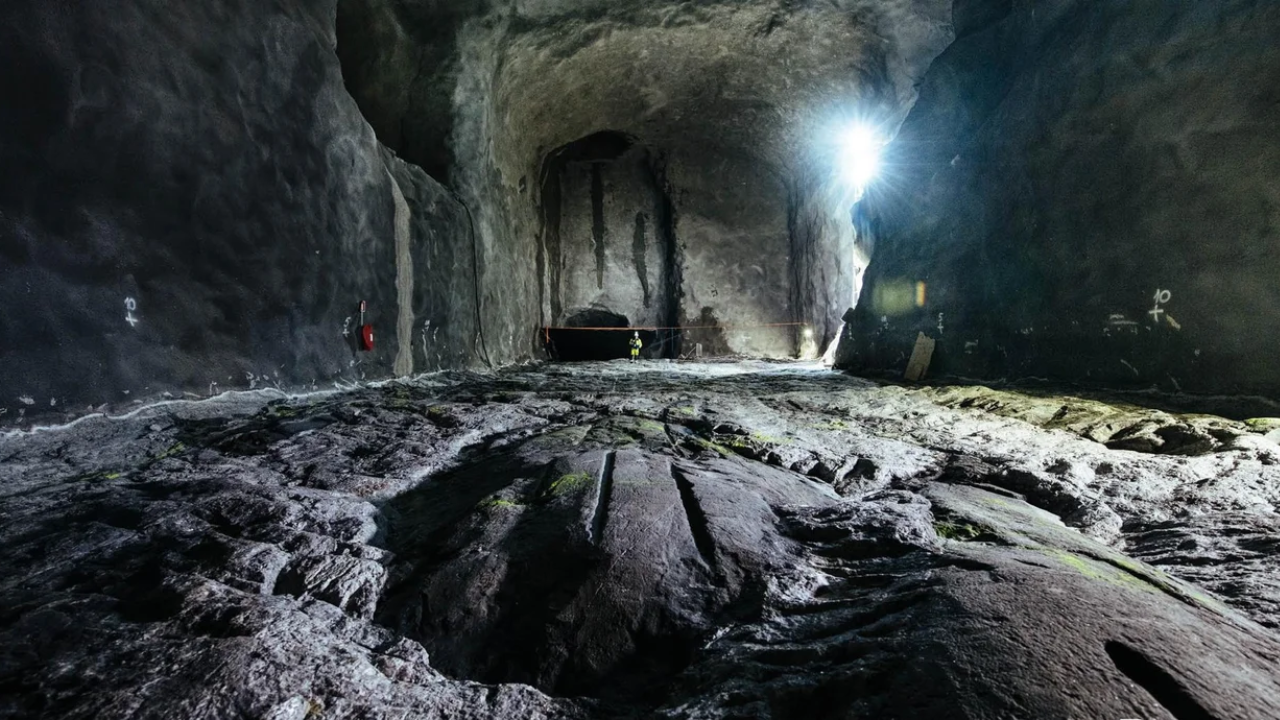
With a project aimed at ensuring safety for more than 100,000 years, Onkalo represents a breakthrough in nuclear waste management, protecting the environment and future generations from the risks of radioactivity.
Finland is about to inaugurate one of the most ambitious and revolutionary projects in the history of nuclear energy. This is Onkalo, an underground cavern designed to store nuclear waste for more than 100,000 years.
Located on the island of Olkiluoto, on the west coast of Finland, this unique structure in the world represents a milestone in the management of radioactive waste. With an inauguration scheduled for 2026, Onkalo promises to be the definitive solution to the challenges posed by Finnish nuclear waste.
The Onkalo Project
The word “Onkalo” means “cavity” or “hiding place” in Finnish, an appropriate description for this impressive nuclear cavern. The project is located 430 meters deep in a rocky bed, where the radioactive waste from Finland’s nuclear plants will be stored.
-
Friends have been building a small “town” for 30 years to grow old together, with compact houses, a common area, nature surrounding it, and a collective life project designed for friendship, coexistence, and simplicity.

-
This small town in Germany created its own currency 24 years ago, today it circulates millions per year, is accepted in over 300 stores, and the German government allowed all of this to happen under one condition.

-
Curitiba is shrinking and is expected to lose 97,000 residents by 2050, while inland cities in Paraná such as Sarandi, Araucária, and Toledo are experiencing accelerated growth that is changing the entire state’s map.

-
Tourists were poisoned on Everest in a million-dollar fraud scheme involving helicopters that diverted over $19 million and shocked international authorities.


Currently, the country has the Loviisa 1 and 2 nuclear plants, Olkiluoto 1, 2, and 3, as well as the planned Olkiluoto 4, whose waste will be deposited in Onkalo.
The Onkalo nuclear cavern was designed to safely store used nuclear fuel. The waste will be sealed in copper and cast iron canisters before being deposited. Once filled, the facility will be permanently sealed in 2120.
This nuclear waste storage model was designed to ensure safety even for future generations, preventing leaks and environmental risks.
The Importance of the Onkalo Nuclear Cavern
The storage of nuclear waste is one of the greatest challenges of nuclear energy. Although it is considered a cleaner alternative compared to fossil fuels, nuclear energy generates highly dangerous radioactive waste.
The Onkalo nuclear cavern represents an innovative solution, providing a safe and isolated space for high-level radioactive waste, which can take thousands of years to lose its radioactivity potential.
Nuclear waste is classified into three categories: low, intermediate, and high-level radioactivity. While the majority (90%) consists of low-risk materials, such as contaminated clothing and tools, the high-level fraction, although it represents only 3% of the total, carries 99% of the radioactivity.
According to the Nuclear Energy Agency (NEA), high-level waste takes about 10,000 years to reach a radioactivity level comparable to that of the original ore from which it was extracted.
The Signage Dilemma
One of the major challenges of the Onkalo nuclear cavern is ensuring that future civilizations understand the dangers buried there. How to signal the risks of Onkalo thousands of years from now, when we do not know what language will be spoken or if humanity will still exist?
Among the proposed solutions, one of the more radical involves creating a hostile landscape around the nuclear cavern, making the area inhospitable and frightening. Another curious idea suggests genetically engineering cats that would change color upon detecting radiation, creating a lasting legend about “signaling cats” to alert people to danger.
In the short term, Onkalo will feature standardized signage to indicate the presence of radioactive material. However, the future of risk communication in Onkalo remains an enigma to be solved.










Seja o primeiro a reagir!