





 Portuguese
  English
  Spanish
  5 min of reading
  0 comments


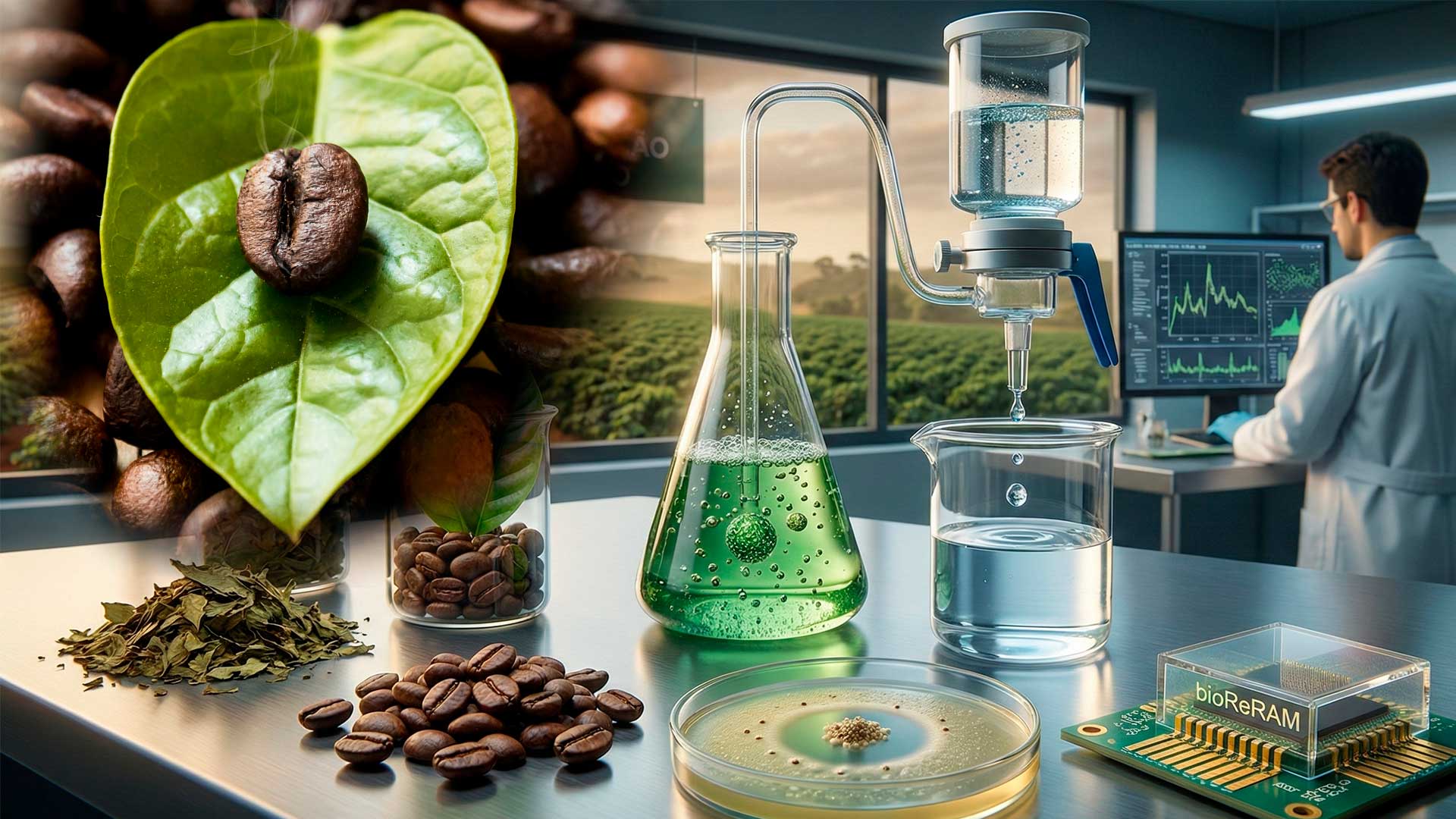
IFSC-USP Research Transforms Discarded Coffee Leaves into Zinc Oxide Nanoparticles Produced by Green Synthesis, with Potential Use in Health, Water Treatment, and Sustainable Electronics, Opening a New Frontier for Brazilian Coffee Cultivation.
The coffee leaves, which are usually treated only as agricultural waste, have just gained a prominent role in Brazilian science. Researchers from the Instituto de Física de São Carlos (IFSC) at the Universidade de São Paulo (USP) led an international study that uses these leaves to produce zinc oxide nanoparticles with applications in health, the environment, and technology.
The work was published in August 2025 in the journal Scientific Reports, part of the Nature group, and is pointed out as an example of innovation in circular economy applied to agribusiness. The research shows that an item with no direct commercial value can become a high-value input, with uses in medicines, water filters, and cleaner electronic components.
The differentiator lies in the use of the so-called green synthesis, a technique in which natural substances present in the leaves themselves act as reagents to transform the material into nanoparticles, without relying on toxic chemicals and expensive traditional processes used in the industry.
-
While the world looks at oil, the war with Iran is already disrupting helium supply from Qatar, affecting car and iPhone chips, threatening AI expansion, and putting pressure on aluminum packaging at the highest value in four years.

-
Global warming will expose a treasure hidden under the ice of Antarctica and may spark an international dispute over gold and valuable minerals.

-
A street vendor from Praia Grande built a robot made of scrap from scooters and washing machines that pulls his popcorn cart on the beach, emits sounds, and interacts with customers, becoming an attraction on the coast of São Paulo.

-
The specifications of the Xiaomi 18 Pro Max have been leaked, and the highlight is a dual 200 MP camera with a new 22-nanometer technology that promises to consume less energy and capture details in shadows and bright areas using LOFIC HDR.


For Brazil, the largest producer and one of the biggest exporters of coffee in the world, the discovery opens the door for new production chains in the field, while bringing coffee cultivation closer to themes such as green technology, material innovation, and future computing based on sustainable devices.
From Agricultural Waste to High-Tech Raw Material
In the fields, coffee leaves are usually discarded after the harvest and processing of the beans. They do not factor into the producer’s account, do not appear in the cost spreadsheet, and are almost never put to noble use. It was precisely this abundant waste that caught the attention of the IFSC-USP team.
According to a note from Fapesp, the leaves were chosen for being abundant and for concentrating antioxidant and bioactive compounds that facilitate the formation of nanoparticles. In the laboratory, the extract from the leaves acts as a reducing and stabilizing agent, allowing the formation of zinc oxide particles at the nanoscale without aggressive additives to the environment.
According to Jornal da USP, this type of biotechnological route reduces costs, decreases the generation of hazardous waste, and aligns with the principles of green chemistry, by utilizing biomass that is already available on the rural property. Instead of representing waste, the leaves are seen as a technological asset linked to sustainability.
Nanoparticles That Fight Bacteria and Help Clean Water
When zinc oxide is reduced to the size of nanometers, it starts to exhibit properties that do not appear in conventional material. According to the scientific article, the nanoparticles obtained with coffee leaves showed strong action against bacteria such as Staphylococcus aureus and Escherichia coli, both associated with hospital and community infections.
This antimicrobial performance is relevant in a context of increasing bacterial resistance to antibiotics. The nanoparticles may be used in the future in coatings for hospital surfaces, dressings, cosmetics, or even in pharmaceutical formulations, as long as further studies validate safety and efficacy in humans, as highlighted by the researchers.
The research also evaluated the ability of the nanoparticles to degrade organic pollutants. In tests with dyes used by the textile industry, frequent contaminants in rivers and water sources, the material was able to break down harmful molecules when exposed to ultraviolet light. This indicates potential use in water treatment plants and in environmental decontamination systems aimed at industrial effluents.
In practice, the same leaf that is born to feed the coffee plant may, in the future, help reduce water pollution. For a country that still faces challenges in sewage management and industrial effluents, such solutions can strengthen sanitation policies and protect water sources.
bioReRAM: The Promise of Green Computing Made with Coffee Leaves
One of the most striking points of the study is the creation of an electronic memory device called bioReRAM, which stands for biological resistive random access memory. In simple terms, it is a type of chip capable of storing data by exploiting changes in electrical resistance in a material, as an alternative to traditional memories used in computers and cell phones.
The researchers combined zinc oxide nanoparticles synthesized with coffee leaves with chitosan, a biopolymer obtained from crustacean shells, to form the active layer of the device. The result is a memory that uses mostly biodegradable materials, manufactured through a low-energy process, with steps such as drop deposition and drying at room temperature.
According to the group, the electrical performance of bioReRAM is comparable to that of resistive memories already studied by the industry, but with a smaller environmental footprint. The combination of a biobased polymer with nanoparticles produced by green synthesis brings closer the concept of green computing, where electronic devices seek to reduce environmental impact from the choice of materials to disposal.
Experts point out that memories of this type may be useful in areas such as the Internet of Things, wearable sensors, and disposable electronics, where durability is important, but recovery and recycling are still significant challenges. If the active layer of the device comes from renewable sources, such as coffee leaves and seafood waste, the environmental equation becomes more favorable.
For Professor Igor Polikarpov, coordinator of the research at IFSC-USP, the work shows that it is possible to unite sustainability, high technology, and agribusiness in a single solution. In interviews released by USP and Fapesp, he emphasizes that if the process is industrially scaled, the innovation can generate additional income for producers, stimulate regional technology hubs, and position Brazil at a strategic frontier of nanotechnology applied to computing.
Impacts for Coffee Producers and the Sustainable Agenda of Brazil
From the perspective of coffee cultivation, the research opens the possibility of transforming an abundant waste into a exportable technological product. Cooperatives and associations may, in the future, negotiate contracts for the supply of leaves, integrating science and field into new business models, especially in traditional production regions such as Sul de Minas, Mogiana, and Cerrado.
At the same time, the discovery aligns with goals of low-carbon economy, efficient use of biomass, and reduction of agricultural waste. Instead of following a linear model of production and disposal, coffee cultivation is now seen as a source of inputs for cutting-edge areas such as health, sanitation, and electronics, reinforcing Brazil’s image as a country capable of generating innovation from biodiversity and public science.
Do you think transforming agricultural waste into chips, medicines, and water filters is the right approach, or does it create a new technological dependency on Brazilian agribusiness? Share your opinion in the comments and participate in the debate about how far green science can go when it comes to the coffee that reaches your cup.








-

-

5 pessoas reagiram a isso.