





 Portuguese
  English
  Spanish
  6 min of reading
  0 comments


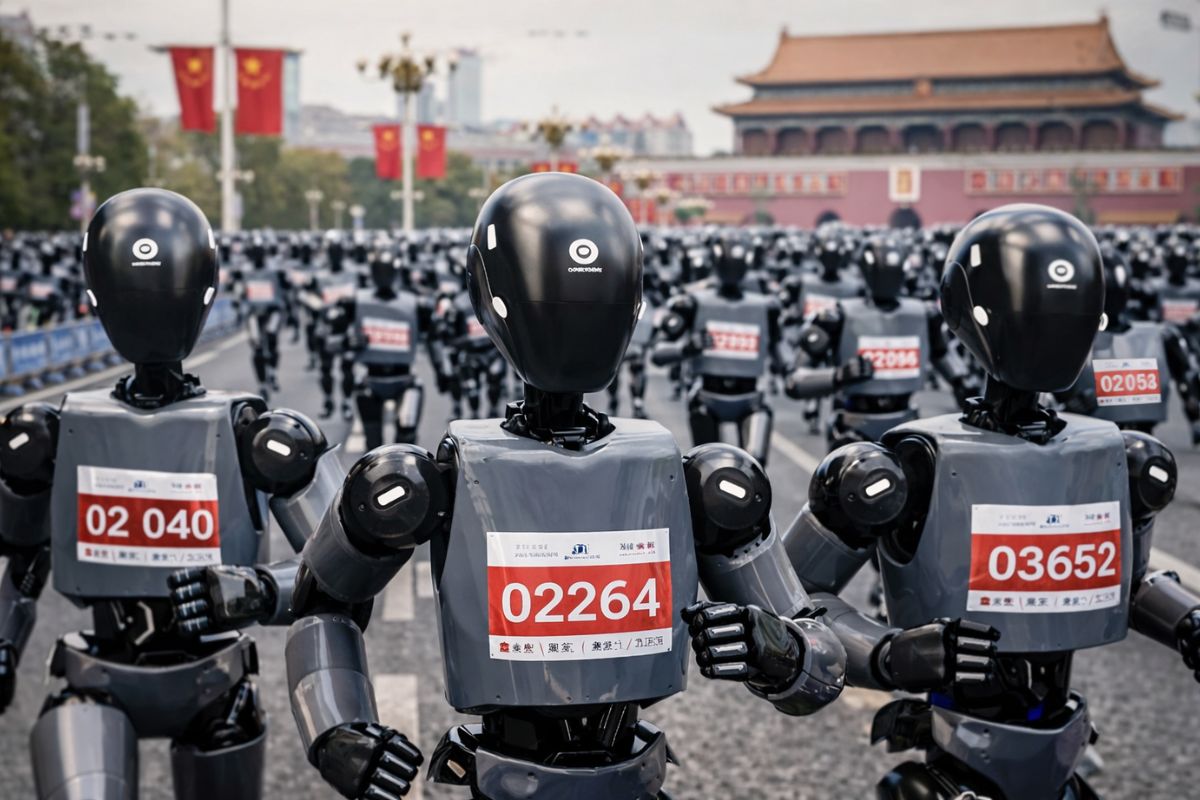
More than 300 humanoid robots will compete in the world’s largest half-marathon of bipedal machines in Beijing on April 19, 2026, and for the first time an entire category will be dedicated to autonomous navigation, where competitors must complete the race without any human intervention, using only sensors and artificial intelligence to navigate the full course.
For the first time in history, humanoid robots will run an entire half-marathon without receiving any human assistance. The event takes place on April 19, 2026, in the Yizhuang economic and technological development zone in Beijing, and will bring together more than 300 bipedal machines from over 100 teams from 13 regions of China. The race marks the moment when robotics leaves the laboratories and faces a challenge that until recently seemed impossible: making machines walk on two legs for 21 kilometers in real conditions, with autonomous navigation.
The leap from the inaugural edition in 2025 is impressive. The number of registered teams has increased nearly fivefold, and more than a third of the registrations are for the new autonomous navigation category where humanoid robots operate completely independently, without an operator in control. Experts point out that the Beijing half-marathon represents a concrete shift in the global robotics industry, signaling that bipedal machines are already ready to face complex real-world scenarios, and not just smooth laboratory floors.
What humanoid robots need to do to complete the half-marathon
The rules are clear and strict. All participating humanoid robots must move exclusively on two legs—no wheels, tracks, or any other locomotion mechanism. The entire race, of 21 kilometers, must be completed in a single attempt, without breaks for maintenance or battery changes.
-
Submarine cables installed to transmit the internet now also help scientists detect earthquakes.

-
After so many blackouts, a family transforms an electric truck into a power source for their home and shows how a 100 kWh battery can keep everything running for days.

-
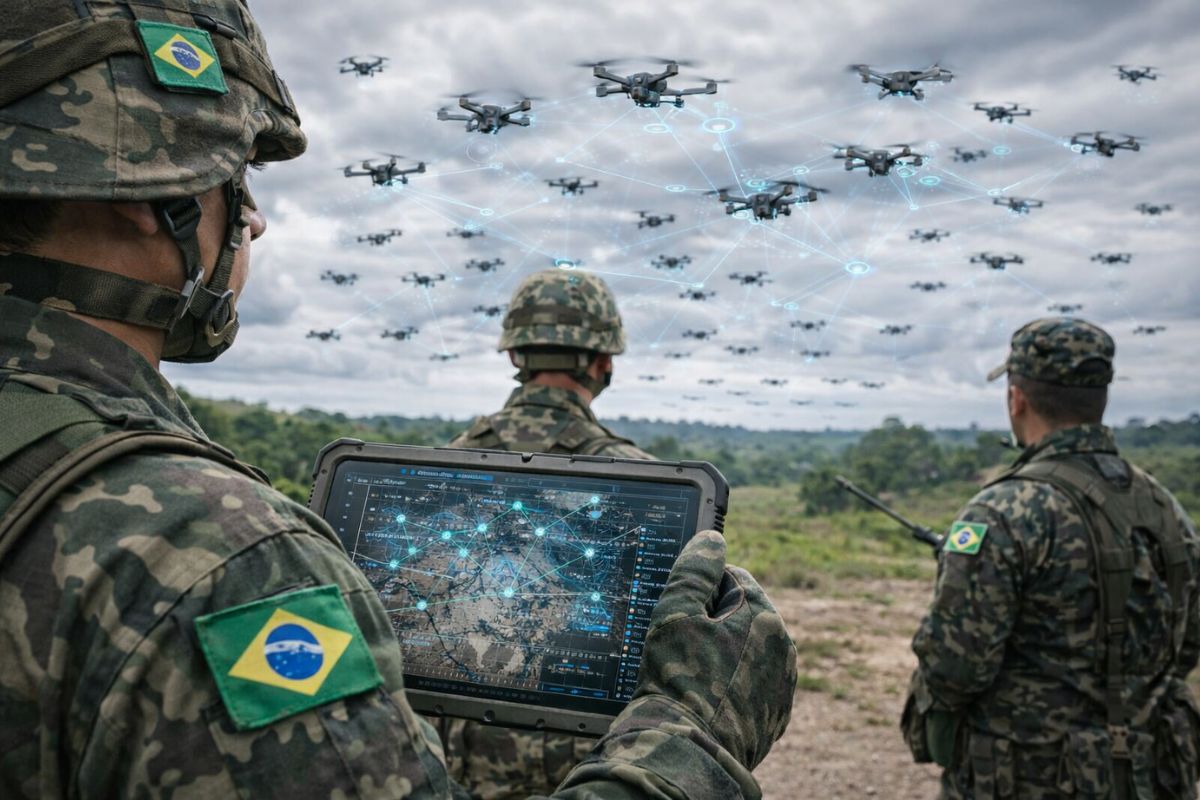
Ukraine is already testing, and China has already shown the world, and now the Brazilian Army is developing its own swarm of autonomous drones with artificial intelligence that share data in real time and operate without centralized control, uniting military and universities.
-
Few people know, but the most nutritious part of wheat has been discarded for decades to produce white flour, and the “polyamine” spermidine activates cellular cleaning, reduces mortality, and may slow down memory loss.


The course is the same as a human half-marathon that takes place in parallel, which means that the machines face the same terrain conditions, curves, and surface variations.
In the autonomous navigation category, the requirements go further. The robots do not receive commands from operators during the race. They rely exclusively on advanced environmental sensors and real-time decision-making systems to navigate the course.
This includes avoiding obstacles, adjusting speed on inclines and declines, maintaining balance on uneven surfaces, and making route decisions without external intervention.
The technical challenge is immense. Walking on two legs is already one of the most difficult tasks in robotics—bipedal balance requires constant calculations of the center of gravity, real-time joint adjustments, and instant responses to disturbances.
Doing this for 21 kilometers, in an open environment and without human control, is the kind of test that separates laboratory prototypes from truly functional machines.
Why Beijing became the stage for the world’s largest humanoid robot race
The choice of Beijing is not casual. The Chinese capital is home to Yizhuang, a technological development zone that houses dozens of robotics and artificial intelligence companies. It is there that much of the Chinese humanoid robot industry is developed, with access to capital, testing infrastructure, and proximity to top universities. Hosting the half-marathon in the region is a technological showcase with global impact.
China has heavily invested in humanoid robotics in recent years, and events like the Beijing half-marathon serve to demonstrate advancements to the world.
More than 100 teams from 13 provincial regions have registered, including a significant number of university research groups which reflects the growing collaboration between academia and industry in the country. The race simultaneously functions as a technical competition, a demonstration of national capability, and a stimulus for the development of new technologies.
The inaugural edition in 2025 was the starting point. But the 2026 edition is qualitatively different: the introduction of the autonomous navigation category transforms the event from a demonstration of mobility into a real test of applied artificial intelligence.
The humanoid robots competing in Beijing are not just machines that walk—they are systems that perceive, decide, and act independently.
Autonomous navigation as a game changer in robotics
The big novelty of the 2026 half-marathon is the category dedicated to autonomous navigation, responsible for more than a third of the registrations. In this category, humanoid robots operate without any human intervention during the race.
No operator, no remote control, no manual route corrections. The machine needs to interpret the environment in real time and make all decisions on its own.
The autonomous navigation systems used by the competitors combine distance sensors (like LiDAR), depth cameras, accelerometers, and artificial intelligence algorithms trained to recognize terrain patterns, obstacles, and track conditions.
It is the same logic that guides autonomous cars, but applied to a bipedal body that needs to maintain balance with every step—a computationally much more complex task than moving a vehicle on four wheels.
For the robotics industry, this category is a test of maturity. If humanoid robots can complete 21 kilometers autonomously in a dynamic and uncontrolled environment, the technology will be ready for real-world applications: disaster assistance, logistics in difficult terrains, exploration of dangerous areas, and support in environments where humans cannot or should not enter. The Beijing half-marathon is the proving ground.
Beyond the race: the Baturu challenge and disaster scenarios
In addition to the half-marathon, the organizers included the “Baturu” challenge—a parallel competition with obstacle-based tasks designed to simulate complex environments. Humanoid robots need to navigate scenarios that replicate disaster response situations, such as destroyed terrains, narrow passages, and unstable surfaces.
The Baturu serves as a practical complement to the half-marathon. While the race tests endurance and autonomous navigation on a linear course, the obstacle challenge assesses agility, adaptability, and decision-making in unpredictable conditions.
For university research teams and robotics companies, participating in both events is the most comprehensive way to demonstrate that their humanoid robots function in real scenarios, not just in simulations.
The combination of half-marathon and obstacle challenge transforms the Beijing event into the most comprehensive humanoid robotics competition in the world.
No other event simultaneously demands physical endurance, autonomous navigation, and responsiveness to emergency scenarios—three skills that define whether a humanoid robot is viable for use outside the laboratory.
What the humanoid robot half-marathon reveals about the future
The Beijing race is not just a technological spectacle—it is a marker of where robotics is and where it is headed. If humanoid robots can run 21 kilometers without help in April 2026, the barrier between laboratory machines and field tools will have been officially broken.
And the next steps—bipedal home assistants, robotic rescue teams, autonomous workers in dangerous environments—become a matter of time, not possibility.
The fivefold increase in the number of teams between 2025 and 2026 shows that the industry is accelerating.
The massive participation of universities indicates that the next generation of Chinese engineers and researchers is already working with humanoid robots as applied technology, not as science fiction.
The Beijing half-marathon is, at the same time, a competition, a showcase, and a signal that the era of autonomous bipedal robots is closer than most people think.
With information from the portal TV Brics.
What do you think: humanoid robots running a half-marathon without help is impressive or scary? Do you believe this technology will reach everyday life in the coming decades? Leave your opinion in the comments—the debate about the future of robotics deserves your perspective.





Seja o primeiro a reagir!